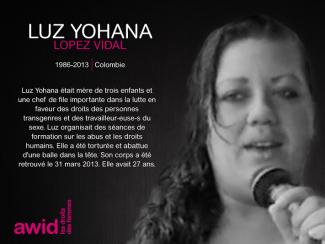
Luz Yohana Lopez Vidal
Over the past few years, a troubling new trend at the international human rights level is being observed, where discourses on ‘protecting the family’ are being employed to defend violations committed against family members, to bolster and justify impunity, and to restrict equal rights within and to family life.
The campaign to "Protect the Family" is driven by ultra-conservative efforts to impose "traditional" and patriarchal interpretations of the family, and to move rights out of the hands of family members and into the institution of ‘the family’.
Since 2014, a group of states have been operating as a bloc in human rights spaces under the name “Group of Friends of the Family”, and resolutions on “Protection of the Family” have been successfully passed every year since 2014.
This agenda has spread beyond the Human Rights Council. We have seen regressive language on “the family” being introduced at the Commission on the Status of Women, and attempts made to introduce it in negotiations on the Sustainable Development Goals.
AWID works with partners and allies to jointly resist “Protection of the Family” and other regressive agendas, and to uphold the universality of human rights.
In response to the increased influence of regressive actors in human rights spaces, AWID joined allies to form the Observatory on the Universality of Rights (OURs). OURs is a collaborative project that monitors, analyzes, and shares information on anti-rights initiatives like “Protection of the Family”.
Rights at Risk, the first OURs report, charts a map of the actors making up the global anti-rights lobby, identifies their key discourses and strategies, and the effect they are having on our human rights.
The report outlines “Protection of the Family” as an agenda that has fostered collaboration across a broad range of regressive actors at the UN. It describes it as: “a strategic framework that houses “multiple patriarchal and anti-rights positions, where the framework, in turn, aims to justify and institutionalize these positions.”
All our annual reports are accessible online.
Facebook: @AWIDWomensRights
Instagram: @awidwomensrights
Twitter ENG: @awid
LinkedIn: Association for Women's Rights in Development (AWID)
.

แน่นอน! กรุณาอ่านการเปิดรับสมัครกิจกรรมภายในงานและสมัครได้ที่นี่ กำหนดเส้นตายในการปิดรับรายละเอียดกิจกรรมใหม่ : 1 กุมภาพันธ์ 2567


หากกิจกรรมของคุณได้รับการคัดเลือกคุณจะได้รับการติดต่อจาก AWID ที่จะช่วยสนับสนุนและตอบคำถามถึงการล่ามและการช่วยในการเข้าถึงที่จำเป็น
Premier Dialogue de haut niveau sur le financement du développement, 29-30 octobre 2003.
Les dialogues de haut niveau de l’Assemble générale des Nations Unies sur le financement du développement, tenus tous les deux ans, sont l’un des mécanismes de suivi de la Conférence de Monterrey. À la suite de ce premier dialogue, huit tables rondes ont été organisées autour de différentes questions comprenant les subventions agricoles, le commerce, l’allègement de la dette et le financement des OMD. Toutes les discussions se concentraient sur les manières de faire face aux obstacles structurels qui pesaient sur ces questions et défavorisaient les nations « en développement ».
D'autres mécanismes de suivi de la Conférence de Monterrey :
COZINHA OCUPAÇÃO 9 DE JULHO
.

ตอบแบบสั้นคือ ใช่! AWID กำลังทำงานร่วมกับคณะกรรมการการเข้าถึงเพื่อให้มั่นใจว่าฟอรัมนี้จะสามารถเข้าถึงได้มากที่สุดเท่าที่จะเป็นไปได้ เรากำลังทำการตรวจสอบการเข้าถึงสถานที่จัดงานฟอรัม โรงแรมโดยรอบ และการคมนาคมขนส่ง ข้อมูลโดยละเอียดเกี่ยวกับการช่วยการเข้าถึงของ AWID ฟอรัม จะถูกอัปเดทเนื้อหาที่นี่ก่อนที่จะเปิดการลงทะเบียน ในระหว่างนี้ หากมีคำถามใดๆ โปรดติดต่อเรา
The Fifth High- Level Dialogue on Financing for Development, 7 – 8 December 2011, marked the beginning of the Post 2015 development agenda discussions, and the link to financing for development. The conference gave a special focus to increasing aid to finance the MDG’s. In his closing remarks, the Secretary General called on members to begin to consider the post-2015 development framework.
She was born in Bahia, the Northeastern part of Brazil. She is an immigrant, a social activist and a mother of 8 children.
Carmen experienced homelessness at the age of 35, after migrating to Sao Paulo on her own. This led her to become a fierce advocate for vulnerable, marginalized and invisibilized communities most affected by the housing crisis. She eventually became one of the founders of MSTC in 2000.
As a visionary political organizer and the current leader of the MSTC, Carmen’s work has laid bare the city's housing crisis and provided inspiration to others on different ways to organize and manage occupations. She stood strong on the forefront of several occupations. One of them is the 9 de Julho Occupation, which now serves as a stage for direct democracy, and a space where everyone can be heard, seen, appreciated and work together.
Carmen has been long celebrated for her boldness in giving life back to abandoned buildings in the heart of São Paulo.
To know more about her life, you can follow her on Instagram!