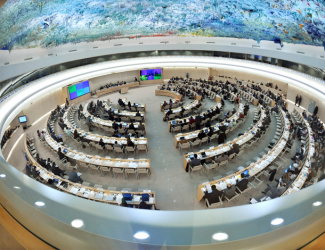
The Human Rights Council (HRC) is the key intergovernmental body within the United Nations system responsible for the promotion and protection of all human rights around the globe. It holds three regular sessions a year: in March, June and September. The Office of the UN High Commissioner for Human Rights (OHCHR) is the secretariat for the HRC.
The HRC works by:
Debating and passing resolutions on global human rights issues and human rights situations in particular countries
Examining complaints from victims of human rights violations or activist organizations on behalf of victims of human rights violations
Appointing independent experts (known as “Special Procedures”) to review human rights violations in specific countries and examine and further global human rights issues
Engaging in discussions with experts and governments on human rights issues
Assessing the human rights records of all UN Member States every four and a half years through the Universal Periodic Review
AWID works with feminist, progressive and human rights partners to share key knowledge, convene civil society dialogues and events, and influence negotiations and outcomes of the session.
With our partners, our work will:
◾️ Monitor, track and analyze anti-rights actors, discourses and strategies and their impact on resolutions
◾️Support the work of feminist UN experts in the face of backlash and pressure
◾️Advocate for state accountability
◾️ Work with feminist movements and civil society organizations to advance rights related to gender and sexuality.
Related Content
Love letter to Feminist Movements #7
Dearest Feminist community,
I am pleased to share with you one of my remarkable dates as feminist with disability. It was May 30, 2014 when we (the Nationwide Organization of Visually-Impaired Empowered Ladies NOVEL) participated in the Philippine Fashion Week Holiday 2014 for our white cane advocacy campaign. Two ladies who are blind walked down the catwalk to promote the white cane as one of the symbols of gender equality, empowerment, full inclusion and equal participation of women and girls with visual impairment in society.
Their walk in front of the crowd were extremely a nerve-wracking experience for me, as the proponent of our project with the Runway Productions (I enduringly waited for a year for its approval), knowing that they were not models, they were the crowned Ms. Philippines Vision and 1st Runner Up of 2013 Ms. Philippines on Wheels, Signs and Vision by Tahanang Walang Hagdanan, Inc. (House with No Steps). Also, they fell on their orientation and practiced the evening before the event and they didn’t have practice with professional models. Before the show started, I talked to them via mobile phone to boost their confidence and to pray together for God’s guidance. When they exited the catwalk, I breathed deeply while my tears were flowing. I was feeling euphoric because we did it despite the challenges we’ve been through! Our message to the world that women and girls with visual impairment can walk with dignity, freedom and independence on an equal basis with others, with the use of our assistive device - white canes was successfully delivered! We trended in social media and we were featured by television networks.
My life as a feminist with disability started as a means to mend my broken spirit and to see a different path towards finding my life’s purpose after I became victim-survivor to a vicious acid attack in 2007 while I was waiting for a ride going home from office. My eyes were severely damaged, to the point that I became a woman with low vision.
I never knew how joyful and purposeful my life could be again until I met women leaders in the gender and disability movement who influenced me to keep going. Their words of encouragement attracted me and became the sweetest music to my ears. My broken heart leaped like a hummingbird in flight every time I think of them and feminism which stimulated me to partake in making difference for our invisible sisters with disabilities and to those who continue to experience discrimination. To date, I am consumed by the desire to be with the movement. I cannot hide my excitement whenever I submit project proposals to different stakeholders for our sisters with disabilities' empowerment, development and advancement; and to make representations in local, national and international conversations to amplify our voices even at my expense.
Unexpectedly, I was selected as our country’s female representative in the 2012 World Blind Union (WBU) General Assembly in Thailand even though I was a newcomer in the disability movement. In the same year, I was elected as the only woman officer of the Philippine Blind Union (PBU) in its assembly. I was inspired to reach out, gather and empower our sisters with visual impairment on their rights and to know their intersecting issues. In 2013, we officially launched the Nationwide Organization of Visually-Impaired Empowered Ladies (NOVEL) to support the empowerment of our sisters with disabilities, build coalitions with cross-disability and women’s movements and promote gender and disability-inclusive development.
My participation as co-focal person of women with disabilities in our 2016 CEDAW Shadow Report submission convened by Women’s Legal and Human Rights Bureau (WLB) with the marginalized groups of women, opened many doors such as working with various women’s organizations and attending the 2017 Inclusion Days International in Berlin, Germany together with 3 Filipino women leaders with disabilities to share our good practices, mainly our engagement with the women’s movement in our country.
My journey as feminist with disability has been an emotional roller coaster for me. It gave me happiness and a sense of worth when I participated in promoting for our sisters with disabilities full inclusion, equal and effective participation in society, yet I felt frustrated and upset when I gave my all but I received negative remarks. Nevertheless, I feel that way because I am in love with the movement.
I see my future working in solidarity with the movement to ensure that our sisters with and without disabilities can equally and fully enjoy and participate in society.
Love lots,
Gina Rose P. Balanlay
Feminist with disability
Philippines
All our change processes rely on the relationships we build at spaces like the AWID Forums where you dance together, your humour comes through, your real self, you tell stories. That is what makes the difference. - Nicky Mcintyre, USA
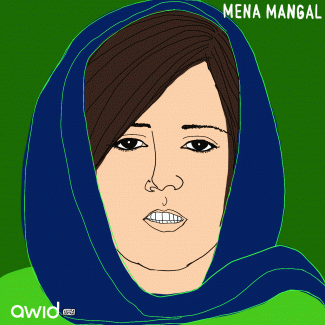
Mena Mangal was a prominent TV journalist, women’s rights advocate and cultural adviser to Wolesi Jirga, the lower house of Afghanistan's national parliament.
For more than a decade, she worked for Ariana TV, Tolo TV's Pashto-language channel Lamar, and the private Afghan national television broadcaster Shamshad TV. As a presenter, Mena focused on women’s rights and cultural talk shows.
"Women's rights activist Wazhma Frogh said Mangal "had a loud voice" and actively spoke out as an advocate for her people."
Off-screen, she also ran popular social media pages that advocated for the rights of Afghan girls and women to education and work. In terms of her private life, Mena wrote extensively about being forced into an arranged marriage in 2017 and the process she had to go through to finally obtain a divorce.
In a Facebook post, Mena wrote she was receiving death threats from unknown sources but would continue to carry out her work.
On 11 May 2019, she was attacked by unknown gunmen and shot dead in broad daylight in a public space in Southeast Kabul.
"We are concerned about the situation because it has a direct impact on women who work outside their homes...Female journalists are changing their professions due to the increasing risks they are facing." - Robina Hamdard, Kabul-based women’s rights activist.
Film club - Finding Sally
Finding Sally (2016) Amárico | Inglés con subtítulos en inglés
Una investigación personal sobre la misteriosa vida de Sally (la tía de la directora), una aristócrata etíope que se convirtió en rebelde comunista y desapareció luego de la revolución que llevó al derrocamiento del Emperador Haile Selassie.
Conversación en vivo con Tamara Dawit, directora de << Finding Sally >>
If the positions advertised have closed, or just don’t match your area of interest and expertise, we suggest the following resources for your job search.
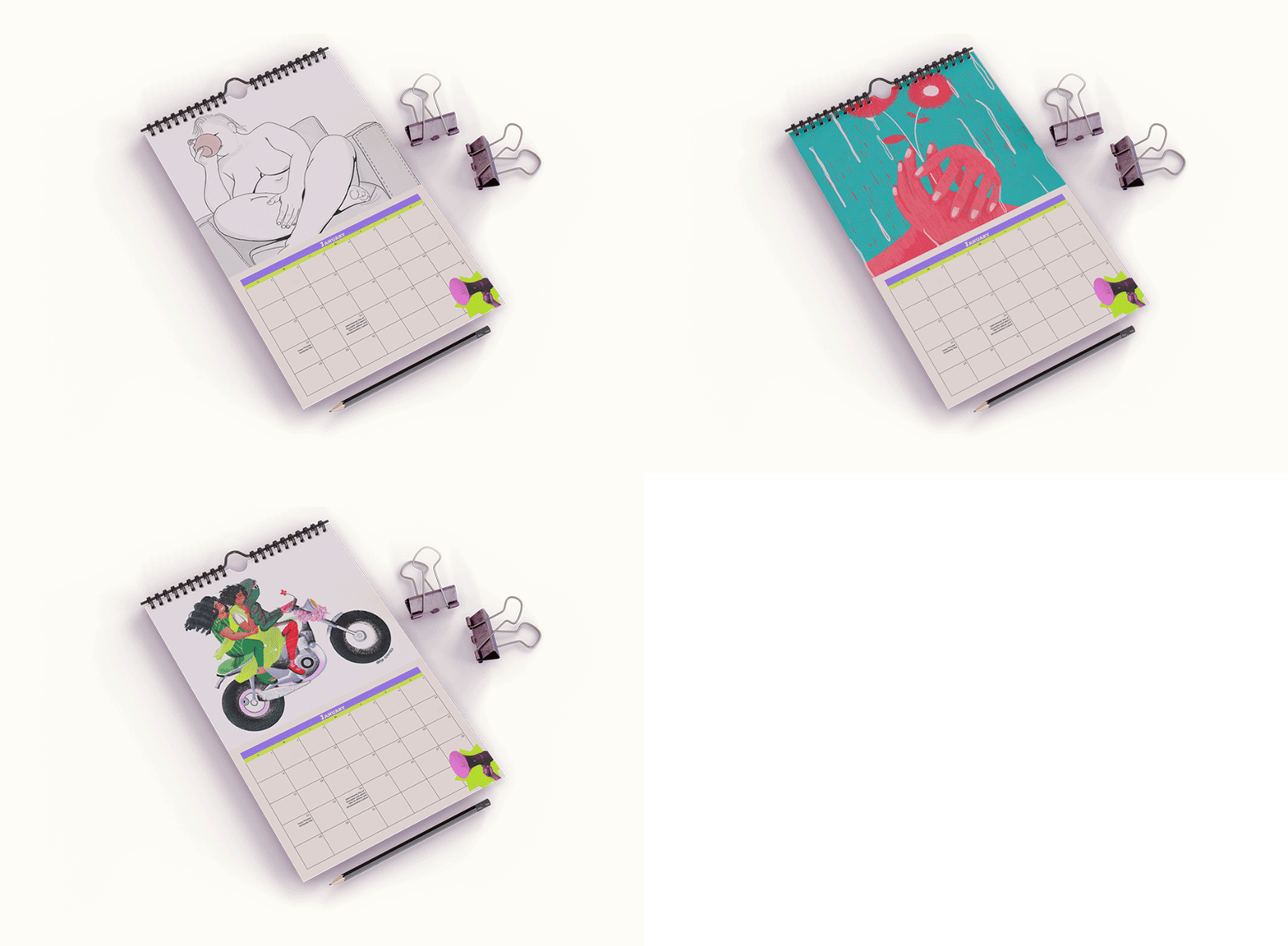
El Calendario Feminista 2023
AWID es parte de un impresionante ecosistema de movimientos feministas que trabajan para alcanzar la justicia de género y la justicia social en todo el mundo. Al acercarse nuestro 40° aniversario estamos celebrando todo lo que hemos construido a lo largo de estos últimos cuarenta años. Como organización global de apoyo a los movimientos feministas, sabemos que nuestro camino hacia adelante es trabajar con feminismos apasionados, reconociendo tanto la multiplicidad de los feminismos como el valor de un impulso por la justicia apasionado y sin reservas. El estado del planeta y de los movimientos feministas requiere conversaciones y acciones valientes. Esperamos con ansia trabajar junto con nuestrxs afiliadxs, asociadxs y donantes para crear los mundos en los que creemos,celebrar los logros y expresar la verdad ante el poder, al servicio de los movimientos feministas a nivel global.
El Calendario Feminista 2023 es un regalo para los movimientos. Presenta las obras de arte de algunxs de nuestrxs maravillosxs afiliadxs de AWID.
Cada Foro se lleva a cabo en una región diferente, ¡y es hora de que el Foro de AWID regrese a Asia! Visitamos muchos países de la región, consultamos a los movimientos feministas y realizamos evaluaciones detalladas de logística, accesibilidad, seguridad, visas y más. Finalmente, la Junta Directiva de AWID aprobó con entusiasmo Bangkok, Tailandia, como la mejor opción. Nos sentimos muy emocionadxs de volver a Bangkok, donde celebramos el Foro de AWID en 2005.
«Quiero transmitir el siguiente mensaje a todos los tunecinos y tunecinas: Tenemos que unirnos para decir no a la censura y a los juicios contra el derecho a opinar.» - Lina Ben Mhenni (entrevista de 2013)
Lina Ben Mhenni fue bloguera, activista y docente de lingüística tunecina. Se expresaba en contra de la censura en Internet, defendía la libertad de expresión, y era una defensora de los derechos humanos y de las mujeres. Lina luchó también por la liberación de lxs estudiantes arrestadxs durante el gobierno del anterior presidente Zine El Abidine.
«Es cierto que la información y la Internet son importantes, pero para hacer una revolución es crucial estar en el territorio. Algunas personas aquí en Túnez piensan que el cambio se dará mediante un simple “me gusta” en Internet. Yo creo que hay que estar activxs en el terreno. Y, por supuesto, que hay que combinar las acciones en el terreno con la acción en las redes.» - Lina Ben Mhenni (entrevista en POCIT)
En 2010 co-organizó una protesta que desafió la decisión gubernamental de suprimir medios de comunicación e instalar la censura de Internet. Lina era muy conocida por su blog «A Tunisian Girl», y por su trabajo durante la revolución tunecina de 2011. En su blog, difundió la información sobre el levantamiento, compartió imágenes que documentaban las protestas, y fue una de las pocas voces que hablaron sobre los asesinatos y la represión de lxs manifestantes de Sidi Bouzid. Lina publicaba en su blog utilizando su nombre real en lugar de un seudónimo que protegiera su identidad, y fue una de lxs pocxs bloguerxs en hacerlo.
«Nuestra libertad de expresión corre verdadero peligro. Me temo que estamos perdiendo los extraordinarios frutos de la revolución: la desaparición del miedo y nuestra libertad de expresión. Tenemos que seguir luchando para proteger y preservar este derecho.» - Lina Ben Mhenni (entrevista de 2013)
Lina tenía solamente 36 años cuando falleció, el 27 de enero de 2020, debido a complicaciones derivadas de una enfermedad autoinmune.
«Libertad, mejor educación y mejor salud—eso era lo que todxs queríamos. Cuando fracasábamos, ella nos empujaba.» - Hala, maestra de Lina
Ours report 2021 summary
Today, a complex and evolving network of anti-rights actors is exerting more influence in international and regional spaces as well as domestic politics. Anti-rights actors are entering multilateral spaces (spaces where multiple countries come together for international collaboration) to transform and undermine them from the inside out. They employ a range of persuasive discourses to gain legitimacy, often co-opting the language of rights and justice to hide their true agendas.
This report is the second in a series on human rights trends reports produced by the Observatory on the Universality of Rights (OURs). As well as analysis of key anti-rights actors, discourses, strategies, and impacts, the report features inspiring short stories of feminist action, and knowledge-building exercises to help strengthen our collective resistance.
The effect on our rights has already been grave, but this is not a done deal. We can all play a part in resisting anti-rights agendas and reclaiming our rights.
Search for funders based on their requirements for groups to be registered.
Become an AWID member
By joining AWID, you are becoming part of worldwide feminist organizing, a collective power that is rooted in working across movements and is based on solidarity.
Merci de calculer le coût de votre voyage à Bangkok, vos frais d'hébergement et vos indemnités journalières, le montant de votre visa, vos besoins en matière d'accessibilité et les frais accessoires, en plus des frais d'inscription qui seront annoncés sous peu. Les hôtels du quartier de Sukhumvit à Bangkok coûtent entre 50 et 200 dollars américains par nuit pour une chambre double. Les membres de l'AWID bénéficient d'une réduction lors de l'inscription. Si ce n’est pas encore fait, nous vous invitons à envisager de devenir membre et à rejoindre notre communauté féministe mondiale.
Activiste sociale et de l’environnement équatorienne, Gloria Chicaiza était une fervente défenseuse du droit à la terre et à l’eau. Elle s’est opposée au statu quo en luttant contre un modèle de développement fondé sur l’extraction et a oeuvré sans relâche pour la justice écologique et les droits des communautés affectées par l’exploitation minière.
Dans divers endroits de l’Équateur, Gloria a participé à des actions de résistance en faveur de la protection de l’écosystème. Avec passion et dévouement, Goria a apporté son soutien au mouvement autochtone et environnemental, à ces communautés et organisations qui s’opposent aux projets miniers et protègent leurs territoires et leurs projets de vie collectifs. Elle est intervenue au sein de forums locaux et internationaux contre la criminalisation des dissident·e·s et des résistant·e·s, contre les pressions et la violence exercées à l’encontre des activistes communautaires, en particulier des femmes défenseuses des droits humains, et pour soutenir les efforts déployés par les communautés en faveur de la souveraineté alimentaire et de la durabilité.
Elle était la coordonnatrice de la justice minière à Acción Ecológica, membre du Réseau latino-américain des femmes défenseuses des droits sociaux et environnementaux, et membre du conseil d'administration de l'Observatoire latino-américain des conflits miniers.
En octobre 2010, Gloria a été accusée par la société minière Curimining/Salazar Resources S.A. (dont le siège est à Vancouver, au Canada) d’avoir commandité un acte de terrorisme, de sabotage et d’association illégale dans le but de commettre un crime. Acción Ecológica a estimé qu’il s’agissait là de “représailles pour son travail de dénonciation concernant l’impact des activités minières dans le pays”.
En 2015, Gloria a facilité la coordination d’une délégation, composée de 25 femmes autochtones d’Amérique latine, affectée au Dialogue sur le changement climatique de la COP 20 des Nations Unies.
Gloria est décédée le 28 décembre 2019 des suites de complications liées à une transplantation pulmonaire. On se souvient d’elle pour ses actes de résistance et son travail acharné.
"Le moyen le plus rapide de parvenir à la durabilité reste encore la résistance.” - Gloria Chicaiza (2010 interview)
Hommages :
“Pour GLORIA. GLORIA Eau. GLORIA Terre. GLORIA Mère. GLORIA Révolution. GLORIA Soeur. GLORIA Ciel. GLORIAmie. GLORIAstrale. Merci de nous avoir entrelacé·e·s.” -Liliana Gutierrez
“Merci Glorita, d’avoir nourri l'espoir, d’avoir préservé la solidité de la structure, d’avoir tissé des liens avec la communauté, pour les mains unies, pour la solidarité, merci Glorita de t’être tenue à nos côtés dans les moments les plus difficiles. Merci de nous avoir appris que tout au long de la vie, personne ne se fatigue.” (Chakana News)
“Gloria Chicaiza appréciait ne pas sortir du lot et s’y épanouissait. Et aussi humble qu'elle fût, elle avait une capacité inouïe à mener et garder un rythme régulier et étourdissant, un pouls de vie qui guidait, mobilisait et inspirait les communautés et les réseaux dans la protection de la Terre Mère. Elle a dénoncé toutes les formes de violence contre les “cuerpos-territorios” (les corps comme territoires). Elle soutenait le “buen vivir" (“bien vivre”). - Gabriela Jiménez, coordonnatrice des partenariats en Amérique latine, KAIROS
“Merci Gloria Chicaiza, nous sommes sûr·e·s que depuis l’infini, tu continueras à soutenir notre combat. Toi qui as continué de te battre en dépit de ta santé défaillante. Tu continueras de vivre dans les forêts et les eaux que tu as défendues avec tant de courage. Tu vivras dans nos coeurs.” - La communauté d’Intag en Équateur
Los actores anti-derechos adoptan una estrategia doble. Además de atacar abiertamente al sistema multilateral, los actores anti-derechos también socavan los derechos humanos desde adentro. Se involucran con el fin de cooptar procesos, consolidar normativas regresivas, y erosionar responsabilidades.
GLOBAL Y DIVERSA: Reflexiona acerca de las realidades de la dotación de recursos entre las organizaciones feministas a escala mundial y desglosada por regiones.
CONTEXTUALIZADA: Se centra en las voces, perspectivas y experiencias de los movimientos feministas en toda su riqueza, audacia y diversidad, en sus respectivos contextos.
DE CREACIÓN CONJUNTA: Desarrollada y puesta a prueba en consulta estrecha con lxs afiliadxs y movimientos aliados de AWID.
COMPLEMENTARIA: Contribuye a la evidencia disponible acerca del estado de la dotación de recursos para las organizaciones feministas, por los derechos de las mujeres y la justicia de género por parte de activistas, donantes feministas y aliadxs, y la difunde.
PLURILINGÜE: Disponible en árabe, español, francés, inglés, portugués y ruso.
CONFIDENCIAL: Damos prioridad a tu privacidad y anonimato. En ningún caso, AWID divulgará información acerca de una organización en particular ni exhibirá información que permita identificar a una organización por su ubicación o características. Los detalles de nuestra política de privacidad se encuentran disponibles aquí.
ACCESIBLE: Es accesible a personas con distinto grado de capacidades auditivas, de movilidad, visuales y cognitivas, y responderla toma aproximadamente 30 minutos.
REPLICABLE: Es susceptible de ser replicada por los movimientos en sus respectivos contextos; las herramientas y los conjuntos de datos de la encuesta estarán disponibles al público como forma de apoyar una mayor investigación y la promoción colectiva.
Clone of Anuncio: Foro AWID 2024
¡Es hora para el próximo Foro de AWID: en 2024!
Cuando miles de feministas se unen, creamos una fuerza arrolladora de solidaridad que tiene el poder de cambiar el mundo. El Foro de AWID será un momento para que descansemos y nos recuperemos juntas, nos conectemos más allá de las fronteras y descubramos nuevas y osadas direcciones estratégicas.
La fecha y el lugar se anunciarán el próximo año, tan pronto como podamos. Estamos emocionades y sabemos que ustedes también lo están. ¡Manténganse al tanto!
We are acutely aware of the practical hurdles and emotional distress associated with international travel, particularly from the Global South. AWID is working with TCEB (the Thailand Convention and Exhibition Bureau) to support Forum participants with acquiring visas. More information about this visa assistance will be available upon registration, including contact information for where and how to apply.