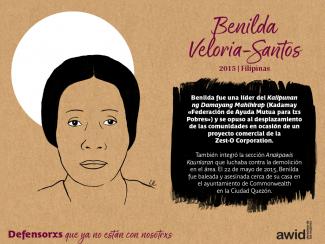
Benilda Valoria-Santos
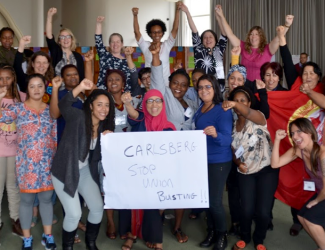
Women human rights defenders (WHRDs) worldwide defend their lands, livelihoods and communities from extractive industries and corporate power. They stand against powerful economic and political interests driving land theft, displacement of communities, loss of livelihoods, and environmental degradation.
Extractivism is an economic and political model of development that commodifies nature and prioritizes profit over human rights and the environment. Rooted in colonial history, it reinforces social and economic inequalities locally and globally. Often, Black, rural and Indigenous women are the most affected by extractivism, and are largely excluded from decision-making. Defying these patriarchal and neo-colonial forces, women rise in defense of rights, lands, people and nature.
WHRDs confronting extractive industries experience a range of risks, threats and violations, including criminalization, stigmatization, violence and intimidation. Their stories reveal a strong aspect of gendered and sexualized violence. Perpetrators include state and local authorities, corporations, police, military, paramilitary and private security forces, and at times their own communities.
AWID and the Women Human Rights Defenders International Coalition (WHRD-IC) are pleased to announce “Women Human Rights Defenders Confronting Extractivism and Corporate Power”; a cross-regional research project documenting the lived experiences of WHRDs from Asia, Africa and Latin America.
"Women Human Rights Defenders confronting extractive industries: an overview of critical risks and Human Rights obligations" is a policy report with a gender perspective. It analyses forms of violations and types of perpetrators, quotes relevant human rights obligations and includes policy recommendations to states, corporations, civil society and donors.
"Weaving resistance through action: Strategies of Women Human Rights Defenders confronting extractive industries" is a practical guide outlining creative and deliberate forms of action, successful tactics and inspiring stories of resistance.
The video “Defending people and planet: Women confronting extractive industries” puts courageous WHRDs from Africa, Asia, and Latin America in the spotlight. They share their struggles for land and life, and speak to the risks and challenges they face in their activism.
Challenging corporate power: Struggles for women’s rights, economic and gender justice is a research paper outlining the impacts of corporate power and offering insights into strategies of resistance.
AWID acknowledges with gratitude the invaluable input of every Woman Human Rights Defender who participated in this project. This project was made possible thanks to your willingness to generously and openly share your experiences and learnings. Your courage, creativity and resilience is an inspiration for us all. Thank you!
📅Monday, March 11
🕒4:30 - 6pm EST
Organisers: AWID, IJSC and NAWI
🏢 Church Center of the United Nations, 777 United Nations Plaza, New York, 11th Floor
(French and Spanish interpretation available)

("exchange hand")
Term of the black communities of the Northern Cauca for the minga, the collective work based on solidarity and mutual support.
Day 3

Thanks to our global feminist community! From May to August 2024, nearly 1,200 organizations working for Women's rights, gender justice, and LBTQI+ equality shared their experiences in the WITM survey. The results offer a unique picture of how feminist movements are resourced and where gaps remain.
Les Femmes Maintiennent les Soins | Les Soins Soutiennent la Vie | La Vie Soutient l'Économie | Qui s'Occupe des Femmes ? | Pas Une de Moins1 | Ensemble | Déjeuner du Dimanche
1Nenhuna a menos se traduit littéralement par « pas une femme de moins » ou « ni una menos » en espagnol - un célèbre slogan féministe en Amérique latine qui a émergé en Argentine en réponse à l'augmentation de la violence sexiste.

Para darle visibilidad a la complejidad de la dotación de recursos para las diversas formas de organización feministas.


 While funders committed significantly more money to gender equality over the last decade, still only 1% of philanthropic and development funding has actually been moved to directly resource feminist-led social change.
In solidarity with movements that continue to be invisibilized, marginalized and without access to core, long-term, flexible and trust-based funding, the WITM survey highlights the actual state of resourcing, challenges false solutions, and points to how funding models must change for movements to thrive and meet the complex challenges of our times.
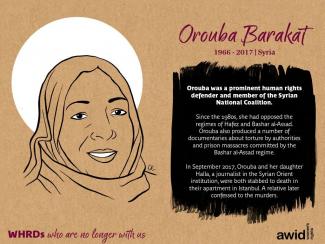
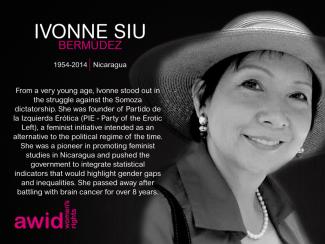
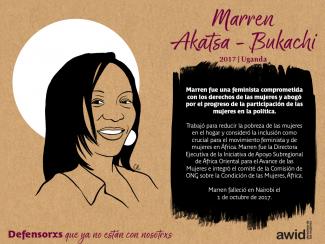
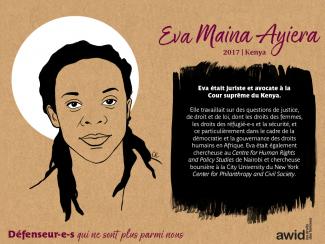
AWID honra a lxs feministas y defensoras de los derechos humanos que han muerto y cuyas contribuciones al progreso de los derechos humanos se echa mucho en falta.
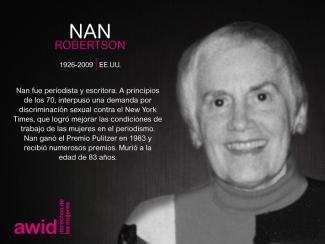
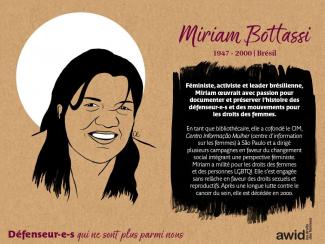
El Tributo de AWID a las defensoras de derechos humanos es una exhibición fotográfica que presenta a activistxs del feminismo, de los derechos de las mujeres y de la justicia social de todo el mundo que ya no están con nosotrxs.
El Tributo fue lanzado por primera vez en 2012, en el 12º Foro Internacional de AWID, en Turquía. Tomó la forma de una exposición física de retratos y biografías de feministas y activistxs que fallecieron. La iniciativa fue descrita por lxs participantes del Foro como una manera única, emotiva y energizante de conmemorar nuestra historia colectiva.
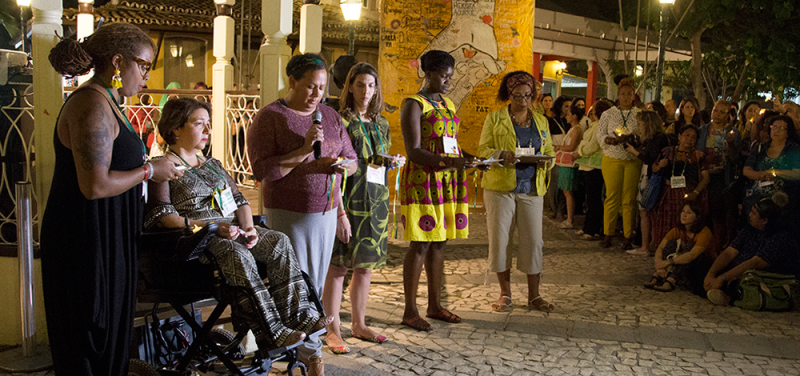
En el 13º Foro Internacional, en Brasil, honramos a lxs activistas y a las defensoras de derechos humanos con una ceremonia de inauguración de un mural en cuatro idiomas, un espectáculo de danza y un ritual brasileño.
Entre los eventos, el Tributo permanece como una galería en línea que se actualiza cada año como parte de la Campaña de los 16 Días de Activismo Contra la Violencia de Género (25 de noviembre al 10 de diciembre).
Desde 2012, a través de nuestro Tributo anual a las defensoras de derechos humanos que ya no están con nosotrxs, hemos presentado más de 400 feministas y defensorxs de 11 regiones y 80 países.
AWID quiere agradecer a las familias y organizaciones que compartieron sus historias personales y contribuyeron a este homenaje. Nos unimos a ellxs para continuar con el notable trabajo de estas mujeres y redoblar esfuerzos para asegurar que se logre justicia en los casos que permanecen en la impunidad.
Visite la exhibición en línea del Tributo a las Defensoras de Derechos Humanos
Además de rendir homenaje a estxs increíbles activistas, el Tributo arroja luz sobre la gravedad de la situación de las defensoras de derechos humanos que han sido asesinadas o están desaparecidas.
Un tercio de las personas presentadas en el Tributo fueron activistas asesinadxs o están desaparecidxs en circunstancias sospechosas. Fueron atacadxs específicamente por ser quiénes eran y por haber desafiado:
Mujeres como Agnes Torres, de México, fueron asesinadas debido a su identidad de género y orientación sexual; o Cheryl Ananayo, una activista ambientalista de Filipinas que fue asesinada mientras luchaba contra una compañía minera; o Ruqia Hassan, una periodista y bloguera independiente siria asesinada por sus críticas al Estado Islámico de Iraq y Levante (EIIL, ISIS en inglés). Y muchas otras.
Con el Tributo a las defensoras de derechos humanos lxs traemos a todxs a nuestra memoria colectiva y llevamos su legado de lucha como nuestra antorcha en los movimientos feministas y por los derechos de las mujeres. Reconocemos que la seguridad y el autocuidado deben ser una prioridad en todas nuestras agendas políticas. Y hacemos un llamamiento a los gobiernos y a los organismos internacionales para que aborden colectivamente la violencia contra lxs feministas y las defensoras de derechos humanos.
Visite la exhibición en línea del Tributo a las Defensoras de Derechos Humanos
.
We are living in a world where the destruction of Nature fuels our current global economy. |
Even in times of climate crisis, governments continue to encourage large-scale agriculture industries to expand. These activities poison the land, threaten biodiversity, and destroy local food production and livelihoods. Meanwhile, while women produce the majority of our food in the world, they own almost none of the land. |
|
What if we perceived land and Nature not as private property to exploit, but as a whole to live in, learn from, and harmoniously coexist with? What if we repaired our relationships with the land and embraced more sustainable alternatives that nurture both the planet and its communities? Nous Sommes la Solution (We Are the Solution, NSS) is one of many women-led movements striving to do this. This is their story. |
|