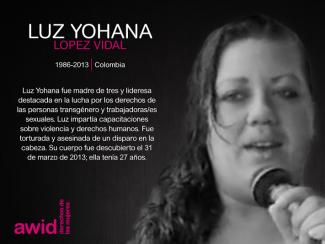
Luz Yohana Lopez Vidal
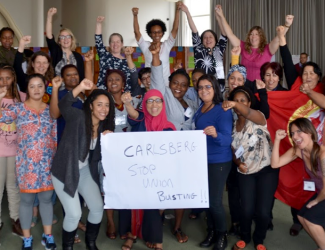
Women human rights defenders (WHRDs) worldwide defend their lands, livelihoods and communities from extractive industries and corporate power. They stand against powerful economic and political interests driving land theft, displacement of communities, loss of livelihoods, and environmental degradation.
Extractivism is an economic and political model of development that commodifies nature and prioritizes profit over human rights and the environment. Rooted in colonial history, it reinforces social and economic inequalities locally and globally. Often, Black, rural and Indigenous women are the most affected by extractivism, and are largely excluded from decision-making. Defying these patriarchal and neo-colonial forces, women rise in defense of rights, lands, people and nature.
WHRDs confronting extractive industries experience a range of risks, threats and violations, including criminalization, stigmatization, violence and intimidation. Their stories reveal a strong aspect of gendered and sexualized violence. Perpetrators include state and local authorities, corporations, police, military, paramilitary and private security forces, and at times their own communities.
AWID and the Women Human Rights Defenders International Coalition (WHRD-IC) are pleased to announce “Women Human Rights Defenders Confronting Extractivism and Corporate Power”; a cross-regional research project documenting the lived experiences of WHRDs from Asia, Africa and Latin America.
"Women Human Rights Defenders confronting extractive industries: an overview of critical risks and Human Rights obligations" is a policy report with a gender perspective. It analyses forms of violations and types of perpetrators, quotes relevant human rights obligations and includes policy recommendations to states, corporations, civil society and donors.
"Weaving resistance through action: Strategies of Women Human Rights Defenders confronting extractive industries" is a practical guide outlining creative and deliberate forms of action, successful tactics and inspiring stories of resistance.
The video “Defending people and planet: Women confronting extractive industries” puts courageous WHRDs from Africa, Asia, and Latin America in the spotlight. They share their struggles for land and life, and speak to the risks and challenges they face in their activism.
Challenging corporate power: Struggles for women’s rights, economic and gender justice is a research paper outlining the impacts of corporate power and offering insights into strategies of resistance.
AWID acknowledges with gratitude the invaluable input of every Woman Human Rights Defender who participated in this project. This project was made possible thanks to your willingness to generously and openly share your experiences and learnings. Your courage, creativity and resilience is an inspiration for us all. Thank you!
Do you want to be inspired by the creative resistance strategies of feminists from all over the world? Do you want to discover feminist initiatives that show us how we can all live in a more just world? Do you want to learn about models of feminist care and healing to bring to your own community? Is that a resounding yes that we hear? YES!
Then check out Crear | Résister | Transform: a festival for feminist movements. This festival took place virtually throughout the month of September 2021 across all of AWID’s platforms, and now you can experience it on your own time.
The panelists participated in their preferred language and at AWID we included subtitles on the videos for your accessibility.
Contenido relacionado
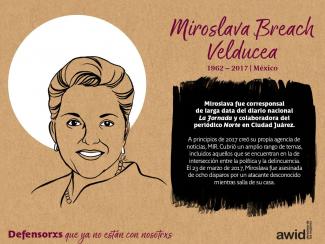
Norte Digital de Ciudad Juárez: Cerramos en protesta
La Jornada: Brazo del ‘cártel’ de Sinaloa ordenó asesinar a Miroslava Breach: FGE
BBC: Miroslava Breach, la periodista “incómoda” asesinada en México cuando llevaba a su hijo a la escuela

يمكنك أن تتوقع جميع المواد الأساسية لورش العمل والعروض التقديمية: اللوحات الورقية، والأقلام والملاحظات اللاصقة، بالإضافة إلى أجهزة العرض والمعدات السمعية والبصرية. أي مواد إضافية تقع على عاتق منظمي/ات النشاط. سيكون الفريق اللوجستي التابع لجمعية حقوق المرأة في التنمية متاحًا للإجابة على الأسئلة وتقديم المشورة.
Conférence internationale de suivi sur le financement du développement, Doha, Qatar
Related content
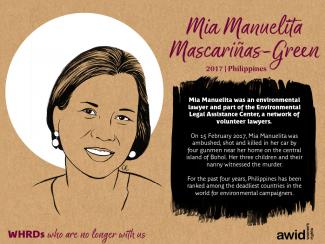
ABS - CBN (Original: Agence France Presse): Environmental lawyer murdered in Bohol
Business and Human Rights Resource Centre: Philippines: Killing of lawyer Mia Mascariñas-Green brings to 112 the number of environmental campaigners murdered in the country in the last 15 years
BBC: Mia Mascarinas-Green: Widower tells how wife was killed in Philippines (Audio)

Rejoignez la co-création du 15e Forum international de l’AWID à Bangkok, en Thaïlande.
The 1st drafting session on the outcome document for the 3rd Financing for Development Conference