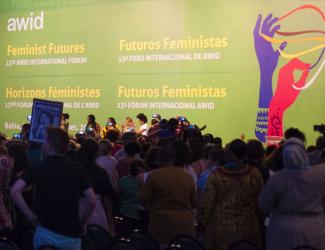
AWID Forum: Co-creating Feminist Futures

In September 2016, the 13th AWID international Forum brought together in Brazil over 1800 feminists and women’s rights advocates in a spirit of resistance and resilience.

This section highlights the gains, learnings and resources that came out of our rich conversations. We invite you to explore, share and comment!


What has happened since 2016?

One of the key takeaways from the 2016 Forum was the need to broaden and deepen our cross-movement work to address rising fascisms, fundamentalisms, corporate greed and climate change.

With this in mind, we have been working with multiple allies to grow these seeds of resistance:

And through our next strategic plan and Forum process, we are committed to keep developing ideas and deepen the learnings ignited at the 2016 Forum.

What happens now?

The world is a much different place than it was a year ago, and it will continue to change.

The next AWID Forum will take place in the Asia Pacific region (exact location and dates to be announced in 2018).

We look forward to you joining us!

About the AWID Forum

AWID Forums started in 1983, in Washington DC. Since then, the event has grown to become many things to many peoples: an iterative process of sharpening our analyses, vision and actions; a watershed moment that reinvigorates participants’ feminisms and energizes their organizing; and a political home for women human rights defenders to find sanctuary and solidarity.

Learn more about previous Forums

Related Content

Snippet - CSW69 - Other events - EN

Find AWID staff at these partners' events!

Nilcéa Freire

Nilcéa Freire était une activiste, politicienne et universitaire brésilienne. Ardente défenseuse des droits des femmes et des minorités sous-représentées dans le pays, sa vie et son travail ont été marqués par une longue histoire de luttes et de victoires.

"Nous devons, tout en résistant, continuer à chercher à progresser, et ce que nous pouvons accomplir actuellement, je pense que nous le devons à la fantastique organisation des jeunes femmes blanches, et surtout des femmes noires, dans toutes les capitales d’États et les grandes villes brésiliennes.” - Nilcéa Freire

En 1999, elle est devenue la première femme à occuper le poste de doyenne de l'université d'État de Rio de Janeiro. Elle y a dirigé la mise en œuvre de la première politique d'action positive pour les étudiant·e·s des écoles publiques, demandant au sein d’une école publique que des places soient spécifiquement réservées aux étudiant·e·s noir·e·s à faible revenu. Ce système a été adopté dans des dizaines d'autres universités publiques. 

Quelques années plus tard, Nilcéa dirigea le Secrétariat spécial des politiques pour les femmes sous le gouvernement de l'ancien président Luiz Inácio Lula da Silva. C’est à ce titre qu’elle conduisit la première Conférence nationale des femmes. Plus de 12 000 femmes de tout le pays y participèrent et le résultat de ce travail collectif fut incorporé dans le Plan national des politiques pour les femmes. 

Son engagement envers les femmes, les Afro-Brésilien·ne·s et les populations autochtones se reflète aussi fortement dans son travail de défense de leurs droits, qu’elle a mené dans le cadre des initiatives du bureau de la Fondation Ford du Brésil, dont elle était la directrice régionale. 

L’activiste féministe Manoela Miklos a dit de Nilcéa qu'elle était "une femme sans égal·e".

Nilcéa s’est éteinte à Rio de Janeiro à l'âge de 66 ans, le 29 décembre 2019, des suites d’un cancer.


"Je n’ai pas de mots face à l’annonce de la mort de notre chère Nilcéa Freire. Il m’est trop triste de savoir qu’elle est partie si tôt. Elle s’est toujours rangée du côté de celleux qui ne tolèrent pas les injustices de ce monde. Elle était la ministre des femmes, sans cesse engagée dans la cause féministe. Elle nous manquera beaucoup!” - Jandira Feghali, Federal Deputy
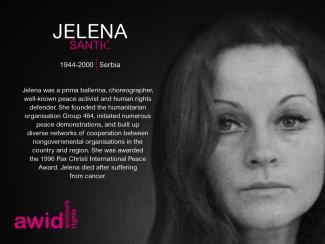
Retrouvez sur YouTube la féministe brésilienne Nilcea Freire et pourquoi il importe de se montrer solidaires avec le Brésil

Snippet Join Forum Dreaming (FR)

Vous voulez construire le Forum avec nous ?

Devenez membre de l'AWID et participez à notre prochain événement "Forum Dreaming" le 20 juin.

Crear Resistar Snippet

Crear | Résister | Transform

Crear | Résister | Transform is for you and all the amazing feminist and social justice activists that you know. Let’s come together to share our resistance strategies, co-create some feminist magic, and transform this world together.

 A Festival for Feminist Movements!

Jessica Whitbread

Biography

Jessica est une artiste-activiste queer de Toronto, au Canada, mais qui vit actuellement en Bulgarie. Elle a plus de 15 ans d'expérience dans la riposte au VIH, travaillant aux intersections du genre et du VIH auprès de populations clés (travailleurs·ses du sexe, femmes consommatrices de drogues, communautés LGBTQI, personnes incarcérées et, bien sûr, personnes vivant avec le VIH). Jessica aime créer du mouvement et réfléchir/entreprendre/élaborer des stratégies sur des interventions basées sur les arts. L'un des projets amusants qu'elle a lancé en 2013 était LOVE POSITIVE WOMEN (Femmes positives à l’amour), qui implique plus de 125 groupes et organisations communautaires du monde entier, du 1er au 14 février, pour célébrer les femmes vivant avec le VIH dans leurs communautés.

Position
Responsable de l’Adhésion et de l’Engagement des Membres
Add to stories
Off

We Are the Ones We Have been Waiting For!

We’re beginning a new year--2023. COVID-19 continues to infect and re-infect many, many people around the world. We are witnessing the resurgence of right-wing and fascist governments, even in places we may not have expected like Sweden. War, armed conflict, and dramatic increase in militarization, militarism, and military spending are enabling the unbridled capital accumulation by the few, with participation of seemingly “strange” alliances locking arms, both visibly and invisibly, where economic and political elites of the Global North and Global South are benefitting beyond our wildest imagination. In the meanwhile, our people and the natural environment pay enormous costs and suffer all the expected and unexpected consequences.

As all of you and all of us at AWID know, feminists in multiple movements around the world are resisting and organizing against multiple faces of tyranny, creating alternative structures, implementing grassroots strategies, and building transnational alliances. We are generating joy, inspiring one another, singing, and dancing within and against the prevailing culture of killing and cynicism that seems to have engulfed so much of the world.

We--Staff and Board--of AWID are prepared and inspired more than ever before to face challenges by strengthening our relationships with our members and organizational partners, meeting and getting to know those who we are yet to meet and do what we do best: support the global feminist movements. Although we were sad facing the departures of our beloved former Co-Eds Cindy and Hakima, our wonderful new Co-EDS Faye and Inna along with committed and creative staff have embraced the moment that encapsulates both opportunities and threats.

For sure, all of us at AWID and all our movement folks know:  As the Caribbean US poet and activist June Jordan wrote to the South African women activists during the height of the apartheid regime, “We are the ones we have been waiting for”!

Snippet - WCFM type of funder - EN

Type of funder:

Filter your search by funders from different sectors i.e., philanthropic foundations, multilateral funders, women’s and feminist funds

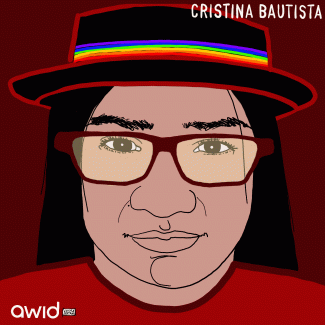
Cristina Bautista

“If we stay quiet they kill us and if we talk [they kill us] too. So, let’s talk.” -  Cristina Bautista, 2019

Cristina Bautista was a member of the Nasa Indigenous people’s community whose home is situated in the region of Northern Cauca, Colombia. She was part of their resistance as a leader, land rights defender, social worker, and governor of the Nasa Tacueyó Indigenous reserve. 

A tireless defender of the rights of Nasa people, Cristina spoke strongly and loudly against the violence directed at her community. In a speech before the United Nations, she called for the protection of Indigenous women’s lives and their involvement in different spheres of life. In 2017, Cristina was a UN Human Rights Office Indigenous fellow and she was awarded a grant from the UN Voluntary Fund for Indigenous Peoples in 2019. 

“I would like to bring to light the current situation of the Indigenous people in Colombia, the killing of Indigenous leaders, the repression of social protest. Instead of helping, the peace deal has increased war and the exploitation of sacred territories in Colombia… In the current situation, in almost all Indigenous nations as women we have been working to find a better future for our families. I don’t want more women from the countryside to continue living under these circumstances. We need opportunities for Indigenous women to participate in politics, in the economy, in society and in culture. Today gives me true strength, to see all these women here and that I am not alone.” - Cristina Bautista, 2019

On 29 October 2019, Cristina was murdered along with four unarmed Indigenous guards in an attack which was allegedly carried out by armed members of “Dagoberto Ramos”, a FARC dissident group. 

According to Global Witness, “the murder of community and social leaders has risen dramatically in Colombia in recent years.” 

“The Nasa community has repeatedly raised the alarm with the authorities about threats to their safety. Despite efforts by successive Colombian Governments, indigenous peoples continue to face great risks, especially religious or community leaders like Cristina Bautista.” - UN press briefing, 1 November 2019


Watch a speech by Cristina Bautista in August 2019 in which she denounced previous murders of Indigenous guards (Spanish only)

What will be different about this Forum?

With up to 2,500 participants on-site and 3,000 virtual/hybrid participants, it will be the largest AWID Forum ever. We envision multiple spaces for meaningful connection, learning, exchange, strategic conversations, healing and celebration. It is the first time we gather in this space since the pandemic, and we can’t wait.

OURS 2021 - Chapitre 1

Chapitre 1

Promouvoir les programmes féministes : principales avancées en matière de genre et de sexualité

Alors que les fondamentalismes, les fascismes et autres systèmes d’oppression se métamorphosent et trouvent de nouvelles tactiques et stratégies pour consolider leur pouvoir et influence, les mouvements féministes persévèrent et célèbrent leurs victoires nationales, régionales et internationales.

En lire plus

Leila Hessini

Biography

Leila is a transnational feminist leader, strategist, and advisor with over 25 years of organizing, advocacy and philanthropic experience advancing human rights, gender equality, and sexual and reproductive rights and justice.  She was born in Algeria and educated in the U.S., France, and Morocco; over her professional career, she has lived and worked in forty countries across Africa, Europe, Latin America and Asia.  Leila currently serves as a Senior International Fellow at the Asfari Institute for Civil Society and Citizenship at the American University of Beirut in Lebanon and as Senior Strategist for various feminist movements and organizations as well as the the Urgent Action Fund-Africa and Trust Africa on an initiative on Reimagining Feminist and Pan-African Philanthropies.
 
From 2017-2023, Leila held the position as Vice-President of Programs at Global Fund for Women where she oversaw its strategic grantmaking, movement-strengthening, global advocacy and philanthropic collaborations. At GFW, she doubled its grantmaking to over $17 million, launched its feminist and gender-based movements and crises work, created an adolescent girls program led by a girls’ advisory council and led its philanthropic advocacy work.  Prior to that she served on the senior leadership team of Ipas from 2002 to 2016 where she published extensively on abortion rights and justice, lead global advocacy efforts and partnered with feminist groups working on self-management, community strategies and stigma reduction around bodily integrity and sexual and reproductive rights.
 
Leila is currently researching shifts in the philanthropic sector including recognizing non-institutional practices of giving resources in the Global South and efforts to decolonize practices in the Global North.  She has written extensively on the political nature of veiling across North Africa and the Middle East, abortion practices in majority Muslim contexts and feminist approaches to sexual and reproductive health, rights and justice.
 
Leila holds an MPH in public health and a MA in Middle Eastern and North African Studies, studied Islamic law in Morocco and pursued doctoral studies in sociology in France. She studied Arabic and speaks French and English fluently.  She is a mother of two feminist young women, an avid scuba diver, mountain bike rider, skier, and outdoor enthusiast.

Position
Treasurer
Add to stories
Off

Who can fund my women’s rights organizing?

We know feminists still need and deserve more and better resources! We have revised our funder database.

The Who Can Fund Me? Database is an easy-to-use, practical tool for movements looking for funders from philanthropic foundations, multilateral funders to women’s and feminist funds to support vital lifesaving efforts. 

Explore now

Snippet2 - WCFM type of funding- EN

Court icon

Type of funding:

Be it core funding, programmes & projects or rapid response/ emergency grants.

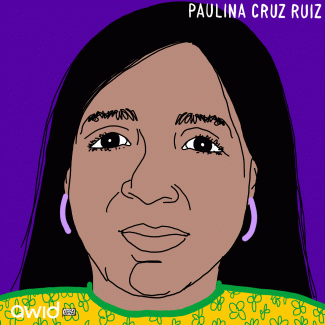
Paulina Cruz Ruiz

Paulina Cruz Ruiz, de la región de Rabinal, Baja Verapaz, en Guatemala, fue una autoridad ancestral Maya Achí (Indígena) y una defensora de los derechos humanos. Paulina se involucró activamente en la organización comunitaria y la resistencia, lo cual incluyó la adopción de medidas legales contra los proyectos mineros en territorios Indígenas, proyectos que afectarían y perjudicarían severamente el tejido socio ambiental. 

"El modelo de industria extractiva promovido por el gobierno guatemalteco y la construcción de proyectos de desarrollo a gran escala en tierras indígenas, sin el consentimiento de la comunidad afectada, ha sido una fuente de disputas permanentes con los movimientos de resistencia". - Minority Rights Group International

Paulina también formó parte de la Marcha por la Dignidad, la Vida y la Justicia, del 1º de mayo de 2019, en la cual miles de guatemaltecxs iniciaron una marcha de ocho días contra la corrupción y la impunidad en la persecución y el asesinato de dirigentes de derechos humanos, líderes campesinxs e indígenas y defensorxs de la tierra. 

Paulina fue asesinada el 14 de septiembre de 2019 cerca de su casa en la aldea de Xococ.

Según el Grupo Internacional de Derechos de las Minorías: "actualmente, uno de los principales problemas que afectan a las comunidades mayas es la creciente actividad de la industria minera".


Para leer más sobre la comunidad Maya en Guatemala

Para leer más sobre la Marcha por la Dignidad, la Vida y la Justicia

¿Cómo puedo financiar mi participación en el Foro de AWID?

Si tu grupo u organización recibe financiamiento, es posible que desees discutir con tus donantes desde ahora si pueden apoyar tu viaje y participación en el Foro. Muchas instituciones planifican sus presupuestos para el próximo año a principios de 2023, por lo que es mejor no retrasar esta conversación para el próximo año.

Primer: Spot key groups and debunk their narratives

Primer:

Spot key groups and debunk their narratives

Are you a UN policy maker and want to know the main anti-rights groups and discourses to look out for? Or a feminist looking for quick counter-arguments? This 8-page primer provides key information at a glance.

Get the primer

Fatima Qureshi

Biography

Culturellement nomade, née à Hong Kong et enracinée dans un héritage turco-pakistanais, l'amour de Fatima pour les récits - tant pour les lire que pour les cocréer - a alimenté sa passion pour l'activisme à travers la communication. Forte de sa formation en journalisme, Fatima a travaillé pendant 7 ans dans les domaines de la communication numérique et médiatique avec des ONG qui offrent des opportunités d'éducation et de l’aide juridique aux réfugié·e·s et demandeur·se·s d'asile, ainsi qu'avec le mouvement féministe musulman qui applique une perspective féministe et fondée sur les droits dans la compréhension et la quête d’égalité et de justice au sein de la tradition juridique musulmane. Elle rédige régulièrement des tribunes sur les questions féministes dans les pays du Sud.

Grâce à la narration dans cette ère ultra digitale des réseaux sociaux, Fatima continue de collaborer avec des animateur·rice·s communautaires et des activistes de terrain pour créer du contenu audiovisuel dans le but de cultiver des ponts de compréhension vers la libération collective et la décolonisation. Les jours où elle ne travaille pas, elle regarde attentivement des films féministes indépendants venant d’Iran, du Maroc et du Pakistan, et les autres jours elle interprète de la poésie orale avec ses camarades à Kuala Lumpur.

Position
Responsable des communications numériques et des partenariats de l'ICM
Add to stories
Off