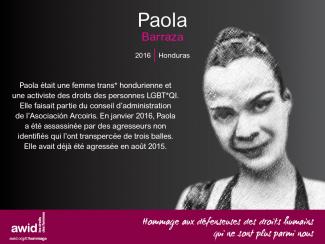
Paola Barraza
WHRDs are self-identified women and lesbian, bisexual, transgender, queer and intersex (LBTQI) people and others who defend rights and are subject to gender-specific risks and threats due to their human rights work and/or as a direct consequence of their gender identity or sexual orientation.
WHRDs are subject to systematic violence and discrimination due to their identities and unyielding struggles for rights, equality and justice.
The WHRD Program collaborates with international and regional partners as well as the AWID membership to raise awareness about these risks and threats, advocate for feminist and holistic measures of protection and safety, and actively promote a culture of self-care and collective well being in our movements.
WHRDs are exposed to the same types of risks that all other defenders who defend human rights, communities, and the environment face. However, they are also exposed to gender-based violence and gender-specific risks because they challenge existing gender norms within their communities and societies.
We work collaboratively with international and regional networks and our membership
We aim to contribute to a safer world for WHRDs, their families and communities. We believe that action for rights and justice should not put WHRDs at risk; it should be appreciated and celebrated.
Promoting collaboration and coordination among human rights and women’s rights organizations at the international level to strengthen responses concerning safety and wellbeing of WHRDs.
Supporting regional networks of WHRDs and their organizations, such as the Mesoamerican Initiative for WHRDs and the WHRD Middle East and North Africa Coalition, in promoting and strengthening collective action for protection - emphasizing the establishment of solidarity and protection networks, the promotion of self-care, and advocacy and mobilization for the safety of WHRDs;
Increasing the visibility and recognition of WHRDs and their struggles, as well as the risks that they encounter by documenting the attacks that they face, and researching, producing, and disseminating information on their struggles, strategies, and challenges:
Mobilizing urgent responses of international solidarity for WHRDs at risk through our international and regional networks, and our active membership.
Originaire de la cordillère des Andes, Brenda Salas est un·e stratège féministe queer. Iel œuvre à changer les discours et mobiliser les ressources pour soutenir les mouvements de justice raciale et climatique dans le monde entier. Brenda a produit de nombreux projets de communication pour exalter le pouvoir des migrant·e·s et dénoncer les interventions militaires américaines en Amérique latine avec Deep Dish TV et le Portland Central America Solidarity Committee (Comité de Solidarité avec l’Amérique centrale de Portland). Fier·ère d’être membre de l’Audre Lorde Project, iel est titulaire d’un diplôme du mouvement United World Colleges (UWC).
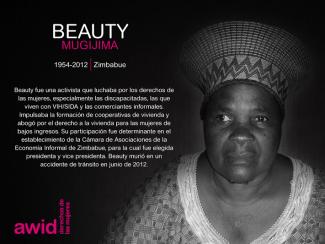
Naike Ledan
Semi Kaefra Alisha Fermond, Trans Rights Activist ACIFVH
Natalie Desrosiers
Fédorah Pierre-Louis

คุณสามารถคาดหวังว่าจะมีอุปกรณ์มาตราฐานสำหรับกิจกรรมและการนำเสนอเตรียมไว้ให้ ได้แก่ กระดาษฟลิปชาร์ท ปากกามาร์กเกอร์ โพสต์อิท รวมถึง โปรเจคเตอร์ อุปกรณ์ด้านภาพและเสียง อุปกรณ์เพิ่มเติมนอกเหนือจากนี้ถือเป็นความรับผิดชอบของผู้จัดกิจกรรม ฝ่ายโลจิสติกส์ AWID จะพร้อมที่จะตอบคำถามและให้คำแนะนำต่างๆ
Related Content
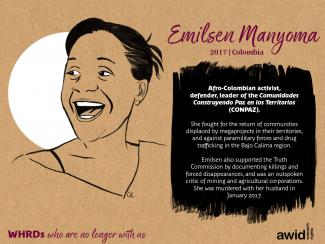
Front Line Defenders: Emilsen Manyoma Killed
ReliefWeb: A human rights defender killed every other day in 2017 in Colombia (between 1 and 23 January 2017)
Global Witness: Defenders of the Earth (2016 Report)
okayafrica.: Who is Killing Colombia's Black Human Rights Activists?
PBI Colombia: We will always accompany your work
Bitch Media: Don’t Touch My Crown: The failure of decapitation and the power of black women’s resistance
Rachel est une experte en finance, avec plus de vingt ans d’expérience. Elle a supervisé des opérations financières et des projets pour des entités privées et publiques, des organisations à but non lucratif et des organisations non gouvernementales internationales. Comptable agréée et titulaire d’un master global en administration des affaires, elle est également membre de l’Institut sud-africain des comptables agréés. Pendant son temps libre, Rachel conçoit des œuvres d’art typographiques, elle aime voyager et passer du temps avec ses proches autour d’une bouteille de vin.

In this selection of films you will find the voices of filmmakers who are not content with simply recording the feminist realities that palpitate in every corner of this vast and diverse territory. These are works that from their very conceptualization are questioning for what, by whom, and how films and videos are made. They understand film to be an instrument of struggle, something more than images to be enjoyed on a screen. These are individual or collective filmmakers who see film and video making as an instrument to promote discussion, open a debate, and thus serve as a resource for popular and feminist pedagogies.
نحن نراقب هذه المخاطر والمخاطر الأخرى بعناية، وسننشر معلومات شاملة عن الصحة والسلامة عند فتح التسجيل، حتى تتمكن/ين من اتخاذ القرار. بالإضافة إلى ذلك، تم تصميم التنسيق الهجين لتوفير تجربة مشاركة هادفة للمشاركين/ات الذين/ اللواتي يفضلون عدم السفر أو غير القادرين على السفر.

Check Out our Super Short Guide To Organising Global Feminist Festivals And Online Events!
Participa en co-crear el 15° Foro Internacional de AWID en Bangkok, Tailandia.
El enfoque principal de nuestro trabajo es mundial y trabajamos en estrecha colaboración con nuestra membresía y otras organizaciones de derechos de las mujeres y aliadxs del ámbito local, nacional y regional para que sus realidades nutran con información la labor que realizamos.
Ven a conocer las economías feministas que AMAMOS.
Cuando hablamos de economía, hablamos de cómo organizamos nuestras sociedades, nuestros hogares y lugares de trabajo. ¿Cómo vivimos juntxs? ¿Cómo producimos alimentos, organizamos los cuidados y aseguramos nuestra salud? La economía también se trata de cómo accedemos y gestionamos recursos, cómo nos relacionamos con otras personas, con nosotrxs mismxs y con la Naturaleza.
Lxs feministas han estado construyendo alternativas económicas a los sistemas capitalistas explotadores durante siglos. Estas alternativas existen en el aquí y el ahora, y son los pilares de los mundos más justos y más sostenibles que necesitamos y merecemos.
Nos emociona compartir contigo una muestra de alternativas económicas feministas, con colectivos inspiradores de todo el mundo.