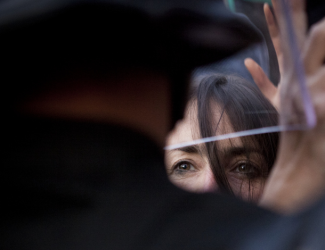
WHRDs are self-identified women and lesbian, bisexual, transgender, queer and intersex (LBTQI) people and others who defend rights and are subject to gender-specific risks and threats due to their human rights work and/or as a direct consequence of their gender identity or sexual orientation.
WHRDs are subject to systematic violence and discrimination due to their identities and unyielding struggles for rights, equality and justice.
The WHRD Program collaborates with international and regional partners as well as the AWID membership to raise awareness about these risks and threats, advocate for feminist and holistic measures of protection and safety, and actively promote a culture of self-care and collective well being in our movements.
Risks and threats targeting WHRDs
WHRDs are exposed to the same types of risks that all other defenders who defend human rights, communities, and the environment face. However, they are also exposed to gender-based violence and gender-specific risks because they challenge existing gender norms within their communities and societies.
By defending rights, WHRDs are at risk of:
Physical assault and death
Intimidation and harassment, including in online spaces
Judicial harassment and criminalization
Burnout
A collaborative, holistic approach to safety
We work collaboratively with international and regional networks and our membership
to raise awareness about human rights abuses and violations against WHRDs and the systemic violence and discrimination they experience
to strengthen protection mechanisms and ensure more effective and timely responses to WHRDs at risk
We work to promote a holistic approach to protection which includes:
emphasizing the importance of self-care and collective well being, and recognizing that what care and wellbeing mean may differ across cultures
documenting the violations targeting WHRDs using a feminist intersectional perspective;
promoting the social recognition and celebration of the work and resilience of WHRDs ; and
building civic spaces that are conducive to dismantling structural inequalities without restrictions or obstacles
Our Actions
We aim to contribute to a safer world for WHRDs, their families and communities. We believe that action for rights and justice should not put WHRDs at risk; it should be appreciated and celebrated.
Promoting collaboration and coordination among human rights and women’s rights organizations at the international level to strengthen responses concerning safety and wellbeing of WHRDs.
Supporting regional networks of WHRDs and their organizations, such as the Mesoamerican Initiative for WHRDs and the WHRD Middle East and North Africa Coalition, in promoting and strengthening collective action for protection - emphasizing the establishment of solidarity and protection networks, the promotion of self-care, and advocacy and mobilization for the safety of WHRDs;
Increasing the visibility and recognition of WHRDs and their struggles, as well as the risks that they encounter by documenting the attacks that they face, and researching, producing, and disseminating information on their struggles, strategies, and challenges:
Mobilizing urgent responses of international solidarity for WHRDs at risk through our international and regional networks, and our active membership.
Феминистские движения, движения за права женщин, гендерную справедливость, ЛГБТКИ+ и смежные движения по всему миру переживают критический момент, сталкиваясь с мощной негативной реакцией на ранее завоеванные права и свободы. Последние годы привели к быстрому росту авторитаризма, жестоким репрессиям в отношении гражданского общества и криминализации правозащитниц(-ков) с разнообразной гендерной самоидентификацией, эскалации войн и конфликтов во многих частях света, продолжающейся экономической несправедливости, – и все это на фоне кризиса в области здравоохранения, экологии и климата.
Joanne is an African feminist who is passionate about dismantling gender inequalities on the African continent. Joanne has worked with a number of global organizations, media and think tanks including Amnesty International, Wrthy, Local Development Research Institute, BBC, East African Community (EAC) among others.She serves on a couple of boards including Freely in hope-an NGO based in Kenya and Zambia that seeks to equip survivors and advocates to lead in ending sexual violence and Msingi Trust-a movement of activists that meet at the confluence of faith and human rights. She has a Masters in Business Administration, Masters of Public Policy and a Bachelor of Laws. She is a book junkie with a penchant for fiction.
Position
Manager, Membership and Constituency Engagement
Add to stories
Off
AWID Members Engaging at CSW61
Member states and women's rights advocates and organisations are gathering at the United Nations Headquarters in New York from 13 - 24 March for the 61st Commission on the Status of Women to address ‘women’s economic empowerment’ in the context of Sustainable Development Goal 5.
Whilst AWID is looking forward to physically meeting those of you who will be in New York, we want to engage with all those who cannot attend CSW, and as much as possible, amplify your voices in relevant spaces.
Continue reading to find out how to engage with AWID around CSW, whether you are attending physically or not.
Participate in an artistic takeover!
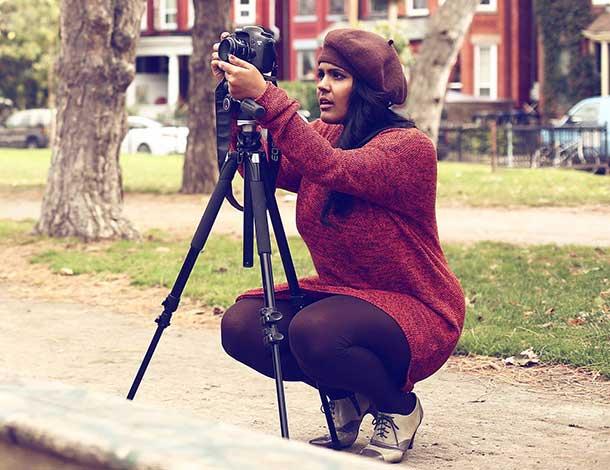
We are thrilled that AWID member Nayani Thiyagarajah is attending CSW this year and will take over the AWID Instagram. She will be available onsite to connect with other members for a possible feature on our Instagram. She will also explore possibilities of including some AWID members in a short film on the theme, ‘The personal is political’, a story of Nayani’s participation in this year’s CSW.
Nayani Thiyagarajah
Who is Nayani?
Nayani Thiyagarajah is a director, producer, and writer, dedicated to stories for the screen. A daughter of the Tamil diaspora, she calls Toronto home. For over 10 years, Nayani has worked in the arts and cultural industries. Her first independent feature documentary Shadeism: Digging Deeper (2015) had its World Premiere at the 2015 Zanzibar International Film Festival, where it won a Special Jury Prize. Nayani recently launched [RE]FRAME, with her producing partner Camaro West, a production company based out of Atlanta and Toronto, focused on re-framing the narratives around Black, Indigenous, and other people of colour through storytelling on screen.
On a more serious note, it should be noted that Nayani has a strange laugh, she's quite awkward, and her head is always in the clouds. She feels blessed beyond belief to create stories for the screen and play make believe for a living. Above all else, she believes in love.
Interested in meeting Nayani and being considered for inclusion in the film?
Send an email to membership@awid.org with the subject line “CSW Artistic Takeover”
By 13 March 2017
Please include your full name and country information.
Can't attend? Voice it!
If you are not able to attend CSW61 because of a travel ban, either due to the one imposed by the Trump administration or one you are facing from your own government, please share your story with us.
Send us messages you want heard in the United Nations spaces concerning funding, the impact of the reinstatement of the Global Gag Rule, and the need to push back against all types of religious fundamentalisms. You can send these in the following formats:
Video: no longer than two minutes and sent through a file sharing folder (for example dropbox, google drive)
Audio: no longer than two minutes and sent through a file sharing folder (for example dropbox, google drive)
Image: you can share a photo or a poster of your message
Text: no longer than 200 words and sent in the body of an email or in a word document
AWID members tell us that connecting with other members at CSW is valuable. In such a huge advocacy space, it is useful to connect with others including activists working on similar issues, or originating from the same country or region. Recognising the importance of connecting for movement building, we invite you to:
Interested in connecting with other members @CSW61?
If you are attending the CSW, we’d love to see what’s going on through your eyes!
Show us by capturing a moment you find speaks to the energy in the CSW space, be it on or off site. We hope to publish some of your ‘images’ on our social media channels and share on awid.org.
You can send us:
colour and/ or black and white photographs with a title (if you wish) and
a caption (no longer than 100 words) about the story your image tells.
Please also include:
your full name and country of origin and
let us know if we can publish the information you shared (in part or in full).
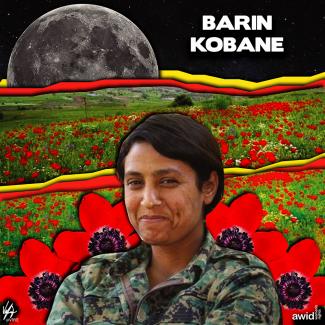
Barin was a member of the all-women fighting unit of the Kurdish People’s Protection Unit (YPG)
She was killed while on active duty.
Lebanese journalist Hifaa Zuaiter wrote: “Barin represents everything we have heard about the courage of the Kurdish female fighters, and her death is far more than the killing of a rival, or the result of a political or ethnic struggle. The horror of displaying her body only because she is a woman stems from the fact that she dared to threaten male hegemony by becoming a female fighter on a battlefield meant for men”.
Snippet FEA how important essential workers are (ES)
La pandemia de COVID-19 le mostró al mundo la importancia de lxs trabajadorxs esenciales. Estamos hablando de limpiadorxs, enfermerxs, paramédicxs, trabajadorxs del hogar, transportistxs, las personas que trabajan en los supermercados, entre muchísimas otras. Su trabajo es atender y garantizar el bienestar de lxs demás y hacer funcionar nuestras economías.
Pero mientras ellxs nos cuidan…
Snippet - WITM Our objectives - AR
أهداف استطلاع "أين المال"
تقديم تحليل محدّث، قوي، مبني على الأدلة ومسيّر نحو النشاط عن وقائع التمويل النسوي للتنظيمات النسوية ووضع البيئة التمويلية النسوية لأعضاء وعضوات AWID، الشركاء/ الشريكات في الحركة والممولين/ات.
1
تحديد وإظهار الفرص للتحول لتمويل أفضل وأكبر للحركات النسوية، لكشف الحلول الزائفة ووقف التوجه الذي يجعل التمويل يتحرك ضد الأجندات التقاطعية أو أجندات العدالة الجندرية.
2
تحديد الرؤى المقترحات والأجندات النسوية، لتمويل يحقق العدالة.
María es diseñadora gráfica y comunicadora visual. Ha trabajado con ONG e instituciones por los derechos humanos como Profamilia y OXFAM. Como mujer del Sur Global, se siente especialmente atraída a usar sus competencias para trabajar con organizaciones que ayudan a proteger el bienestar, así como los derechos de millones de niñas y mujeres de América Latina.
Position
Coordinadora, Comunicaciones Digitales
Add to stories
Off
Background
Why this resource?
While active participants on the front lines of protests and uprisings in the Middle East and North Africa (MENA), women became invisible, absent from processes of formation of the new states, and excluded from decision-making roles, responsibilities, and positions in the aftermath of the uprisings. Except in rare cases, men dominated leadership positions in transitional structures, including the constitutional reform and electoral committees[i]. Subsequent elections brought very few women to parliamentary and ministerial positions.
Additionally, a strong and immediate backlash against women and women’s rights has clearly emerged in the aftermath. The rise of new religious fundamentalist groups with renewed patriarchal agendas aiming to obliterate previous gains of the women’s movements even in countries with longer histories of women’s rights, such as Tunisia, has been very alarming.
The varying contexts of governance and transition processes across the MENA countries presents an important opportunity for women human rights defenders to shape the future of these democracies. However, the lack of prioritization of women’s rights issues in the emerging transitions and the aforementioned backlash have posed a variety of complex challenges for the women’s movements. Faced with these enormous challenges and possibilities, women’s rights activists have been struggling to forge ahead a democratic future inclusive and only possible with women’s rights and equality. The particular historical and contextual legacies that impact women’s movements in each country continue to bear on the current capacities, strategies, and overall preparedness of the women’s movements to take on such a challenge. Burdened with daily human rights violations in one context, with lack of resources and tools in another, with organizational tensions in a third, in addition to the constant attacks on them as activists, women human rights defenders have voiced their desire to be more equipped with knowledge and tools to be effective and proactive in engaging with these fast-changing environments. Conceptual clarity and greater understanding of notions and practices of democratization, transitional justice tools and mechanisms, political governance and participation processes, international and local mechanisms, movement building strategies, constitutional reform possibilities, and secularization of public space and government are important steps to defining future strategic action.
It is clear that feminists and women’s rights activists cannot wait for women’s rights to be addressed after transitions – issues must be addressed as the new power configurations are forming. Experiences of earlier moments of transition, namely from colonial rule, have clearly demonstrated that women’s rights have to be inherently part of the transition movement towards a more just and equal society.
What is included?
This publication represents a research mapping of key resources, publications and materials on transitions to democracy and women’s rights in different countries of the world that have undergone such processes, such as: Indonesia, Chile, South Africa, Nepal, Mexico, Argentina, Poland, Ukraine, as well as within the Middle East and North Africa (MENA). It provides bibliographic information and short summaries of resources which succinctly identify the contextual changes and challenges facing women in those particular transitional moments, as well as clearly delineates the ways in which women’s rights activists sought to confront those challenges and what lessons were learned.
A key criterion in the selection process was the primacy of a women’s rights/feminist perspective; the few exceptions to this rule offer a unique and, we hope, useful, perspective on the issues that women’s rights organizations and activists face in the region. The texts have been selected to provide a wide range of information, relevant to women human rights defenders working from the grassroots to the international level, across issues (including different case studies and examples), from different perspectives (international human rights bodies, academic institutions, NGO contributions, activists’ experiences, etc.), and at a wide range of levels of complexity, in order to respond to the needs of as many readers as possible.
The mapping clusters resources under six major categories:
Transitions to Democracy
Political Participation
Movement Building
Transitional Justice
Constitutional/Legal Reform
Responses to Fundamentalisms
[i]This and other context points are drawn from the report from Pre AWID Forum meeting on Women’s Rights in Transitions to Democracy: Achieving Rights, Resisting Backlash, collaboratively organized by AWID, the Equality Without Reservation Coalition, Global Fund for Women and Women’s Learning Partnership
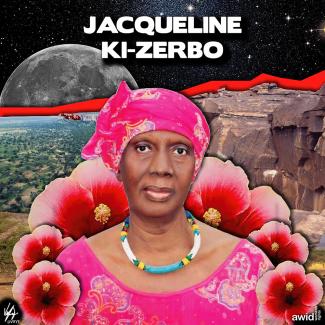
Jacqueline fue una feminista pionera malí-burkinesa, nacionalista y educadora.
Enseñó inglés en Senegal antes de ser convocada en 1961 como maestra de inglés en el Lycée Philippe Zinda Kaboré en Ouagadougou, Burkina Faso. Debido a su activismo, estuvo involucrada en el alzamiento popular del 3 de enero de 1966. Entre 1961 y 1966 fue responsable de la prensa del sindicato docente, Voces de lxs Maestrxs. Fue nombrada directora del Curso Normal para Niñas Jóvenes (ahora conocida como Escuela Secundaria Nelson Mandela), cargo que ocupó hasta 1974, dedicándose a la educación de las niñas y a la promoción de los derechos de las mujeres.
En 1984 recibió el Premio Paul G. Hoffmann por su destacado trabajo para el desarrollo nacional e internacional.
Группы, организации и движения, работающие исключительно или главным образом в интересах женщин, девочек, гендерной справедливости, прав ЛГБТКИ+ людей во всех регионах и на всех уровнях, как недавно созданные, так и давно существующие.
Leila est une dirigeante, défenseuse et conseillère féministe transnationale qui compte plus de 25 ans d'expérience dans la promotion des droits humains, de l'égalité des genres et de la santé et des droits sexuels et reproductifs, ainsi que de la justice au niveau local et mondial. Née en Algérie, Leila a fait ses études aux États-Unis, en France et au Maroc. Au cours de sa carrière professionnelle, elle a vécu et travaillé en Afrique, en Europe et aux États-Unis.
Elle a occupé le poste de vice-présidente des programmes au Fonds mondial pour les femmes (GFW) pendant plus de cinq ans, où elle a supervisé son octroi de subventions stratégiques, le renforcement des mouvements, le plaidoyer mondial et les collaborations philanthropiques. Au sein du GFW, elle a doublé le montant de ses subventions pour atteindre plus de 17 millions de dollars, a lancé son travail sur les mouvements et les crises féministes et axées sur le genre, a créé un programme pour les adolescentes dirigé par un conseil consultatif de filles et a dirigé son travail de plaidoyer philanthropique. Avant cela, elle a fait partie de l'équipe de direction d'Ipas de 2002 à 2016, où elle a publié de nombreux articles sur le droit à l'avortement et la justice, dirigé des actions de plaidoyer mondiales et établi des partenariats avec des groupes féministes travaillant sur l'autogestion, la mobilisation communautaire et la réduction de la stigmatisation autour de l'intégrité corporelle et des droits sexuels et reproductifs. Alors qu’elle était basée en Afrique du Nord, elle a cofondé une société de conseil féministe intersectionnelle, Strategic Analysis for Gender Equality (SAGE), qui travaillait sur les intersections entre l'économie, le genre et les droits sexuels et reproductifs, et a dirigé le travail national, régional et mondial sur le genre du bureau du Caire de la Fondation Ford pendant 5 ans.
Leila dispose d'une vaste expérience dans les domaines de l'éducation populaire, le plaidoyer, l'organisation à but non lucratif, le développement de conseils d'administration, la philanthropie et le suivi et l'évaluation. C'est une communicatrice compétente qui privilégie une approche intersectionnelle pour centrer et amplifier les voix et les expériences des personnes les plus marginalisées. Elle a reçu la bourse Op-ed Public Voices de la Fondation Ford et a été boursière Fulbright au Maroc. Ses publications couvrent un large éventail de sujets, notamment les approches féministes et décoloniales de la philanthropie, la promotion des droits humains des femmes dans les contextes majoritairement musulmans, les stratégies féministes visant à promouvoir la justice reproductive, la promotion du recours des femmes aux avortements autogérés et la lutte contre la stigmatisation et la discrimination.
Leila est actuellement coprésidente du conseil du Center for Constitutional Rights et membre du conseil de Highlander Research and Education. Elle fait également partie du conseil de responsabilité du Numun Feminist Technology Fund et du comité consultatif de la Plateforme des femmes défenseuses des droits humains d'Afrique. Elle a précédemment siégé aux conseils d'administration de SisterSong Women of Color Reproductive Justice Collective, du Réseau mondial des femmes pour les droits sur la reproduction, du Fonds mondial pour les femmes, du Safe Abortion Access Fund et du Reproductive Health Technologies Project. Elle a été élue trésorière et membre du comité exécutif du conseil d'administration de Prospera et a siégé au comité directeur du Fonds Fenomenal pendant quatre ans. Leila est titulaire d'une maîtrise en santé publique et d'une maîtrise en études sur la région du Moyen-Orient et de l'Afrique du Nord, a étudié le droit islamique au Maroc et a poursuivi des études doctorales en sociologie en France. Elle a étudié l'arabe et l'allemand et parle couramment le français et l'anglais.
Position
Trésorier
Add to stories
Off
Twitter Test
@shalinikonanur sharing a comment by her colleague debbie @salco "we can talk about shattering the glass ceiling, but we have to talk about who are sweeping those broken glasses?" challenging the #G7 to truly see who's vulnerable domestically & globally #W7Canada@kramdas@AWIDpic.twitter.com/1rs0SpLYHp
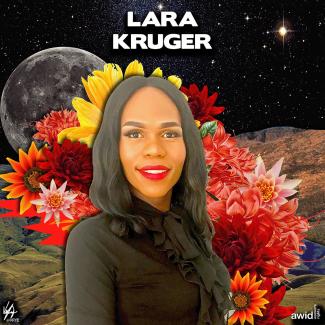
Lara était une DJ bien connue et appréciée de la Motsweding, une radio FM d’Afrique du Sud.
Lara a été l’un des premières animatrices ouvertement transgenre d’une radio grand public. Elle a œuvré sans relâche pour que lumière soit faite sur les questions LGBTI.
L’activisme de Lara a commencé très tôt, alors qu’elle revendiquait son droit de s’habiller et de se comporter afin de se sentir à l’aise auprès des membres de sa communauté qui ne comprenaient pas encore ce que signifiait être transgenre.