Flickr/Leonardo Veras (CC BY 2.0)

Special Focus

AWID is an international, feminist, membership organisation committed to achieving gender equality, sustainable development and women’s human rights

Protection of the Family

The Issue

Over the past few years, a troubling new trend at the international human rights level is being observed, where discourses on ‘protecting the family’ are being employed to defend violations committed against family members, to bolster and justify impunity, and to restrict equal rights within and to family life.

The campaign to "Protect the Family" is driven by ultra-conservative efforts to impose "traditional" and patriarchal interpretations of the family, and to move rights out of the hands of family members and into the institution of ‘the family’.

“Protection of the Family” efforts stem from:

  • rising traditionalism,
  • rising cultural, social and religious conservatism and
  • sentiment hostile to women’s human rights, sexual rights, child rights and the rights of persons with non-normative gender identities and sexual orientations.

Since 2014, a group of states have been operating as a bloc in human rights spaces under the name “Group of Friends of the Family”, and resolutions on “Protection of the Family” have been successfully passed every year since 2014.

This agenda has spread beyond the Human Rights Council. We have seen regressive language on “the family” being introduced at the Commission on the Status of Women, and attempts made to introduce it in negotiations on the Sustainable Development Goals.


Our Approach

AWID works with partners and allies to jointly resist “Protection of the Family” and other regressive agendas, and to uphold the universality of human rights.

In response to the increased influence of regressive actors in human rights spaces, AWID joined allies to form the Observatory on the Universality of Rights (OURs).  OURs is a collaborative project that monitors, analyzes, and shares information on anti-rights initiatives like  “Protection of the Family”.

Rights at Risk, the first OURs report, charts a map of the actors making up the global anti-rights lobby, identifies their key discourses and strategies, and the effect they are having on our human rights.   

The report outlines “Protection of the Family” as an agenda that has fostered collaboration across a broad range of regressive actors at the UN.  It describes it as: “a strategic framework that houses “multiple patriarchal and anti-rights positions, where the framework, in turn, aims to justify and institutionalize these positions.”


Related Content

Rights at Risk: Time for Action

Report:

Rights at Risk: Time for Action

The most recent report from the Observatory on the Universality of Rights unpicks discourses like “gender ideology”, “prenatal genocide”, and “cultural imperialism”. It also digs into CitizenGo, Alliance Defending Freedom, and anti-rights funding flows. You’ll also find analysis on regional human rights systems and successful feminist strategies and wins!

Get the report

Nilcéa Freire

Nilcéa Freire fue una activista feminista, política y académica brasileña. Como perseverante defensora de los derechos de las mujeres y de las minorías subrepresentadas de su país, su vida y su trabajo acumularon una larga historia de luchas y victorias.

«Mientras se resiste, tenemos que empujar para avanzar y los avances que vamos a poder lograr en este momento, a mi juicio, serán a través de la organización estupenda que las jóvenes mujeres blancas, pero sobre todo, las mujeres negras, están haciendo en todas las capitales, y las grandes ciudades de Brasil.» - Nilcéa Freire

En 1999, se convirtió en la primera mujer Rectora de la Universidad del Estado de Río de Janeiro (UERJ). Desde ese puesto, impulsó la implementación de la primera política de acción afirmativa para estudiantes que se graduaban de escuelas públicas, que exigía un cupo específico para estudiantes negrxs de sectores de bajos ingresos, sistema adoptado por decenas de otras universidades públicas.

Unos años más tarde, Nilcéa encabezó la Secretaría Especial de Políticas para las Mujeres del gobierno del ex-presidente Luiz Inácio Lula da Silva. Desde esta función, lideró la Primera Conferencia Nacional de Mujeres Brasileñas, en la que participaron más de doce mil mujeres de todo el país. El resultado de este trabajo colectivo fue incorporado en el Plan Nacional de Políticas para las Mujeres.

Su compromiso con las mujeres y las personas afrobrasileñas e indígenas se reflejó también en su trabajo de promoción de sus derechos, a través de iniciativas de la Fundación Ford en Brasil, de la cual fue Directora Regional.

La activista feminista Manoela Miklos describió a Nilcéa como «una mujer sin igual».

Nilcéa falleció en Río de Janeiro el 29 de diciembre de 2019 a los 66 años, víctima de un cáncer.


 «No tengo palabras ante la noticia de la muerte de la querida Nilcéa Freire. Es demasiado triste saber que partió tan pronto. Siempre formó parte de las filas de quienes no aceptan las injusticias del mundo. Fue Ministra de las Mujeres, una activista, siempre activa en la causa feminista. ¡La extrañaremos mucho!» - Jandira Feghali, Diputada Federal

La feminista brasileña Nilcéa Freire nos dice por qué es importante solidarizarse con Brasil

Love letter to Feminist Movements #6

On love to a movement

Kraft paper envelop that says Love letters to feminist movements from Sara AbuGhazal

How does a movement start?
we get expelled by ghosts from a house, a family, and a nation
we arrive fatigued to a space (sometimes an actual address) but mainly to a state of being
preceded by a fallen star 
perhaps our arrival isn’t accompanied by fatigue, 
maybe accompanied by fear 
perhaps our arrival isn’t accompanied by fear 
maybe accompanied by anger 
from issues that keep on repeating themselves: 
a stab in the heart (read heartache) 
a bullet in the back (read betrayal) 
forced disappearances 
bodies sentenced by marriage, disfiguration, and chronic fatigue 
yet when we arrive, we gather, whisper, speak and weep. 
This is how our movements begin when we arrive at each other 
We become seeds,
This is how our movements start when we plant each other
Becoming flowers, sometimes just thorns, sometimes fruits,
we are each other’s oasis
to sing for the battles 
to make remedies 
to place the faces of our lovers, the shape of their smiles, the sound of their laughter 
the secret of turning silences into language
the detailed instructions of witches
our movement is: for all of us
when we arrive as seeds with the purpose of flowering. 

Sara AbuGhazal
www.badiya.blog

WITM - Refreshed Intro Text (EN)

🚨New report out now🚨

Where is the Money? An Evidence-Driven Call to Resource Feminist Organizing

This new report shines a light on the resourcing realities of feminist and women’s rights organizations amid unprecedented political and financial upheaval. Drawing on over a decade of analysis since AWID last Where is the Money? report it takes stock of the gains, gaps, and growing threats in the funding landscape.

Download the report now!

Y aura-t-il des rassemblements régionaux, thématiques ou autres avant le Forum ?

Nous pensons que oui ! Le processus de planification n'en est qu'à ses débuts, alors restez à l'écoute car les plans sont en pleine préparation.

Animación: ¡Llamando a todas las superheroínas feministas!

Animación:

Llamando a todas las superheroínas feministas!

Sigue a nuestra superheroína mientras se embarca en una misión para recuperar las narrativas capturadas por los actores antiderecho en todo el mundo.

Ver la animación

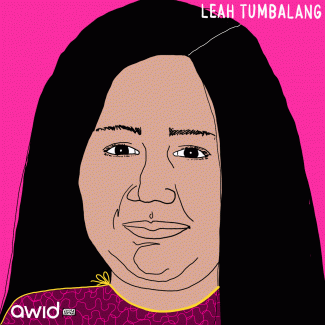
Leah Tumbalang

Leah Tumbalang était une femme lumad de Mindanao, aux Philippines. L’histoire du peuple autochtone Lumad recouvre des générations de résistance à l'exploitation minière à grande échelle par les entreprises, la protection des domaines ancestraux, des ressources et de la culture, et la lutte pour le droit à l'autodétermination. 

Leah était une leader lumad, ainsi qu’une dirigeante du Kaugalingong Sistema Igpasasindog tu Lumadnong Ogpaan (Kasilo), une organisation paysanne lumad plaidant contre l'arrivée des sociétés minières à Bukidnon, dans la province de Mindanao. Elle s’est montrée inébranlable dans son activisme antimines, militant avec ferveur contre les effets dévastateurs de l'extraction minière sur l'environnement et les terres des peuples autochtones. Leah était également une organisatrice de la liste du parti Bayan Muna, membre du parti politique de gauche Makabayan.

Depuis près d’une décennie, Leah (ainsi que d’autres membres de Kasilo) recevait des menaces du fait qu'elle codirigeait l'opposition contre le déploiement de groupes paramilitaires soupçonnés d’être soutenus par des intérêts miniers. 

« En tant que leader des Lumad au sein de leur communauté, elle est au premier plan pour lutter en faveur de leurs droits à la terre ancestrale et à l'autodétermination ». - Organisation régionale lumad de Kalumbay

Être en première ligne de la résistance implique également souvent d’être la cible de violences et victime de l’impunité. Leah a non seulement reçu de nombreuses menaces de mort, mais elle a été assassinée le 23 août 2019 à Valencia, dans la province de Bukidnon.  

Selon un rapport de Global Witness, « les Philippines sont le pays à avoir été le plus touché en chiffre absolu » pour ce qui est des meurtres d’activistes écologistes en 2018. 


Lisez le rapport du Global Witness, publié en juillet 2019

En savoir plus sur les femmes lumad aux Philippines et leur lutte intergénérationnelle pour l'autodétermination
 

Annonce: Forum AWID 2024

Image avec les mots: annonce: forum awid 2024. L'arrière-plan a une photo pâle du public lors du forum précédent et a un dégradé qui va du violet à gauche au jaune à droite.

Il est temps pour le prochain forum de l’AWID en 2024.

Lorsque des milliers de féministes se réunissent, nous créons une grande force de solidarité qui a le pouvoir de changer le monde. Le Forum de l’AWID sera pour nous un moment de repos et de guérison ensemble, de connexion au-delà des frontières et de découverte de nouvelles orientations stratégiques courageuses.

La date et le lieu seront annoncés l'année prochaine, dès que possible. Nous sommes ravi.es et nous savons que vous le serez aussi. Restez à l'écoute!

Assurez-vous de nous suivre sur les médias sociaux et de vous inscrire à notre liste de diffusion pour rester informé!

Snippet - COP30 - The People's Summit

The People's Summit

The climate summit by movements, for movements.

📅 November 12 - November 16, 2025
📍 Universidade Federal do Pará, Belém

More info here

My question isn’t answered here

For additional questions, please use our contact form. We will keep updating this document based on the queries we receive from you!

Snippet Kohl - Panel | El placer más allá de las fronteras

Panel | El placer más allá de las fronteras

con Lindiwe Rasekoala, Lizzie Kiama, Jovana Drodevic y Malaka Grant

YOUTUBESOUNDCLOUD (inglés)

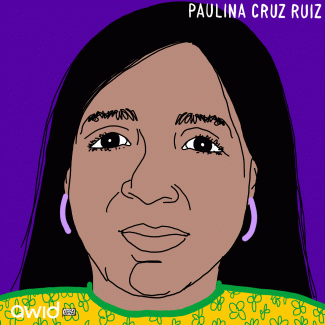
Paulina Cruz Ruiz

Paulina Cruz Ruiz, from the Rabinal, Baja Verapaz region of Guatemala, was an ancestral Maya Achí (Indigenous) authority and a human rights defender.

She was actively involved in community organizing and resistance, including legal measures against mining projects on Indigenous territory, projects that would severely affect and damage the socio-environmental fabric.  

“The extractive industry model promoted by the Guatemalan government and the construction of large-scale development projects on indigenous lands without community consent has been a source of ongoing disputes with resistance movements.” - Minority Rights Group International

Paulina was also part of the March for Dignity, Life and Justice, in which on 1 May 2019 thousands of Guatemalans started a march of eight days against corruption and impunity in the prosecution and assassinations of human rights, peasant and Indigenous leaders and land defenders.

Paulina was murdered on 14 September 2019 near her home in the village of Xococ. 

According to the Minority Rights Group International, “one of the major ongoing issues affecting Mayan communities is the increasing activity of the mining industry.”


Read more about the Mayans of Guatemala

Read more about the March for Dignity, Life and Justice


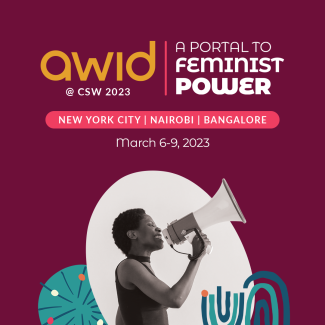
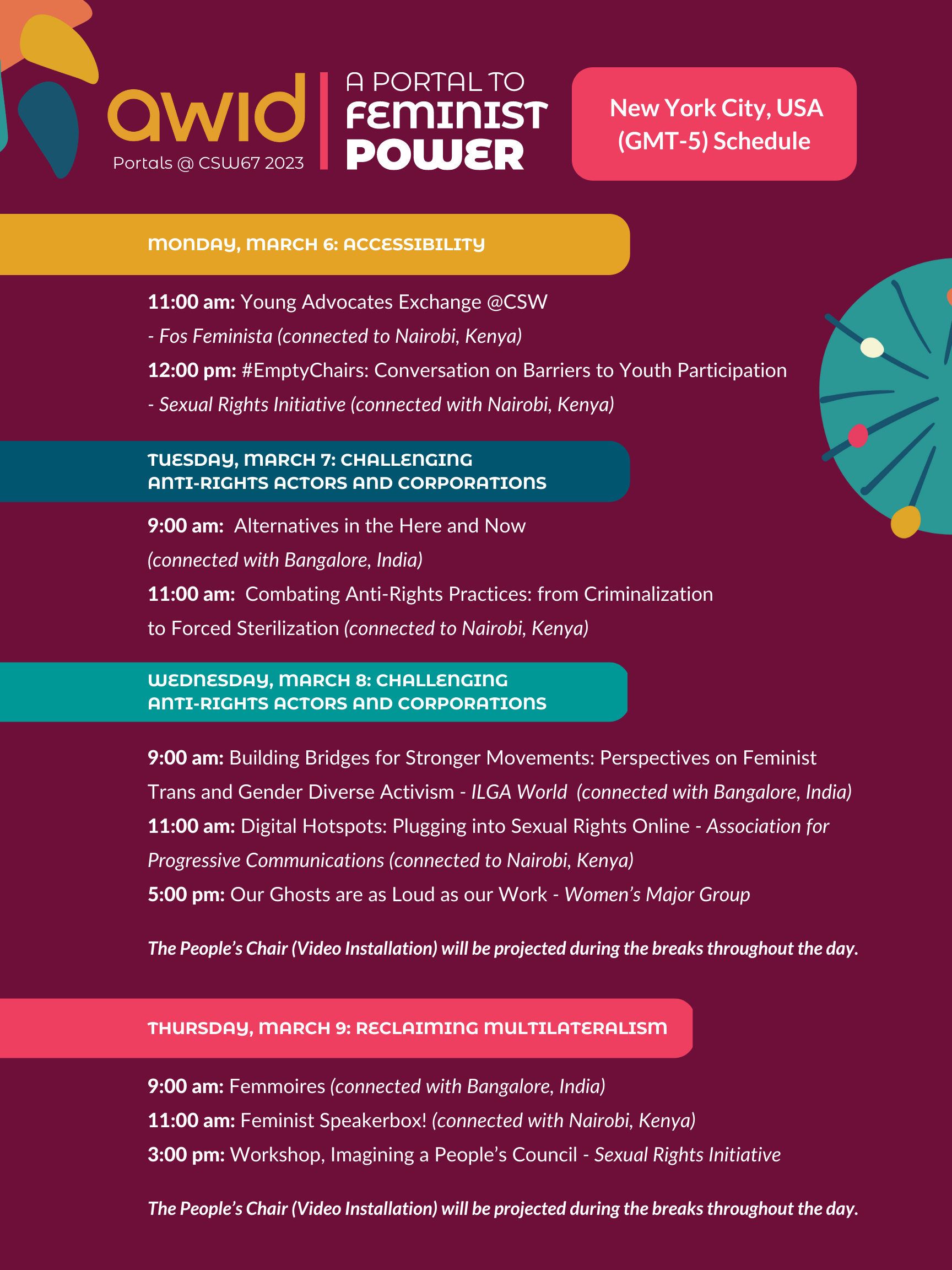
AWID at CSW67: a Portal to Feminist Power

Imagine opening a door which takes you into a conversation with feminist activists in other continents. This portal will transcend the barriers of UN CSW by pushing beyond language barriers, unaffordable travel, unequal protection from COVID19, and racist visa regimes.

This week, we’re putting a virtual spin on CSW by connecting and amplifying feminist activists' voices, to challenge the discriminatory barriers that limit participation and influence. By setting up connecting “portals” in New York City, Nairobi & Bangalore, we'll host a physical-virtual hybrid space for feminists to connect their struggles and build collective power.


Follow us to join the livestreams:

YouTube Facebook

And stay updated following us over:
Instagram Twitter


Graphic for the Announcement of AWID's participation in CSW 2023 with Portals

What are we covering? 

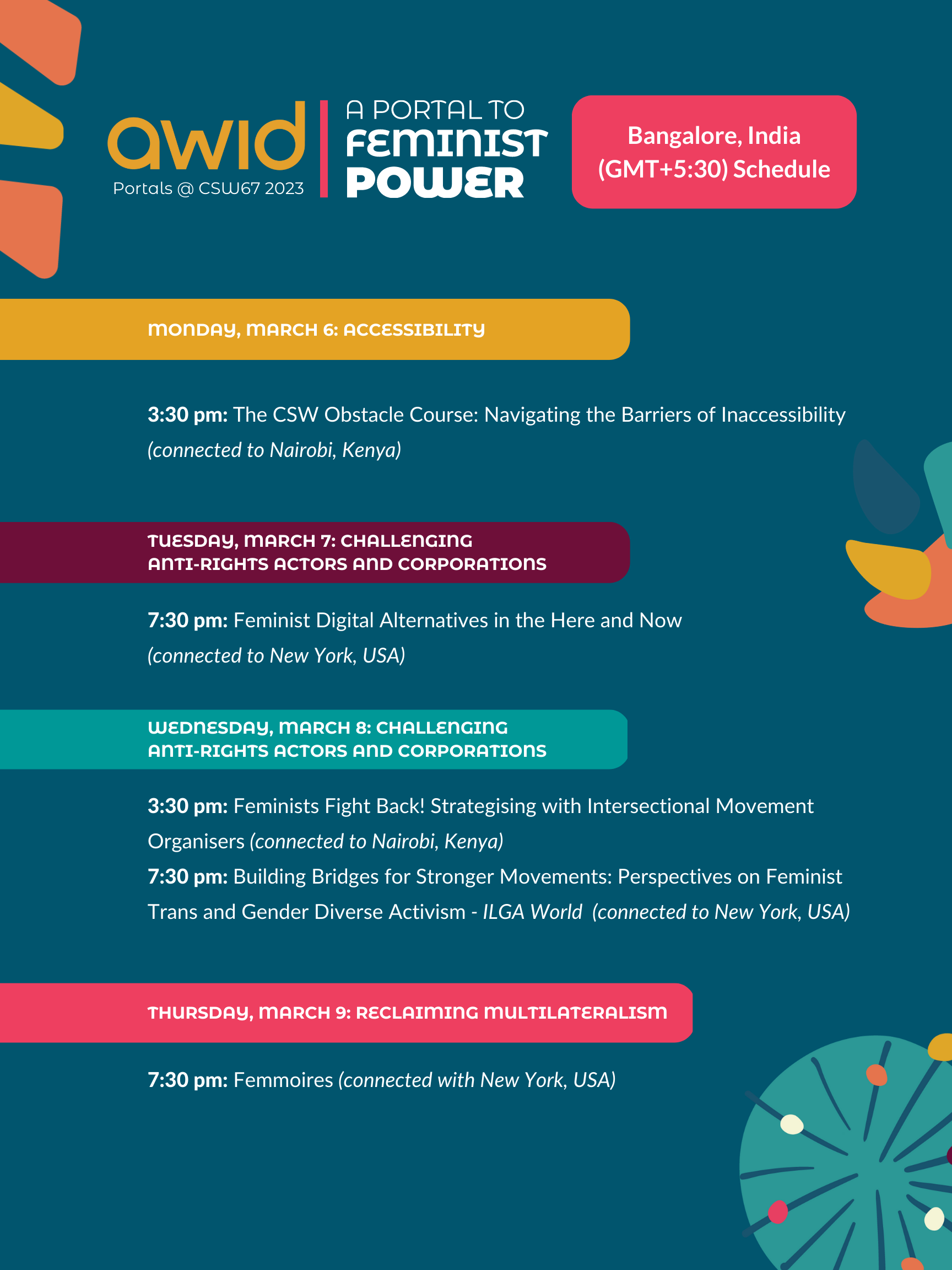
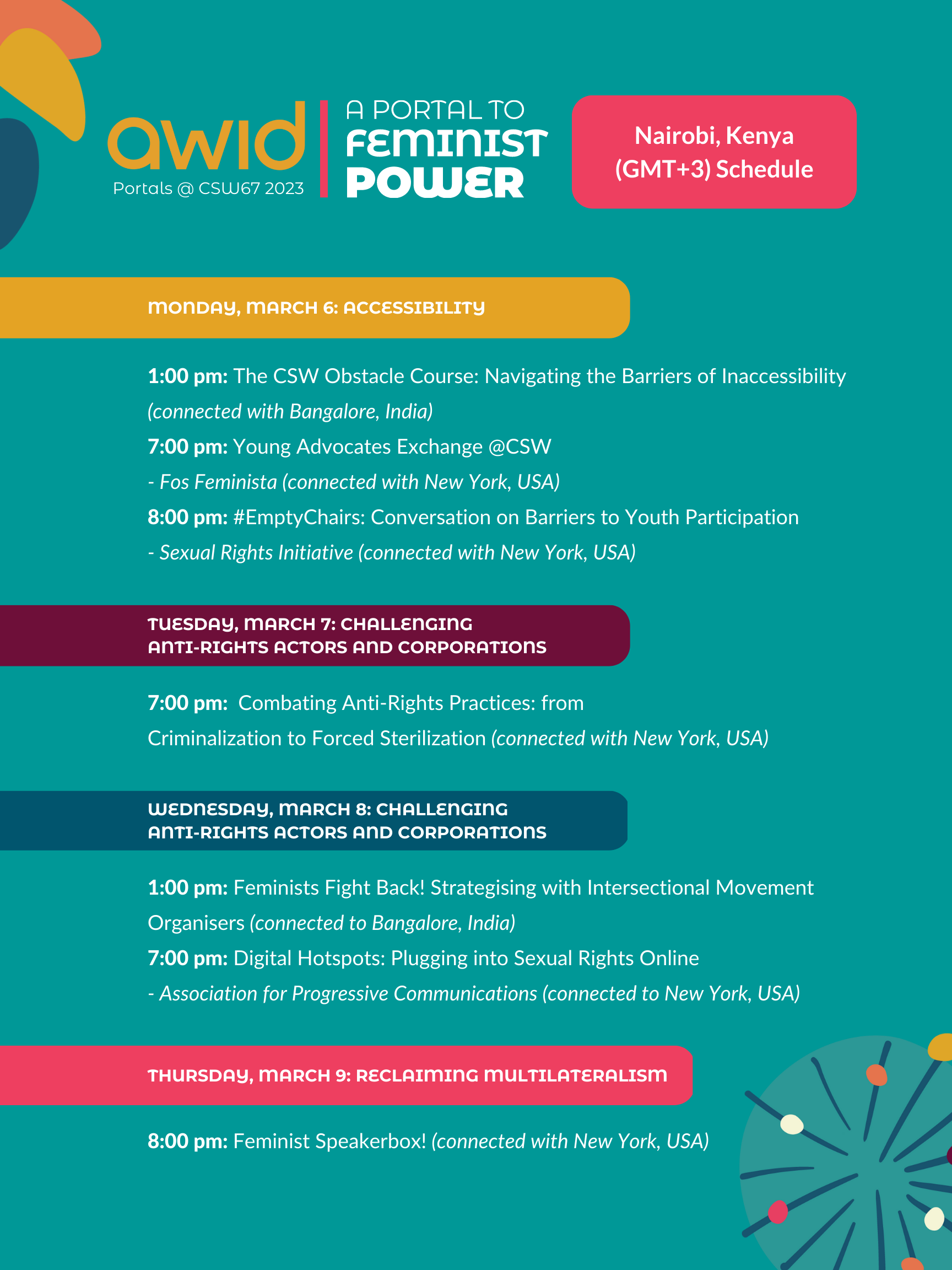
Day 1: March 6 - Accessibility

Day 2: March 7- Challenging Anti-Rights Actors And Corporations

Day 3: March 8 - Challenging Anti-Rights Actors And Corporations

Day 4: March 9- Reclaiming Multilateralism


Find the program for this week's activities here: 

Download full program here (PDF)

Bangalore Schedule (PNG)  Nairobi Schedule (PNG) New York City Schedule (PNG)

Snippet - COP30 - Resistance Hubs Section Title - ES

Nodos de resistencia por la justicia climática

CFA 2023 - Hybrid like never before: in person - FR

Hybride comme jamais auparavant

Pour la première fois, le Forum de l'AWID propose trois modes de participation :

En personne

Les participant.e.s se réuniront à Bangkok, en Thaïlande. Nous sommes impatient.e.s de vous y retrouver!

Crear | Résister | Transform: A Walkthrough of the Festival! - smaller snippet

Ghiwa-Sayegh-visite guidee du festiva

Crear | Résister | Transform : 
visite guidée du Festival

Alors que le capitalisme hétéropatriarcal s’acharne à nous contraindre au consumérisme et à la conformité, nous constatons que nos luttes sont cloisonnées et séparées par des frontières aussi bien physiques que virtuelles.

Lire plus

Una estrategia, un mercado y nuevas voces: Las mujeres indígenas y los Foros AWID

Portada para Una estrategia, un mercado y nuevas voces: Las mujeres indígenas y los Foros AWID Historias


Esta historia es sobre la manera en que un grupo cada vez más diverso de feministas del Pacífico se organizaron a lo largo de los años para asistir a los Foros de AWID, y el modo en que ese proceso lxs transformó en forma personal, como organizaciones y como movimiento a través de lo que aprendieron, descubrieron y experimentaron. Ilustra la importancia de los Foros como espacio que permitió que una región que tiende a ser marginada o ignorada a nivel global pueda construir una presencia sólida en el movimiento feminista, que luego es replicada en otros espacios internacionales de derechos de las mujeres.

Descarga esta historia


En sus propias voces: mira la entrevista con María Manuela Sequeira & Mónica Alemán


Conoce todas las historias Descarga el reporte completo