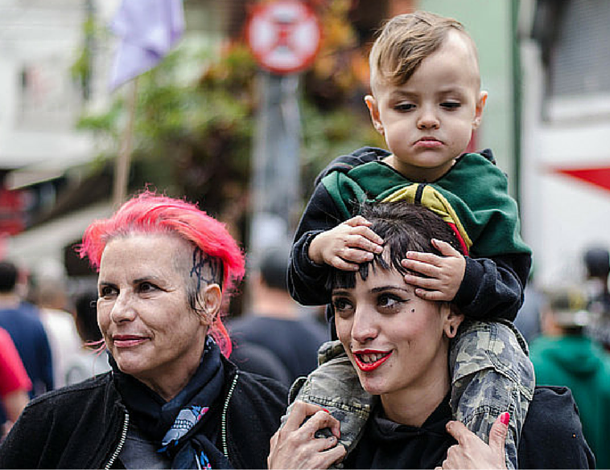
Over the past few years, a troubling new trend at the international human rights level is being observed, where discourses on ‘protecting the family’ are being employed to defend violations committed against family members, to bolster and justify impunity, and to restrict equal rights within and to family life.
The campaign to "Protect the Family" is driven by ultra-conservative efforts to impose "traditional" and patriarchal interpretations of the family, and to move rights out of the hands of family members and into the institution of ‘the family’.
“Protection of the Family” efforts stem from:
rising traditionalism,
rising cultural, social and religious conservatism and
sentiment hostile to women’s human rights, sexual rights, child rights and the rights of persons with non-normative gender identities and sexual orientations.
Since 2014, a group of states have been operating as a bloc in human rights spaces under the name “Group of Friends of the Family”, and resolutions on “Protection of the Family” have been successfully passed every year since 2014.
This agenda has spread beyond the Human Rights Council. We have seen regressive language on “the family” being introduced at the Commission on the Status of Women, and attempts made to introduce it in negotiations on the Sustainable Development Goals.
Our Approach
AWID works with partners and allies to jointly resist “Protection of the Family” and other regressive agendas, and to uphold the universality of human rights.
In response to the increased influence of regressive actors in human rights spaces, AWID joined allies to form the Observatory on the Universality of Rights (OURs). OURs is a collaborative project that monitors, analyzes, and shares information on anti-rights initiatives like “Protection of the Family”.
Rights at Risk, the first OURs report, charts a map of the actors making up the global anti-rights lobby, identifies their key discourses and strategies, and the effect they are having on our human rights.
The report outlines “Protection of the Family” as an agenda that has fostered collaboration across a broad range of regressive actors at the UN. It describes it as: “a strategic framework that houses “multiple patriarchal and anti-rights positions, where the framework, in turn, aims to justify and institutionalize these positions.”
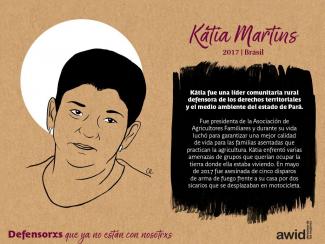
La información compilada para nuestro Tributo indica queMéxico es un país particularmente peligroso para las defensoras. De las 12 defensoras de derechos humanos mexicanas que conmemoramos en el Tributo de este año, 11 fueron asesinadas. Eran periodistas, activistas por los derechos de las mujeres, activistas de los derechos trans* y sociales. Únete a nosotras para recordar y honrar a estas defensoras de derechos humanos, su trabajo y su legado, compartiendo los memes aquí incluidos con tus colegas, amistades y redes; y tuiteando las etiquetas #WHRDTribute y #16Días.
Por favor, haz click en cada imagen de abajo para ver una versión más grande y para descargar como un archivo.
Do I have to respond to all questions at once or can I come back to complete it later?
If you wish to save your responses and come back to the survey later, you are able to do this whenever needed. KOBO will save your draft responses on the top left corner of the survey page and reload your record when you return to the survey. Just make sure to continue from the same computer and browser.
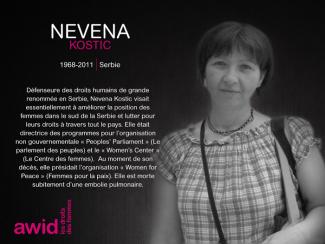
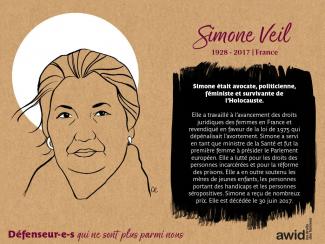
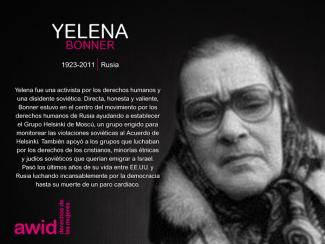
Cette année, dans le cadre de notre hommage en ligne aux défenseuses des droits humains qui ne sont plus parmi nous, nous célébrons la mémoire de quatre femmes originaires d’Afrique subsaharienne. Trois d’entre elles ont été assassinées en raison de leur travail et/ou à cause de leur identité de genre ou de leur orientation sexuelle. Leur mort souligne la violence à laquelle les personnes LGBT* sont confronté-e-s dans cette région et dans le monde entier. Nous vous invitons à vous joindre à nous pour commémorer la vie de ces femmes, leur activisme et l’héritage qu’elles nous ont laissé. Faites circuler ces mèmes après de vos collègues et amis ainsi que dans vos réseaux et twittez en utilisant les hashtags #WHRDTribute et #16Jours.
S'il vous plaît cliquez sur chaque image ci-dessous pour voir une version plus grande et pour télécharger comme un fichier
He respondido la encuesta, pero cambié de opinión y deseo que se retire nuestra respuesta, ¿qué hago?
Si por algún motivo deseas que retiremos y borremos tus respuestas, tienes todo el derecho a hacerlo. Puedes contactarnos a través del formulario disponible aquí indicando «Encuesta WITM (¿Dónde está el dinero?) » en el título del mensaje, y procederemos a retirar y borrar tu respuesta.
Nuestras/os afiliadas/os tanto individuales como institucionales provienen de todas las regiones del mundo y de 163 países; las/os más recientes se nos han unido desde Zimbabue, Turquía y los Estados Unidos. ¡Todas/os nuestras/os afiliadas/os aportan una rica y diversa gama de perspectivas, experiencias, conocimiento, energía e inspiración!
¿Sabías que cada semana publicamos perfiles de afiliadas/os?
Uno de los beneficios de ser afiliada/o de AWID es que tu historia sea destacada en nuestro boletín informativo, el cual llega a 35,000 suscriptoras/es, y a través de nuestros canales en las redes sociales que tienen más de 60,000 seguidores.
Publicaciones recientes:
Conoce a Angila Ashitua, una joven afiliada a AWID que vive en el condado de Vihiga, Kenia Occidental.
Aprendiendo más acerca del trabajo que hace AWID y de temas relativos a los derechos de las mujeres y la justicia social por medio de nuestras publicaciones y recursos, incluyendo el último video "Cambiando sistemas, cambiando vidas". [disponible solo en inglés]
Participando en nuestras sesiones de aprendizaje electrónico. ¡Mira lo más destacado de nuestro seminario en línea sobre justicia fiscal! [disponible solo en inglés]
¡Y mucho más!
Puedes renovar tu membresía por uno, dos o tres años; también ofrecemos membresías individuales e institucionales gratis a quienes tengan bajos ingresos o presupuestos.
Si tienes alguna dificultad y necesitas apoyo con el proceso de inscripción, por favor no dudes en comunicarte conmigo a través de membership@awid.org
Testemonios de nuestras/os afiliadas/os
"AWID nos ha resultado una red muy interesante y estamos participando en muchas de sus plataformas". - Engabu Za Tooro (afiliada/o institucional AWID)
"Espero una colaboración fructífera con el equipo. Me siento excelente. Gracias por aceptarme como afiliada". - R. Chakraborty (afiliada individual AWID)
"Muchas gracias, AWID, pues el trabajo que hacen es formidable. Aprecio realmente sus esfuerzos". - E. Khan (afiliada individual AWID)
Snippet FEA Get Involved Story 2 (FR)
ENGAGEZ-VOUS!
Vous pouvez suivre Nous Sommes la Solution
sur Facebook et soutenir leur travail en faisant un don ici.
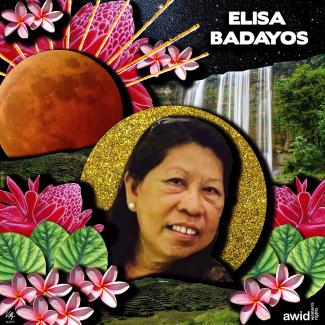
Elisa was the coordinator for the human rights organization Karapatan in Negros Oriental Province in the Philippines.
She also served as an organiser of urban poor communities in Cebu Province, and worked with Desaparecidos, an organization of families of the disappeared.
Elisa and two of her colleagues were killed on November 28, 2017 by two unidentified men at Barangay San Ramon, Bayawan city in the Negros Oriental province during a mission to investigate alleged land rights abuses in the area.