
Left
Half
Left

Special Focus

AWID is an international, feminist, membership organisation committed to achieving gender equality, sustainable development and women’s human rights

Memory as Resistance: A Tribute to WHRDs no longer with us

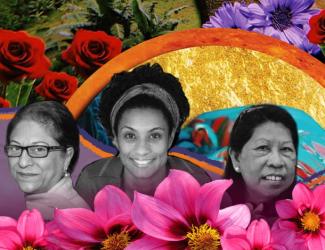
AWID’s Tribute is an art exhibition honouring feminists, women’s rights and social justice activists from around the world who are no longer with us. 


In 2020, we are taking a turn

This year’s tribute tells stories and shares narratives about those who co-created feminist realities, have offered visions of alternatives to systems and actors that oppress us, and have proposed new ways of organising, mobilising, fighting, working, living, and learning.

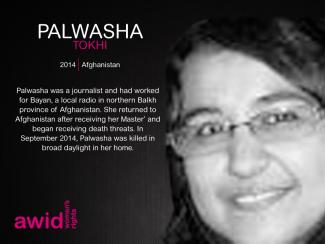
49 new portraits of feminists and Women Human Rights Defenders (WHRDs) are added to the gallery. While many of those we honour have passed away due to old age or illness, too many have been killed as a result of their work and who they are.

This increasing violence (by states, corporations, organized crime, unknown gunmen...) is not only aimed at individual activists but at our joint work and feminist realities.

The stories of activists we honour keep their legacy alive and carry their inspiration forward into our movements’ future work.

Visit the online exhibit

The portraits of the 2020 edition are designed by award winning illustrator and animator, Louisa Bertman

AWID would like to thank the families and organizations who shared their personal stories and contributed to this memorial. We join them in continuing the remarkable work of these activists and WHRDs and forging efforts to ensure justice is achieved in cases that remain in impunity.

“They tried to bury us. They didn’t know we were seeds.” - Mexican Proverb 


The Tribute was first launched in 2012

It took shape with a physical exhibit of portraits and biographies of feminists and activists who passed away at AWID’s 12th International Forum, in Turkey. It now lives as an online gallery, updated every year.

To date, 467 feminists and WHRDs are featured.

Visit the online exhibit

Related Content

Main image
new-witm-banner.png
Body

Colectivo Morivivi

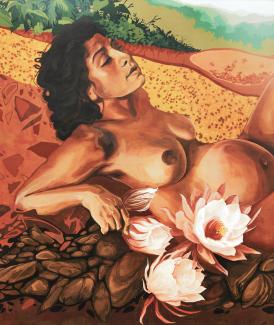
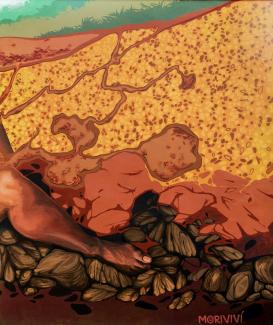
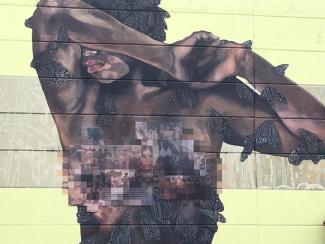
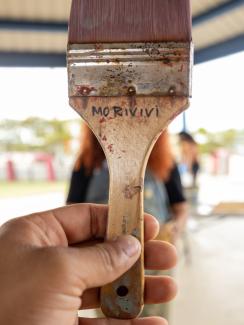
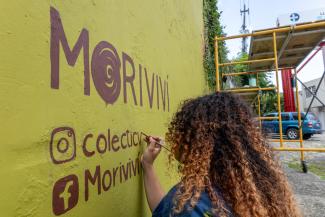
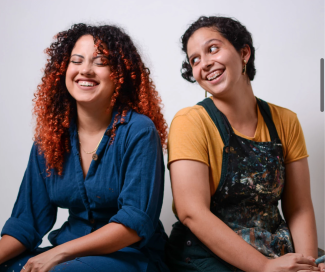
Colectivo Moriviví is an all women artistic collective. Our artistic production consists of muralism, community-led muralism, and protest performance/actions. Our work is about democratizing art and bringing the narratives of Puerto Rican communities to the public sphere to create spaces in which they are validated. We believe that through artivism we can promote consciousness on social issues and strengthen our collective memory.  

“Cacibajagua” 2017, Mural Project. Jiangxi, China
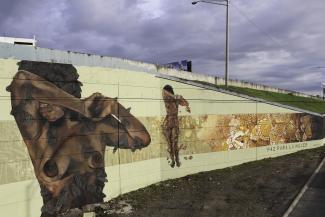
“Paz para la Mujer” 2015, collaboration with Coordinadora Paz para la Mujer Organization. Santurce,
“Paz para la Mujer” 2015, collaboration with Coordinadora Paz para la Mujer Organization. Santurce, Puerto Rico


“Paz para la Mujer” 2015, collaboration with Coordinadora Paz para la Mujer Organization. Santurce, Puerto Rico
“Paz para la Mujer” 2015, collaboration with Coordinadora Paz para la Mujer Organization. Santurce, Puerto Rico
Collectivo Moriri Artwork


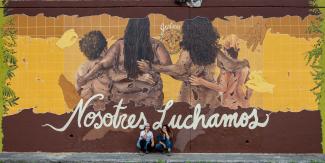
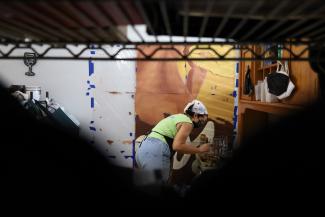
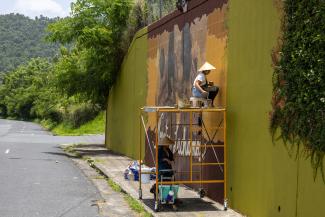
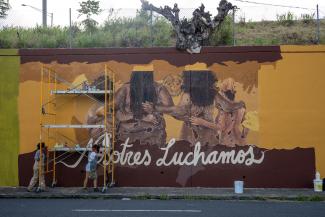
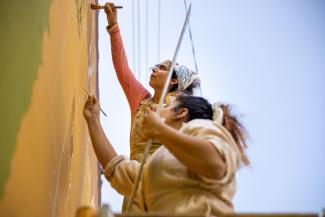
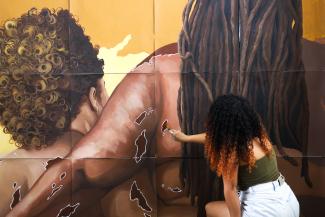
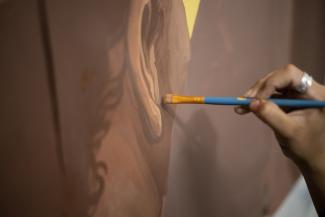
As part of their participation in AWID’s Artist Working Group, Colectivo Morivivi gathered a diverse group of members, partners and staff to facilitate a collaborative process of dreaming into, informing, and deciding on the content for a community mural through a multi-stage co-creation process. The project began with a remote conceptualization with feminists from different parts of the planet brought together by AWID, and then it evolved to its re-contextualization and realization in Puerto Rico. We were honored to have the input of local artists Las Nietas de Nonó(@lasnietasdenono), the participation of local women in the Community Painting Session, the logistics support from the Municipality of Caguas, and FRIDA Young Feminist Fund’s additional support to the collective.
 
The mural explores the transcendence of borders by presenting bodies like a map, in an embrace that highlights the intersection of the different feminist manifestations, practices and realities. 
 
We also thank Kelvin Rodríguez, who documented and captured the different stages of this project in Puerto Rico:

Collectivo Moriri Artwork

About Colectivo Morivivi 

Colectivo Morivivi portrait

Moriviví is a collective of young female artists, working on public art since April 2013. Based in Puerto Rico, we’ve gained recognition for the creation of murals and community led arts.

The group started out in local Urban Art Festivals. As our work became more popular, organizations and community leadership started to reach out to us. We began as eight high schoolers who wanted to paint a mural together. However, in eight years of hard work, we’ve faced many challenges.  Now we are in a period of transition. During this following year, we aim to restructure the collective internally. Our goal is to open new opportunities for collaborators and back-up our decision making process with a new evaluation system.  In the long run, we aspire to become an alternative school of art practice for those interested in immersing themselves in community art production.

Fahmida Riaz

« Après
Après l’amour la première fois,
Nos corps et nos esprits nus
Une galerie des glaces,
Complètement désarmés, absolument fragiles,
Nous nous couchons dans les bras de l’autre
Respirant attentivement,
Avec la crainte de briser
Ces figurines en cristal. » - Fahmida Riaz

Fahmida Riaz a brisé les tabous sociaux en écrivant sur le désir des femmes dans ses poèmes, créant des récits alternatifs à propos du corps des femmes et de leur sexualité, et établissant de nouveaux standards dans la littérature urdu.

Son travail s’est confronté à de sévères critiques de la part des conservateurs, qui l’ont accusée d’utiliser des expressions érotiques et « pornographiques » dans son langage poétique.  

Fahmida a finalement été mise sur liste noire et accusée de sédition en vertu de l’article 124A du Code pénal pakistanais sous la dictature de Zia-ul-Haq. Forcée à l’exil en 1981, elle a passé presque sept ans en Inde avant de retourner au Pakistan. 

Dans la préface de « Badan Dareeda » (Un corps ravagé), un recueil de poèmes publié en 1974, elle écrit :

Si, en effet, je suis forcée à me tenir aujourd’hui devant ce maqtal et me confronte à la potence, je dois y faire face, la tête haute. Mes poèmes sont la trace d’une tête mutilée : des sons émanant même lorsque suspendue par des cordes… Un corps ravagé a pris la forme de razmia, ou  d’un son de rupture. Et si cette rupture est effectivement choquante pour les gens, c’est que la poète a atteint son intention : elle a réussi à la perturber. (traduction de l’urdu vers l’anglais par Asad Alvi) 

La splendeur de Fahmida résidait dans sa défiance de toute logique ou toute catégorie particulière de genre, nation, religion ou culture. Elle refusait d’être mise dans le rôle d’une « femme poète », brisant les définitions traditionnelles de la poésie féminine, des concepts et des thématiques (variant entre conscience politique, corps, culture, désir, religion, foyer), et renversant les inhibitions assignées à son genre.   

« Il faut que vous compreniez que la culture ne peut avoir d’essence. Les cultures changent, circulent entre elles, formant de nouvelles cultures. La culture est née de cette façon. Il n’y a pas de conflits de cultures. »

Fahmida a écrit plus de 15 livres de poésie et de fiction, dont son poème ‘Taaziyati Qaraardaaden’ («Résolutions de condoléances» en anglais) qui pourrait servir d'hommage approprié à sa vie et à son héritage et de collection de poèmes (Apna Jurm To Saabit He «Mon crime est prouvé») publié en 1988 durant son exil.

Fahmida Riaz est née à Meerut, en Inde, le 28 juillet 1946 et est décédée le 21 novembre 2018 à Lahore, au Pakistan. 
Snippet FEA Otras Union meetings and demonstrations (ES)

Reuniones y protestas del Sindicato OTRAS

Our values - esponsibility, Accountability, and Integrity

Responsabilidad, rendición de cuentas e integridad

Nos esforzamos por ser transparentes, por utilizar nuestros recursos en forma responsable, por ser equitativxs en nuestras colaboraciones, y por ser responsables e íntegrxs con nuestrxs afiliadxs, contrapartes y donantes, y con los movimientos con los que trabajamos y en los que participamos. Estamos comprometidxs a reflejar nuestras experiencias, a compartir abiertamente nuestrxs aprendizajes, y a esforzarnos por cambiar nuestras prácticas en consecuencia.

حالة التمويل للحركات النسوية ووقائعها تتغير بسرعة. هل هذا الاستطلاع لمرة واحدة؟

كلا. يبني هذا الاستطلاع على المعلومات التي حشدتها جمعية حقوق المرأة في التنمية حول كيفية الحصول على تمويل أكبر وأفضل للحركات النسوية وحركات التغيير الاجتماعي وهذه الدورة الثالثة لاستطلاع "أين التمويل للتنظيمات النسوية". نهدف للقيام بالاستطلاع مرة كل ثلاثة أعوام.

Body

Tácticas, estrategias e impactos anti-derechos

Capítulo 5

Los actores anti-derechos adoptan una estrategia doble. Además de atacar abiertamente al sistema multilateral, los actores anti-derechos también socavan los derechos humanos desde adentro. Se involucran con el fin de cooptar procesos, consolidar normativas regresivas, y erosionar responsabilidades.

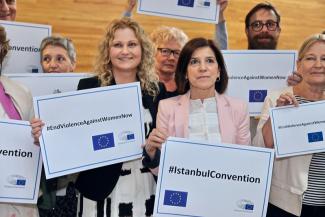
Photo-OP // the first anniversary of the EU signature to the Council of Europe Convention to prevent and combat gender-based violence and domestic violence, the so-called Istanbul Convention
© ALDE Group/Flickr
Photo-OP // El primer aniversario de la firma de la UE del Convenio del Consejo de Europa para prevenir y combatir la violencia de género y la violencia doméstica, el llamado Convenio de Estambul

El involucramiento de los actores anti-derechos en espacios internacionales de derechos humanos tiene un objetivo principal: socavar el sistema y su capacidad de respetar, proteger y satisfacer los derechos humanos para todas las personas, y de exigir rendición de cuentas a los Estados miembro por su violación. Algunas tácticas anti-derechos operan por fuera de la ONU, e incluyen la deslegitimación y la presión política para desfinanciar a la ONU, o para que ciertos Estados miembro se retiren de acuerdos internacionales sobre derechos humanos. En los últimos años, algunos actores antiderechos han logrado una creciente influencia dentro de la ONU. Sus tácticas internas incluyen la capacitación de representantes, la distorsión de los marcos de derechos humanos, el debilitamiento de acuerdos sobre derechos humanos, la infiltración en comités de organizaciones no gubernamentales, las solicitudes de ingreso al Consejo Económico y Social bajo nombres neutrales, la infiltración en los espacios de la juventud, y las presiones para ubicar a actores antiderechos en posiciones clave.

Índice de contenidos

  • Institucionalización de actores anti-derechos en los mecanismos de la ONU
  • Exclusión y deslegitimación
  • Disminución de los estándares de derechos humanos
  • Cooptación - Construcción de un marco paralelo de derechos humanos
  • Ejercicio: Sí, ellos son fuertes, ¡pero también nosotrxs somos fuertes!
  • Ejercicio: Responsabilizar a los gobiernos

Leer el capítulo completo

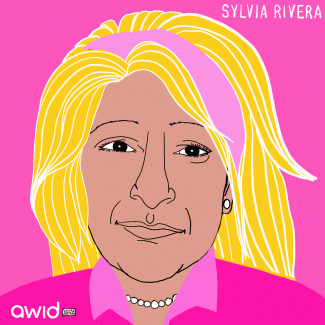
Sylvia Rivera

Sylvia Rivera was a civil rights activist, a transvestite and sex worker.

Known as the New York Drag queen of color, Silvia was fierce and tireless in her advocacy, in defense of those who  were marginalized and excluded as the “gay rights” movement mainstreamed in the United States in the early 1970’s.

In a well-known speech on Christopher Street Day in 1973, Sylvia, shouted through a crowd of LGBT community members: 

“You all tell me, go and hide my tail between my legs.
I will no longer put up with this shit.
I have been beaten.
I have had my nose broken.
I have been thrown in jail.
I have lost my job.
I have lost my apartment.
For gay liberation, and you all treat me this way?
What the fuck’s wrong with you all?
Think about that!” 

In 1969, at age 17, Silvia took part in the iconic Stonewall Riots by allegedly throwing the second Molotov cocktail to protest the police raid of the gay bar in Manhattan. She continued to be a central figure in the uprisings that followed, organizing rallies and fighting back police brutality.

In 1970, Sylvia worked together with Marsha P. Johnson to establish Street Transvestite Action Revolutionaries (S.T.A.R.), a political collective and organisation that would set up projects of mutual support for trans people living on the streets, those struggling with drug addiction and in prisons and in particular for trans people of color and those living in poverty. 

Defiant of labels, Silvia lived life in a way that challenged people in the gay liberation movement to think differently. She said: 

“I left home at age 10 in 1961. I hustled on 42nd Street. The early 60s was not a good time for drag queens, effeminate boys or boys that wore makeup like we did. Back then we were beat up by the police, by everybody. I didn't really come out as a drag queen until the late 60s. when drag queens were arrested, what degradation there was. I remember the first time I got arrested, I wasn't even in full drag. I was walking down the street and the cops just snatched me. People now want to call me a lesbian because I'm with Julia, and I say, "No. I'm just me. I'm not a lesbian." I'm tired of being labeled. I don't even like the label transgender. I'm tired of living with labels. I just want to be who I am. I am Sylvia Rivera. 

Through her activism and courage, Sylvia offered a mirror that reflected all that was wrong within society, but also the possibility of transformation. Sylvia was born in 1951 and passed away in 2002. 

Snippet FEA Union Otras Photo 5 (FR)

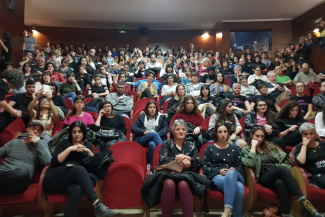
Photo de personnes assises sur des chaises rouges dans une salle de conférence

14th AWID international Forum is cancelled (forum page)

Le Forum international de l’AWID est annulé

Étant donnée la situation mondiale, notre Conseil d’administration a pris la décision difficile d’annuler le Forum, qui devait avoir lieu en 2021 à Taipei. 

Lire le communiqué