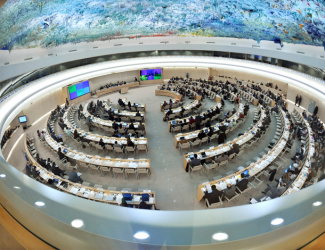
The Human Rights Council (HRC) is the key intergovernmental body within the United Nations system responsible for the promotion and protection of all human rights around the globe. It holds three regular sessions a year: in March, June and September. The Office of the UN High Commissioner for Human Rights (OHCHR) is the secretariat for the HRC.
The HRC works by:
Debating and passing resolutions on global human rights issues and human rights situations in particular countries
Examining complaints from victims of human rights violations or activist organizations on behalf of victims of human rights violations
Appointing independent experts (known as “Special Procedures”) to review human rights violations in specific countries and examine and further global human rights issues
Engaging in discussions with experts and governments on human rights issues
Assessing the human rights records of all UN Member States every four and a half years through the Universal Periodic Review
AWID works with feminist, progressive and human rights partners to share key knowledge, convene civil society dialogues and events, and influence negotiations and outcomes of the session.
With our partners, our work will:
◾️ Monitor, track and analyze anti-rights actors, discourses and strategies and their impact on resolutions
Notre rapport annuel 2013 retrace les temps forts du travail que nous avons réalisé au cours de l'année, afin de contribuer à l'avancement des droits des femmes et de l'égalité des genres à travers le monde.
Nous présentons ici certains points saillants de notre analyse du contexte mondial, la position que nous adoptons en tant qu’organisation associative féministe mondiale dans ce contexte, les résultats que nous souhaitons atteindre et l’organisation de notre travail dans le but d’atteindre ces résultats.
Mientras estés en São Paulo, Brasil, puedes visitar la Ocupação 9 de Julho y pedir una comida colaborativa. También puedes comprar sus productos en su tienda online desde el extranjero.
Visita la tienda en línea de la Asociación de Mujeres Afrodescendientes del Norte del Cauca (ASOM) donde puedes encontrar hermosos productos hechos a mano.
Hay varias formas de apoyar a Metzineres: puedes hacer una donación económica, donar materiales y servicios, o proponer una formación, un taller o una actividad (para más información, ¡ver aquí!)
Snippet - WITM To make - ES
Para darle visibilidad a la complejidad de la dotación de recursos para las diversas formas de organización feministas.
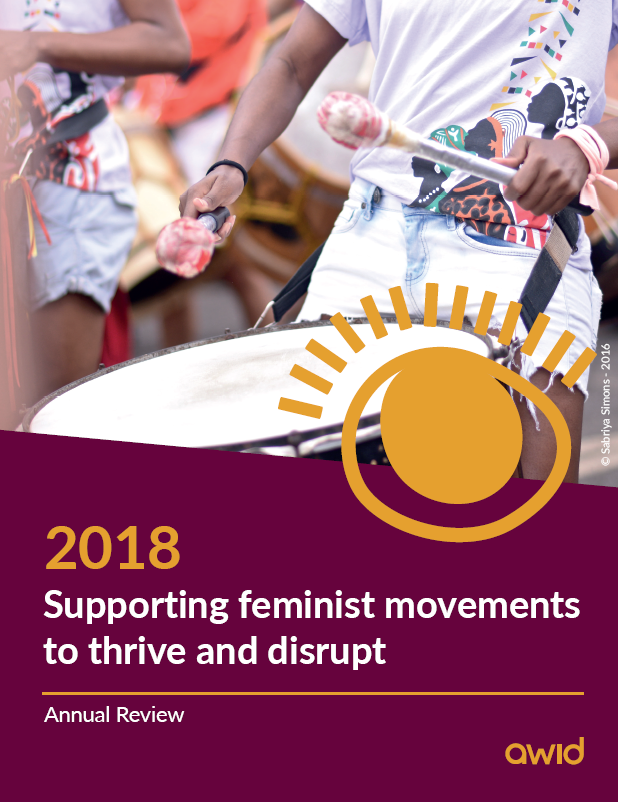
This report looks back and celebrates the first year of AWID’s new strategic plan as we took our first steps towards our desired outcomes of supporting feminist movements to thrive, challenging anti-rights agendas and co-creating feminist realities.
We worked with feminists to disrupt anti-rights agendas, achieving important victories fought and won within the United Nations system when ground-breaking language on structural discrimination, sexual rights, and states’ obligations were included in a number of resolutions. Yes, the multilateral system is in crisis and in need of serious strengthening but these victories are important as they contribute to the legitimacy of feminist demands, providing feminist movements with more pressure points and momentum to advance our agendas.
We tried and tested different ways to build knowledge with feminist movements through webinars, podcasts and ‘live’ conversations. We developed facilitation guides with popular educators to reclaim knowledge in the interest of social and gender justice, even about a topic as seemingly opaque as illicit funding flows. We commissioned blogs and opinions about how feminist groups fund and resource themselves and threw light on the threats facing our human rights systems.
Within AWID, we practiced and learned from our shared leadership approach, and told the story of the trials and tribulations of co-leading a global, virtual organization. We don’t have a definitive answer to what feminist leadership looks like, but we know, a year on, that a continued commitment to collective experimentation and learning has enabled us to keep building an organization that we are all excited to contribute to.
As we look back on this year, we want to thank all our friends and supporters, colleagues and companions, who have given their time and shared their wealth of knowledge and wisdom with us. We want to thank our members who helped frame our strategic plan and joined us to make feminist demands. We could not do this work without you.
GLOBAL & DIVERSE: Reflecting on resourcing realities of feminist organizing at a global scale and disaggregated by region
CONTEXTUALIZED: Centering voices, perspectives and lived experiences of feminist movements in all their richness, boldness and diversity in their respective contexts
CO-CREATED: Developed and piloted in close consultations with AWID members and movement partners
COMPLEMENTARY: Contributing to and amplifying existing evidence on the state of resourcing for feminist, women’s rights and gender justice organizing by activists, feminist funders and allies
MULTI-LINGUAL: Accessible in Arabic, English, French, Portuguese, Russian and Spanish.
PRIORITIZING PRIVACY & SECURITY: We are committed to maintaining the confidentiality and integrity of your data. Read our Privacy Policy to learn more about the measures we take to ensure the protection of your information
ACCESSIBLE: Accessible to people with a diverse range of hearing, movement, sight, and cognitive abilities, taking approximately 30 minutes to complete
REPLICABLE: Replicable by movements in their respective contexts; WITM survey tools and datasets will be publicly available to support more feminist research and collective advocacy.
Our strategic plan “Feminist Realities” completed its final year at the end of 2022. For the past five years, this bold framework pushed us to go beyond feminist futures and to recognize the feminist solutions and ways of life that already exist in the here and now. Realities that must be uplifted, celebrated, and popularized. The Feminist Economies We Love multimedia story project and Our:Resource knowledge hub on autonomous ways to resource feminist activism are just two examples of this visionary work, always deeply collective with diverse feminist movements.
With this reflection on the year, we invite you to celebrate with us beautiful closures and promising beginnings. Change and transitions are an inseparable part of life and movements, which we seek to embrace with intention and care.
The AWID International Forum is both a global community event and a space of radical personal transformation. A one-of-a-kind convening, the Forum brings together feminist, women’s rights, gender justice, LBTQI+ and allied movements, in all our diversity and humanity, to connect, heal and thrive.
About the 15th AWID International Forum
Rising Together: Connect, Heal, Thrive
The Forum theme – Rising Together – is an invitation to engage with our whole selves, to connect with each other in focused, caring and brave ways, so that we can feel the heartbeat of global movements and rise together to meet the challenges of these times.
A Hybrid Experience
For the first time, the AWID Forum offered three modes of participation:
In Person
at the Queen Sirikit National Convention Centre in Bangkok, Thailand.
Online
in Virtual Space (Capacity: 3000 participants).
Hubs
Connected in Cross Border Space.
With over 4,000 participants, 15th AWID International Forum in 2024 created a sweeping force to resist oppression towards collective healing and liberation. Keep watching this space for more forum stories and future forums updates!
In December 2020, the AWID board took the difficult decision to cancel the 14th AWID International Forum which had been scheduled to take place from September 20-23, 2021, in the City of Taipei.
2016 - Feminist Futures: Building Collective Power for Rights and Justice (Costa de Sauipe, Brazil)
Participants at the Black Feminisms Forum in Brazil, 2016
Given the complex world that we face today, the 2016 AWID Forum did not focus on a particular “issue”, but rather on creating more effective ways of working together!
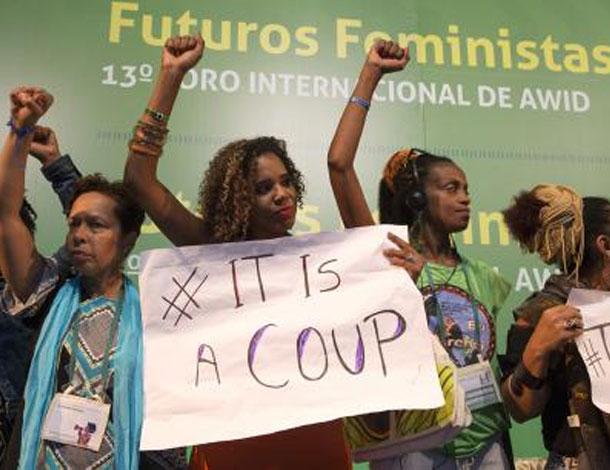
Despite the challenging contexts in which the 2016 Forum took place (the Zika epidemic, a strike by Brazilian foreign-service workers, the impeachment of President Dilma Rousseff and subsequent turmoil), it succeeded in bringing together over 1800 participants from 120 countries and territories across all regions of the world.
What happened at the 13th AWID international Forum:
For 96% of participantswho responded to the post Forum evaluation survey, the Forum was a major source of inspiration and energy.
98% of participants considered it an important convening space for feminist movements and expressed hope that AWID continues to organize forums.
59% of Forum evaluation survey respondents declared to be very satisfied with the Forum and 34% somewhat satisfied.
Over 150 sessions were delivered in different formats on a variety of topics ranging from bodily integrity and freedoms, to gender-based violence in the workplace, to strategies for building collective power.
The first-time Black Feminisms Forum (BFF), held just before the main AWID Forum, brought together 250 Black feminists from all over the world to co-create a powerful space to build and strengthen ongoing, intergenerational, transnational connections
Read more about what the 2016 AWID Forum achieved:
2012 - Transforming Economic Power to Advance Women's Rights and Justice (Istambul, Turkey)
AWID International Forum, in Cape Town, South Africa, 2008
The 12th AWID Forum was the largest and most diverse AWID Forum to date, bringing together 2239 women’s rights activists from 141 countries. Of these participants, around 65% were from the Global South and close to 15% were young women under 30, and 75% attended an AWID Forum for their first time.
The Forum program focused on transforming economic power to advance women’s rights and justice and featured over 170 different kinds of sessions including feminist economics toolbox skills-building sessions, breakout sessions representing all 10 Forum themes, in-depth sessions, and solidarity roundtables.
Building on the momentum of the 2012 Forum, we transformed the website into a resource and learning Hub, which builds on the content generated by participants by featuring multi-media resources on all Forum components.
1999: Leading Solutions for Equality and Justice (US)
1996: Beyond Beijing From Words to Action (US)
1993: Joining Forces to Further Shared Visions (US)
1991: Working Together/Learning Together: A South North Dialogue (US)
1989/1990: Global Em-Powerment for Women (US)
1987: Moving Forward: Innovations in Development Policy, Action and Research (US)
1985: Women Creating Wealth; Transforming Economic Development (US)
1983: ‘Women in Development’ (Washington D.C, US)
What is the AWID International Forum?
Every three to four years, AWID hosts its flagship international event. It is the world’s largest event that wholeheartedly centers feminist and gender justice movements in all their diversity. It is a global gathering of feminist activists, allied movements, scholars, funders and policymakers. The Forums rotate between different regions and countries in the global South.
Snippet FEA Ecofeminism (FR)
Afrique de l’Ouest
NOUS SOMMES LA SOLUTION
ÉCOFÉMINISME :
Le Respect de Tout ce que Nous Avons Autour de Nous
Snippet - WITM Acknowledgements - EN
Acknowledgements
AWID gratefully acknowledges the many people whose ideas, analysis and contributions have shaped the “Where is the Money for Feminist Organizing?” research and advocacy over the years.
First and foremost, our deepest thanks goes to the AWID members and activists who engaged in WITM consultations and piloted this survey with us, sharing so generously of their time, analysis and hearts.
Ritu est une technologue féministe qui apporte son expérience au secteur non lucratif, animée par une passion pour l'utilisation d'approches innovantes pour trouver des solutions technologiques féministes. Titulaire d'un master en technologie des applications informatiques de l'Institut indien de technologie, son rôle au sein de l'AWID couvre un large spectre de responsabilités. De la supervision de la sécurité numérique et gestion des serveurs à l'administration des bases de données, en passant par le renforcement des capacités, l'évaluation technologique, la mise en œuvre de logiciels et de solutions cloud, Ritu veille à ce que l'infrastructure informatique de l'AWID soit résiliente et efficace. Avant de rejoindre l'AWID, elle a joué un rôle central dans l'avancement des initiatives technologiques des secteurs de la promotion de la santé et de l'environnement, alimentée par son engagement à tirer parti de la technologie pour le bien social.