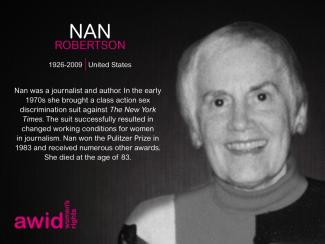
Nan Robertson
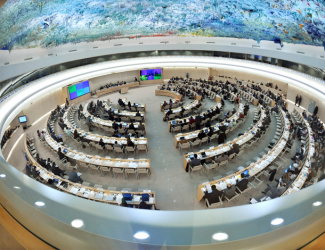
The Human Rights Council (HRC) is the key intergovernmental body within the United Nations system responsible for the promotion and protection of all human rights around the globe. It holds three regular sessions a year: in March, June and September. The Office of the UN High Commissioner for Human Rights (OHCHR) is the secretariat for the HRC.
Debating and passing resolutions on global human rights issues and human rights situations in particular countries
Examining complaints from victims of human rights violations or activist organizations on behalf of victims of human rights violations
Appointing independent experts (known as “Special Procedures”) to review human rights violations in specific countries and examine and further global human rights issues
Engaging in discussions with experts and governments on human rights issues
Assessing the human rights records of all UN Member States every four and a half years through the Universal Periodic Review
AWID works with feminist, progressive and human rights partners to share key knowledge, convene civil society dialogues and events, and influence negotiations and outcomes of the session.
Para preguntas adicionales, por favor escríbenos utilizando nuestro formulario de contacto. Selecciona «14o Foro de AWID» como asunto de mensaje.
Née à Bahia, dans le nord-est du Brésil, Carmen est une immigrante, militante sociale et mère de 8 enfants.
Carmen a connu l'itinérance à l'âge de 35 ans, après avoir émigré seule à São Paulo. Cela l'a amenée à devenir une ardente défenseuse des communautés vulnérables, marginalisées et invisibles les plus touchées par la crise du logement. Elle est finalement devenue l'une des fondatrices de MSTC en 2000.
En tant qu'organisatrice politique visionnaire et actuelle dirigeante du MSTC, le travail de Carmen a révélé la crise du logement de la ville de São Paulo et inspiré d'autres personnes sur différentes façons d'organiser et de gérer les occupations.
Carmen a été fermement à l'avant-garde de diverses occupations. L'une d'elles est l’Ocupação 9 de Julho, qui sert désormais de scène à la démocratie directe et d'espace où chacun·e peut être soigné·e, entendu·e, apprécié·e et travailler ensemble.
Carmen a longtemps été célébrée pour son audace à redonner vie à des bâtiments abandonnés au cœur de São Paulo.
Pour en savoir plus sur sa vie, vous pouvez la suivre sur Instagram!
(avec des invités spéciaux!)
📅Mardi 12 mars
🕒18 h - 21 h 30 HNE
🏢 Blue Gallery, 222 E 46th St, New York
Entrée par RSVP uniquement


In 2002 AWID celebrated its 20th anniversary. Given the challenging political, economic and funding environment in which women's organizations must survive, a milestone such as this is worthy of recognition.
In the past two decades the geo-political landscape has been transformed and development theories have come and gone, but approaches to ensure women benefit from development processes have endured.
In its twenty-year history, AWID grew from a volunteer organization for U.S. "Women in Development" (WID) specialists to an international network striving to support proactive and strategic gender equality research, activism and policy dialogue.
On the occasion of its 20th anniversary, this paper charts not only the changes in AWID's organizational structure and goals but also the shifts in policy approaches to gender equality in a changing global environment, through the lens of a membership organization committed to improving the lives of women and girls everywhere.
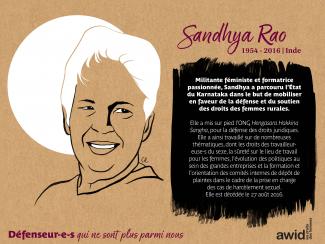
Consideramos a Taipéi como el mejor lugar de la región Asia-Pacífico para construir ese espacio seguro y rebelde destinado a nuestra comunidad feminista global.
Taipéi ofrece un cierto grado de estabilidad y seguridad para la diversidad de participantes que convocamos al Foro. Tiene también capacidad logística, y resulta accesible para muchxs viajerxs (con la facilitación de un trámite de visa electrónico para conferencias internacionales).
El Foro es bien recibido por el movimiento feminista local, que está muy interesado en interactuar con feministas de todo el mundo.
 |
Human and ethnic-territorial rights Ensuring the defense of human rights and Nature’s rights through alliance-building with local, national, regional and global actors and organizations. |
 |
Sustainable development Ensuring all economic, cultural and environmental activities contribute to sustainable development, food security and income generation, while respecting the self-determination and self-government of Afro-descendant communities. |
 |
Education and training Carrying out training for women and empowering them to carry out women’s rights advocacy in different political, social and economic spaces. For more information, see here! |
The WITM survey is focused on the feminist resourcing realities of the last 3 years (2021 to 2023), and has five key sections:
It consists of mandatory* and optional questions, most of which are multiple-choice. You will have a chance to share more on issues that are important to you by responding to the open question(s) at the end of the survey.

To respond to the questions quickly and easily, we advise that you have your key financial information at hand (e.g., your annual budgets from 2021 to 2023). However, if you wish to save your responses and come back to the survey later, you are able to do this whenever needed.
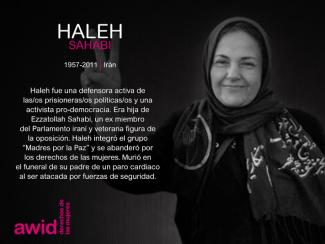
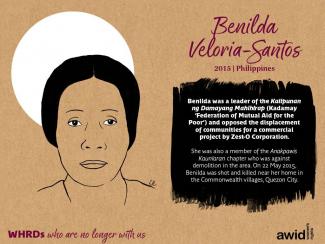
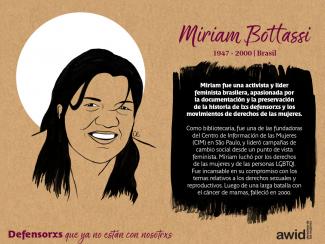
Estas defensoras lucharon por los derechos sobre la tierra, de las mujeres y de los pueblos indígenas; haciendo frente a las industrias extractivas, escribiendo poesía y promoviendo el amor. Una de ellas desapareció hace ya 19 años. Únete a nosotras para recordar y honrar a estas defensoras de derechos humanos, su trabajo y su legado, compartiendo los memes aquí incluidos; y tuiteando las etiquetas #WHRDTribute y #16Días.
Por favor, haz click en cada imagen de abajo para ver una versión más grande y para descargar como un archivo.


Paseando por el barrio del Raval en Barcelona, puede que te encuentres con Metzineres, una cooperativa feminista por y para mujerxs que consumen drogas y que sobreviven múltiples situaciones de vulnerabilidad.
Imagínate un lugar libre de estigma, donde lxs mujerxs puedan consumir drogas de manera segura. Un lugar que brinda seguridad, apoyo y acompañamiento a mujerxs cuyos derechos son sistemáticamente vulnerados por la guerra contra las drogas y que sufren violencia, discriminacion y represión como consecuencia.
Justo afuera de la entrada, lxs transeúntes y visitantes son recibidxs con una enorme pizarra que describe consejos, trucos, deseos y dibujos de personas que usan drogas. También hay un calendario que cuenta con una serie de actividades auto-gestionadas por la comunidad de Metzineres. Ya sean talleres de peluquería y cosmética, radio, teatro, comidas comunales ofrecidas a la comunidad o clases de defensa personal, ¡siempre hay algo que hacer!
La cooperativa proporciona sitios de consumo seguros, así como servicios que cubren las necesidades básicas de las personas. Hay camas, espacios de almacenamiento, duchas, baños, lavadoras y una pequeña terraza al aire libre donde la gente puede relajarse o hacer un poco de jardinería.
Metzineres opera dentro de un marco de reducción de daños, que intenta reducir las consecuencias negativas del uso de drogas. Pero la reducción de daños es mucho más que un conjunto de prácticas: es una política anclada en la justicia social, la dignidad y los derechos de las personas que consumen drogas.

To make the complexity of resourcing diverse forms of feminist organizing visible
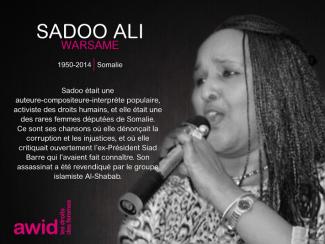
These transgender women were murdered because of their activism and their gender identity. There are insufficient laws recognizing trans* rights, and even where these laws exist, very little is being done to safeguard the rights of trans* people. Please join AWID in honoring these defenders, their activism and legacy by sharing the memes below with your colleagues, networks and friends and by using the hashtags #WHRDTribute and #16Days.
Please click on each image below to see a larger version and download as a file


Les soins comme fondations des économies
La pandémie du COVID-19 a mis en évidence la crise mondiale des soins et démontré les échecs du modèle économique dominant qui continue de détruire les services publics essentiels, les infrastructures sociales et les systèmes de soins dans le monde entier.
Cozinha Ocupaçao 9 Julho, de l’Association des Femmes Afro-Descendantes du Cauca du Nord (ASOM) et Metzineres ne sont que quelques exemples d'économies des soins qui se concentrent sur les besoins des personnes marginalisées et de la Nature, ainsi que sur le travail de soins, le travail reproductif, invisible et non rémunéré nécessaire pour assurer la pérennité de nos vies, de nos sociétés et de nos écosystèmes.