Eden Marcellana
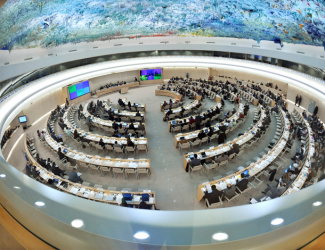
The Human Rights Council (HRC) is the key intergovernmental body within the United Nations system responsible for the promotion and protection of all human rights around the globe. It holds three regular sessions a year: in March, June and September. The Office of the UN High Commissioner for Human Rights (OHCHR) is the secretariat for the HRC.
Debating and passing resolutions on global human rights issues and human rights situations in particular countries
Examining complaints from victims of human rights violations or activist organizations on behalf of victims of human rights violations
Appointing independent experts (known as “Special Procedures”) to review human rights violations in specific countries and examine and further global human rights issues
Engaging in discussions with experts and governments on human rights issues
Assessing the human rights records of all UN Member States every four and a half years through the Universal Periodic Review
AWID works with feminist, progressive and human rights partners to share key knowledge, convene civil society dialogues and events, and influence negotiations and outcomes of the session.
Es un centro comunitario, donde unx puede tomar cursos y capacitarse en actividades creativas que generan ingresos como peluquería local, cocina y creación artística. Lxs niñxs también pueden disfrutar de actividades culturales y educativas.
El MSTC no trabaja solo. Colabora con instituciones y colectivos de arte para producir experiencias culturales, deportivas y educativas, junto con el acceso crítico a la atención médica. Desde su inicio, este proyecto participativo ha sido liderado y llevado a cabo principalmente por mujeres, bajo el liderazgo de la activista afro-brasileña Carmen Silva, quien alguna vez fue una persona sin hogar.
Jour 1
Publication de la version zéro du document final, mars 2015
L'organisation communautaire des femmes noires dans le Cauca du Nord en Colombie remonte au passé colonial du pays, marqué par le racisme, le patriarcat et le capitalisme qui ont soutenu l'esclavage comme moyen d'exploiter les riches sols de la région. Ces organisatrices sont les héroïnes d'un vaste mouvement pour l'autonomie des personnes noires, luttant pour la gestion durable des forêts et des ressources naturelles de la région, vitales pour leur culture et leur subsistance.
Depuis 25 ans, la Asociación de Mujeres Afrodescendientes del Norte del Cauca (l’Association des Femmes Afro-Descendantes du Cauca du Nord, ASOM) se consacre à la promotion de l'organisation des femmes afro-colombiennes du Cauca du Nord.
L’association a été créée en 1997 en réponse aux violations continues des droits humains, à l'absence de politiques publiques, à la gestion inadéquate des ressources naturelles et au manque d'opportunités pour les femmes dans le territoire.
Elles ont forgé la lutte pour garantir les droits ethno-territoriaux, pour mettre fin aux violences contre les femmes et pour faire reconnaître le rôle des femmes dans la construction de la paix en Colombie.
(avec des invités spéciaux!)
📅Mardi 12 mars
🕒18 h - 21 h 30 HNE
🏢 Blue Gallery, 222 E 46th St, New York
Entrée par RSVP uniquement
Development financing has specific threats and opportunities for women's and all people’s human rights. Transformative development financing and policies can make an important contribution to the systemic changes that are needed to ensure the respect, protection and fulfillment of women’s human rights.
2015 is an important year for the FfD process. The Third International Conference on FfD took place from 13-16 July 2015 in Addis Ababa, Ethiopia and governments are finalising the post-2015 development agenda including agreements on how the new Sustainable Development Goals will be financed.
The current stage of the FfD process is an important opportunity to establish a financing framework that will ensure effective financing for the implementation of the post 2015 agenda and the Sustainable Development Goals (SDGs). It is also an opportunity to address the structural conditions, and systemic changes needed, for the full implementation of other agendas and commitments such as Human Rights Conventions, and the Beijing Platform for Action.
Over the last 13 years, women’s rights and feminist organizations have actively engaged in the FfD process.
Metzineres
The WITM survey is focused on the feminist resourcing realities of the last 3 years (2021 to 2023), and has five key sections:
It consists of mandatory* and optional questions, most of which are multiple-choice. You will have a chance to share more on issues that are important to you by responding to the open question(s) at the end of the survey.

To respond to the questions quickly and easily, we advise that you have your key financial information at hand (e.g., your annual budgets from 2021 to 2023). However, if you wish to save your responses and come back to the survey later, you are able to do this whenever needed.
|
383 personas. |

To make the complexity of resourcing diverse forms of feminist organizing visible