Special Focus

AWID is an international, feminist, membership organisation committed to achieving gender equality, sustainable development and women’s human rights

Confronting Extractivism & Corporate Power

Women human rights defenders (WHRDs) worldwide defend their lands, livelihoods and communities from extractive industries and corporate power. They stand against powerful economic and political interests driving land theft, displacement of communities, loss of livelihoods, and environmental degradation.


Why resist extractive industries?

Extractivism is an economic and political model of development that commodifies nature and prioritizes profit over human rights and the environment. Rooted in colonial history, it reinforces social and economic inequalities locally and globally. Often, Black, rural and Indigenous women are the most affected by extractivism, and are largely excluded from decision-making. Defying these patriarchal and neo-colonial forces, women rise in defense of rights, lands, people and nature.

Critical risks and gender-specific violence

WHRDs confronting extractive industries experience a range of risks, threats and violations, including criminalization, stigmatization, violence and intimidation.  Their stories reveal a strong aspect of gendered and sexualized violence. Perpetrators include state and local authorities, corporations, police, military, paramilitary and private security forces, and at times their own communities.

Acting together

AWID and the Women Human Rights Defenders International Coalition (WHRD-IC) are pleased to announce “Women Human Rights Defenders Confronting Extractivism and Corporate Power”; a cross-regional research project documenting the lived experiences of WHRDs from Asia, Africa and Latin America.

We encourage activists, members of social movements, organized civil society, donors and policy makers to read and use these products for advocacy, education and inspiration.

Share your experience and questions!

Tell us how you are using the resources on WHRDs Confronting extractivism and corporate power.

◾️ How can these resources support your activism and advocacy?

◾️ What additional information or knowledge do you need to make the best use of these resources?

Share your feedback


Thank you!

AWID acknowledges with gratitude the invaluable input of every Woman Human Rights Defender who participated in this project. This project was made possible thanks to your willingness to generously and openly share your experiences and learnings. Your courage, creativity and resilience is an inspiration for us all. Thank you!

Related Content

Snippet - Jobs and opportunities intro

If you’re looking to have an impact through your work in feminist, social justice and other non-profit organizations, we hope this page provides a start.

Here you will find open vacancies and call for applications from AWID and the Alliance for Feminist Movements, when available. Follow us on social media to be in the loop.

Instagram LinkedIn Facebook X (Twitter) BlueSky

Mena Mangal

Mena Mangal fue una destacada periodista de televisión, defensora de los derechos de las mujeres y asesora cultural de la Wolesi Jirga, la cámara baja del parlamento nacional de Afganistán.

Durante más de una década, trabajó para Ariana TV, el canal Lamar de lengua Pashto de Tolo TV, y para la emisora privada de televisión nacional afgana Shamshad TV. Como presentadora, Mena se enfocó en los derechos de las mujeres y en los programas de entrevistas culturales.

"La defensora de los derechos de la mujeres Wazhma Frogh dijo que Mangal "tenía una voz fuerte" y  se pronunció activamente como defensora de su pueblo".

Fuera de la pantalla, también dirigió páginas populares de redes sociales que defendían los derechos de las niñas y mujeres afganas a la educación y el trabajo. En lo que concierne a su vida privada, Mena escribió extensamente acerca de cómo había sido forzada a contraer un matrimonio arreglado en 2017, y sobre el proceso que tuvo que atravesar para poder obtener finalmente el divorcio.

En un post de Facebook, Mena escribió que estaba recibiendo amenazas de muerte de fuentes desconocidas, pero que aun así continuaría llevando a cabo su trabajo.

El 11 de mayo de 2019, Mena fue atacada por hombres armados desconocidos y asesinada a tiros a plena luz del día en un espacio público del sudeste de Kabul.

"Estamos preocupadxs por la situación actual ya que está teniendo un impacto directo en las mujeres que trabajan fuera de sus casas... Las mujeres periodistas están cambiando de profesión debido a los crecientes riesgos que enfrentan". - Robina Hamdard, defensora de los derechos de las mujeres en Kabul.
What is at stake for women’s rights?

Development financing has specific threats and opportunities for women's and all people’s human rights. Transformative development financing and policies can make an important contribution to the systemic changes that are needed to ensure the respect, protection and fulfillment of women’s human rights.

2015 is an important year for the FfD process. The Third International Conference on FfD took place from 13-16 July 2015 in Addis Ababa, Ethiopia and governments are finalising the post-2015 development agenda including agreements on how the new Sustainable Development Goals will be financed

The current stage of the FfD process is an important opportunity to establish a financing framework that will ensure effective financing for the implementation of the post 2015 agenda and the Sustainable Development Goals (SDGs). It is also an opportunity to address the structural conditions, and systemic changes needed, for the full implementation of other agendas and commitments such as Human Rights Conventions, and the Beijing Platform for Action.

Over the last 13 years, women’s rights and feminist organizations have actively engaged in the FfD process.

Snippet Forum Quoate Jac s m Kee, Malaysia (EN)

There is nothing like being in a shared space, exchanging body energies,... seeing the world and doing something together. Events like the Forum are among the strongest of the global feminist movement.
- Jac s m Kee, Malaysia

Lutter pour les droits humains et affronter l'injustice en Amérique latine et dans les Caraïbes

Cette année, nous rendons hommage à dix-neuf défenseuses des droits humains originaires de la région Amérique latine et Caraïbes. Parmi elles, seize ont été assassinées, dont six journalistes et quatre défenseuses des droits des personnes LGBT*QI. Nous vous invitons à vous joindre à nous pour commémorer la vie et le travail de ces femmes. Faites circuler les mèmes figurant ci-dessous auprès de vos collègues et amis ainsi que dans vos réseaux et twittez en utilisant les hashtags #WHRDTribute et #16Jours.


S'il vous plaît cliquez sur chaque image ci-dessous pour voir une version plus grande et pour télécharger comme un fichier

[scald=2380:sdl_editor_representation]
[scald=2378:sdl_editor_representation]
[scald=2375:sdl_editor_representation]
[scald=2372:sdl_editor_representation]
[scald=2371:sdl_editor_representation]
[scald=2370:sdl_editor_representation]


Film club - outrun

Out Run (2016) Inglés | Tagalo con subtítulos en inglés

Mediante la movilización de peluquerxs y reinas de belleza transgénero de clase trabajadora, lxs dinámicxs líderes del único partido político LGBT del mundo libran una cruzada histórica para elegir a una mujer trans al Congreso filipino.


Conversación en vivo con S. Leo Chiang y Johnny Symons, directores de “Out Run”

Snippet - WCFM With smart filtering - EN

With smart filtering for Who Can Fund Me?  Database, you can search for funders based on:

Lina Ben Mhenni

« Je veux dire à tou·te·s les Tunisien·ne·s : Nous devons nous rassembler pour dire “non” à la censure et aux procès d’opinion. » - Lina Ben Mhenni (entretien de 2013)

Lina Ben Mhenni était une blogueuse, activiste et chargée de cours de linguistique tunisienne. Elle s’est exprimée haut et fort contre la censure sur Internet, a défendu la liberté d’expression ainsi que les droits des femmes et les droits humains. Lina s’est également battue pour la libération des étudiant·e·s arrêté·e·s sous l’ancien président Zine el-Abidine Ben Ali. 

« Un cyberactiviste doit aller sur le terrain, sentir ce que vivent les autres. On dit que la Révolution tunisienne est celle du Net, mais si elle n’était que ça, elle n’aurait jamais abouti ! » » Lina Ben Mhenni (article dans Ouest-France)

Elle a co-organisé en 2010 une manifestation en réaction à la suppression des médias et la censure sur Internet imposées par le gouvernement. Lina était très connue pour son blog « A Tunisian Girl » et son travail pendant la révolution tunisienne en 2011 était reconnu. Elle s’est servie de son blog pour transmettre des informations sur la révolte, partager des images documentant les manifestations, et a été parmi les rares voix qui s’élevèrent pour dénoncer les assassinats et la répression des manifestant·e·s à Sidi Bouzid. Lina était une des rares blogueuses à utiliser son vrai nom sur Internet, et non un pseudonyme pour protéger son identité. 

« Notre liberté d’expression est vraiment en danger. Je crains que nous ne soyons en train de perdre les fruits magnifiques de notre révolution : la disparition de la peur et la liberté d’expression. Nous devons continuer de nous battre pour protéger et préserver ce droit. » - Lina Ben Mhenni (entretien de 2013)

Lina n’avait que 36 ans lorsqu’elle est décédée, le 27 janvier 2020, de complications d’une maladie auto-immune. 

« La liberté, une meilleure éducation et la santé - c’est tout ce que nous voulions. Lorsque nous échouions, elle nous incitait à continuer. » Hala, l’institutrice de Lina.
 

什麼時候/如何提交會議場次提案?

論壇活動提案現已截止。

我們於2019年11月19日開放論壇活動提案,提案的截止日期是2020年2月14日。

認識其他參與論壇的方法 (In English)

¿Cuándo y dónde será el Foro?

¡Del 2 al 5 de diciembre de 2024 en Bangkok, Tailandia! Nos reuniremos en el Centro Nacional de Convenciones Queen Sirikit (QSNCC) y también de forma virtual en línea.

Defensoras de la región de Asia meridional y Sudeste asiático

Este año, el Tributo Virtual honra a 7 defensoras de derechos humanos de la región de Asia meridional y Sudeste asiático. Son defensoras que han hecho aportes fundamentales para lograr avances en los derechos humanos y de las mujeres, los derechos de los pueblos indígenas y el derecho a la educación. Estas defensoras se desempeñaron como abogadas, activistas de derechos de las mujeres, académicas y políticas. Únete a AWID para conmemorar a estas defensoras de derechos humanos, su trabajo y su legado, compartiendo los memes aquí incluidos con tus colegas, amistades y redes; y tuiteando las etiquetas #WHRDTribute y #16Días.


Por favor, haz click en cada imagen de abajo para ver una versión más grande y para descargar como un archivo. 


Feminist film club - holding up the skies

Découvrez le programme du Club de cinéma féministe de l’AWID  « Porter le ciel » - une série de films sur les réalités féministes d’Afrique et de la diaspora africaine sélectionnés par Gabrielle Tesfaye.

Regardez

Snippet WITM survey result - EN

DATA SNAPSHOTS

Where is the money for feminist organizing?

1,174 feminist, women's rights & LGBTQI+ organizations 
from 129 countries participated in AWID's 2024 survey.

The data reveals the state of resourcing for feminist movements between 2021-2023, amid current major defunding trends in aid and philanthropy.

Our collective power knows no boundaries, but our bank accounts do.

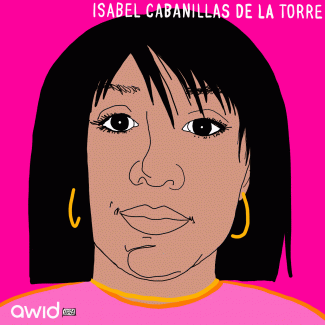
Isabel Cabanillas de la Torre

Isabel Cabanillas de la Torre was a much loved young feminist artist and activist from Ciudad Juárez, Mexico, known for her beautiful and evocative hand-painted clothing with eyes being an emblematic feature in her work. Her murals transformed the run down and vacant buildings in Ciudad Juarez’s downtown, bringing life and political commentary to their walls.

Through her art and political activism Isabel sought to draw attention to the gender based violence pervasive in her hometown. She volunteered with the women’s network Mesa de Mujeres on the Citizen Observatory on Gender to monitor the performance of judges, prosecutors and public defenders on cases of femicides and other gender based violations. She was also a member of Hijas de su Maquilera Madre, a feminist collective whose name makes reference to the daughters of mothers who are maquila workers. Some of these mothers were among the first victims of femicide in the city.

Isabel’s latest project, still in progress, was an art installation to protest a Canadian company that was looking to mine copper in the Samalayuca Desert. 

On 18 January, 2020 Isabel was shot while riding her bike back home in Downtown Juárez, in what appeared to be a targeted killing, her body found beside her bike.

Isabel’s murder, sparked a new wave of outrage against femicides in the region, hundreds marched to the US-Mexico border bridge, blocking it for hours and chanting “Ni una mas” (Not one more) as feminist collectives continue to protest the murders of women throughout Mexico. In 2019 alone, 3142 women and girls were killed in Mexico, many of whom were targeted specifically because of their gender.

She loved riding her bike.

"The bike for her was a symbol of freedom. A symbol of being free in the streets." - Marisol (a friend of Isabel’s)  

我什麼時候可以註冊論壇?

我們會盡快宣布。敬請關注!

Quand pourrai-je m'inscrire au Forum ? Combien coûte l'inscription ? Que comprennent les frais d'inscription ?

Les inscriptions commenceront début 2024. Nous annoncerons bientôt la date exacte et les tarifs d'inscription. L'inscription comprendra la participation au Forum, et inclura le déjeuner et les collations (le petit-déjeuner sera fourni par les hôtels), ainsi qu’un dîner sur place.

Antes de comenzar

Antes de comenzar a aplicar la metodología de investigación WITM, es importante que te prepares y que sepas con qué te vas a encontrar.


Capacidad

Antes de implementar la metodología de investigación WITM de AWID, te recomendamos que leas el Manual completo.

Si bien el propósito de este Manual es democratizar las investigaciones sobre WITM, tu organización podrá usar esta metodología en la medida de su capacidad, es decir, sus recursos y experiencia en investigación.

Utiliza la Planilla «¿Estoy listx?» para evaluar en qué medida estás preparadx para comenzar la investigación WITM. Cuantas más preguntas de la planilla puedas responder, más preparadx estarás para embarcarte en la investigación.

Confianza

Antes de comenzar cualquier investigación, te recomendamos evaluar los lazos que tiene tu organización con la comunidad y la confianza que ha generado en ella.

En muchos contextos, algunas organizaciones tal vez no quieran compartir abiertamente información financiera por distintos motivos que van desde la preocupación acerca de cómo se utilizará la información hasta el miedo frente a la «competencia» por el financiamiento o la ansiedad ante las restricciones cada vez mayores que impone el gobierno a las organizaciones de la sociedad civil.

Cuando desarrolles vínculos con otras organizaciones y te pongas en contacto con ellas de manera informal en el estadio previo a dar inicio a la investigación, ser clarx acerca de tus objetivos te ayudará a generar confianza. La transparencia permitirá que quienes participen en la investigación sepan por qué estás recogiendo información y qué beneficios podrá esperar la comunidad de tu trabajo.

Recomendamos asegurarte de que la información se recoja de manera confidencial, preservando el anonimato de quienes respondan. Esto permitirá que lxs participantes se sientan más cómodxs compartiendo información delicada contigo.


Primer paso

1. Concentra los recursos

También recomendamos que consultes la Planilla «¿Estoy listx?» para evaluar tus avances.