Sandra Viviana Cuellar Gallego
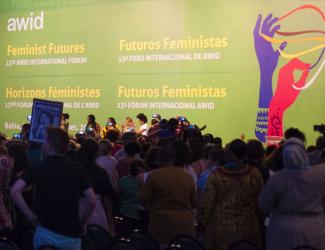
In September 2016, the 13th AWID international Forum brought together in Brazil over 1800 feminists and women’s rights advocates in a spirit of resistance and resilience.
This section highlights the gains, learnings and resources that came out of our rich conversations. We invite you to explore, share and comment!
One of the key takeaways from the 2016 Forum was the need to broaden and deepen our cross-movement work to address rising fascisms, fundamentalisms, corporate greed and climate change.
With this in mind, we have been working with multiple allies to grow these seeds of resistance:
And through our next strategic plan and Forum process, we are committed to keep developing ideas and deepen the learnings ignited at the 2016 Forum.
AWID Forums started in 1983, in Washington DC. Since then, the event has grown to become many things to many peoples: an iterative process of sharpening our analyses, vision and actions; a watershed moment that reinvigorates participants’ feminisms and energizes their organizing; and a political home for women human rights defenders to find sanctuary and solidarity.
Faits saillants de la manière dont l'AWID a contribué à la co-création et à la résistance féministes: sauvetage féministe, contrer les anti-droits, ressources, série de conversations organisées et magazine des Réalités Féministes
Financiamento externo inclui subsídios e outras formas de financiamento de fundações filantrópicas, governos, financiadores bilaterais, multilaterais ou empresariais, e doadores individuais, tanto a nível nacional como internacional. Não inclui recursos gerados autonomamente por grupos, organizações e/ou movimentos, como, por exemplo, quotas de membres, contribuições voluntárias de colaboradores, membres e/ou apoiantes, angariações de fundos comunitários, aluguer de espaços ou venda de serviços. Para facilitar a consulta, estão incluídas no inquérito definições dos diferentes tipos de financiamento e descrições resumidas de diferentes doadores.
So'oalo was a fervent human rights advocate, especially pertaining to the rights of the LGBTQI community in the Pacific.
She was a member of the Samoa Fa’afafine Association (SFA) and a passionate advocate for the acknowledgement of a third gender in the island country. Under her leadership, the SFA pushed for the recognition of the validity and rights of the fa’afafine community.
She was also a pioneer in articulating the links between human rights, exploitation of fa’afafines in Samoa and the Pacific, and the health, wellbeing and security of the LGBTQI community.
She was an inspiration, a visionary and her dedication to the pursuit of rights for her community is admirable and will be remembered.


This economical model exploits nature and as it intensifies, so does the inequality between global North with their large corporations, and the global South, where resources are extracted.
Find more on our report on EXTRACTIVE INDUSTRIES
There are sustainable alternatives for the environment and women's rights.
Ritu es una tecnóloga feminista que aporta su experiencia en el sector sin fines de lucro, movida por la pasión de utilizar enfoques innovadores para encontrar soluciones tecnológicas en clave feminista. Con una maestría en Tecnología de las Aplicaciones Informáticas del Instituto de Tecnología de la India, su función en AWID abarca una diversidad de responsabilidades. Desde la supervisión de la seguridad digital y la gestión de servidores, hasta la administración de las bases de datos, pasando por el desarrollo de capacidades, la evaluación de tecnologías, la implementación de software y soluciones en la nube, Ritu vela por la resiliencia y la efectividad de la infraestructura de las tecnologías de la información de AWID. Antes de incorporarse a AWID, desempeñó un papel fundamental en la promoción de iniciativas tecnológicas en los sectores del medio ambiente y de la promoción de la salud, impulsada por su afán de aprovechar la tecnología en aras del bien social.
تلتزم جمعية حقوق المرأة في التنمية بالعدالة اللغوية ونأسف على عدم توفر الاستطلاع بلغات أخرى في الوقت الحالي. إن كنتم/ن بحاجة لدعم من مترجم/ة أو أردتم/ن تعبئة الاستطلاع بأي لغة أخرى، الرجاء الكتابة لنا عبر البريد الالكتروني: witm@awid.org
Samira fue una activista siria bajo el régimen de Bashar al-Asad.
Desde muy joven, se opuso a todas las formas de despotismo, especialmente en relación al régimen autoritario en el que vivía. En 2013, Samira fue secuestrada junto a otrxs tres destacadxs activistas. Se cree que se la llevaron del Centro para la Documentación de Violaciones de Duma, en el área rural de Damasco.
El principal sospechoso de su desaparición es el Ejército del Islam (el cual niega estar involucrado). No ha habido una investigación formal de la desaparición de Samira y desde entonces no se ha sabido nada de ella. Samira estaba comprometida con su país y se negaba a abandonar Siria hasta tanto no sintiera que su trabajo por el empoderamiento de las mujeres y en la documentación de los crímenes ya no fuera necesario.

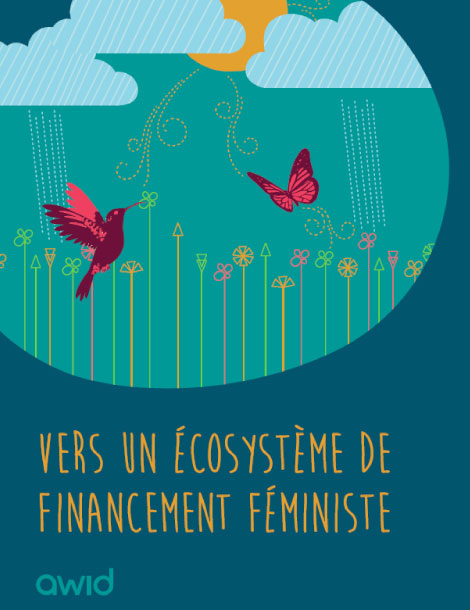
Cliquez sur l'image pour ouvrir le rapport complet en PDF
 |
|
Téléchargez le rapport PDF «Vers un écosystème de financement féminist» |
Où en sommes -nous aujourd'hui ? |
Où nous voulons être |
Financement actuel, par secteur |
 |
 |
 |
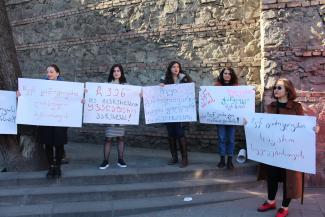
Nous vous présentons le syndicat Réseau Solidarité, un syndicat de la santé et des services dirigé majoritairement par des femmes. Émergeant en réponse à la précarité croissante, aux salaires insuffisants et aux environnements de travail hostiles auxquels les travailleur·euses géorgien·es sont confrontés quotidiennement, le Syndicat Réseau Solidarité se bat pour des lieux et des conditions de travail décents.
Son objectif? Créer un mouvement syndical national démocratique. Pour ce faire, il s'est associé à d'autres syndicats locaux et régionaux et a lentement constitué un réseau de syndicats, permettant à de plus en plus de travailleuses de devenir dirigeantes syndicales en cours de route.
Son approche politique est holistique. Pour le syndicat Réseau Solidarité, les questions relatives aux droits du travail sont directement liées aux programmes et réformes politiques et économiques nationaux plus larges. C'est pourquoi iels font pression pour la justice fiscale, les droits des femmes et des personnes LGBTQIA+, et luttent contre le démantèlement de l'État-providence géorgien.
Le syndicat Réseau Solidarité fait également partie de Grève Sociale Transnationale (Transnational Social Strike, TSS), une plate-forme et infrastructure politique inspirée par l'organisation des migrant·e·s, des femmes et des travailleur·euses essentiel·les qui s'efforcent de créer des liens entre les mouvements ouvriers à travers le monde et de fomenter la solidarité globale.
Priscilla a près de deux décennies d'expérience de travail dans le secteur non lucratif et des organisations de justice sociale qui travaillent sur les droits des femmes et des jeunes, la conservation, la consolidation de la paix et le développement. Elle s’intéresse à la mise en place de processus et de systèmes progressifs qui aident les organisations à respecter leurs valeurs et principes pour s’épanouir, et à l’obtention de moyens permettant aux organisations et aux personnes qui collectent des fonds d’allouer et de sécuriser les ressources nécessaires à la réalisation d’un travail de qualité. Priscilla a rejoint l'AWID en 2018 en tant que responsable de la mobilisation des ressources, pour ensuite assumer le rôle de directrice des opérations et des partenariats financiers à partir de juillet 2023.
Priscilla est titulaire d'un master en politique internationale de l’École des Études Orientales et Africaines (SOAS). Elle tient une pile, de plus en plus grande, de livres pour lesquels elle essaie toujours de trouver du temps pour les lire. Elle siège au sein du conseil d'administration de la Hodan Somali Community, une organisation caritative basée à Londres.
Ориентировочное время для завершения опроса составляет 30 минут.
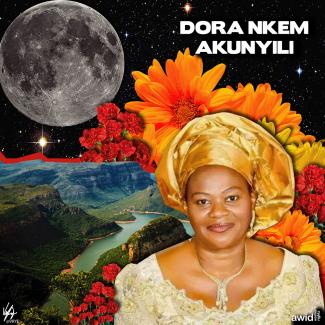
Née dans l'État de Benue, au Nigeria, Dora était une pharmacienne experte et érudite ainsi qu’une dirigeante communautaire de renommée mondiale.
Lorsqu'elle est devenue directrice générale de l'Agence nationale pour la gestion et le contrôle des aliments et drogues (NAFDAC) entre 2001 et 2008, son travail d’envergure révolutionnaire a initié un changement de paradigme au sein de la fonction publique nigériane. Au cours de son mandat, elle a mené des réformes dans l'application des politiques et des réglementations qui ont permis de réduire de manière radicale le nombre de faux médicaments qui ont affecté le secteur pharmaceutique nigérian.
Après avoir incarné la réalité d’une femme courageuse et compétente qui a défié les maux d’une société à dominante patriarcale et qui a conduit au changement, elle est devenue une icône de l’émancipation des femmes. Entre 2008 et 2010 elle a été nommée ministre de l'Information et de la Communication.
Elle est décédée des suites d'un cancer et laisse dans le deuil son mari, ses six enfants et ses trois petits-enfants.
We strive to make the AWID Forum a truly global gathering with participation from a diverse array of movements, regions and generations. To this end, AWID mobilizes resources for a limited Access Fund (AF) to assist some participants with the costs of attending the Forum.
The 14th AWID International Forum will take place 11-14 January 2021, in Taipei, Taiwan.
For this AWID Forum, there will be no application process.

In addition, AWID will fund approximately 100 participants from the Forum’s location. Forum Committee Members (Content and Methodology, Access and Host) as well as those in the Artists Working Group [link] are also granted Access Fund support.
We have listed other ideas on how to fund your participation at the AWID Forum on the Funding Ideas page.

Be part of an international feminist membership organization and community. Our members are based in all regions of the world, learning and supporting each other in a global network based on solidarity.