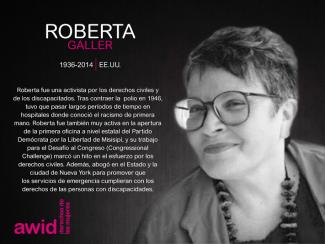
Roberta Galler
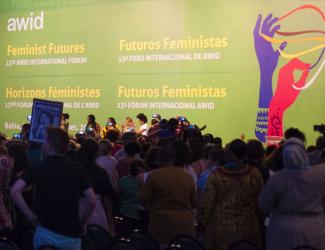
In September 2016, the 13th AWID international Forum brought together in Brazil over 1800 feminists and women’s rights advocates in a spirit of resistance and resilience.
This section highlights the gains, learnings and resources that came out of our rich conversations. We invite you to explore, share and comment!
One of the key takeaways from the 2016 Forum was the need to broaden and deepen our cross-movement work to address rising fascisms, fundamentalisms, corporate greed and climate change.
With this in mind, we have been working with multiple allies to grow these seeds of resistance:
And through our next strategic plan and Forum process, we are committed to keep developing ideas and deepen the learnings ignited at the 2016 Forum.
AWID Forums started in 1983, in Washington DC. Since then, the event has grown to become many things to many peoples: an iterative process of sharpening our analyses, vision and actions; a watershed moment that reinvigorates participants’ feminisms and energizes their organizing; and a political home for women human rights defenders to find sanctuary and solidarity.
It is a community hub, where one can take courses and train in creative income-generation activities like local hairdressing, cooking and artmaking. Children can also enjoy cultural and educational activities. The MSTC doesn't work alone. It collaborates with institutions and art collectives to produce cultural, athletic and educational experiences, alongside critical access to health care. Since its inception, this participatory project has been led and carried out by mostly women, under the leadership of Afro-Brazilian activist Carmen Silva, who was once a homeless person herself.

Feminist, women’s rights, gender justice, LBTQI+ and allied movements around the world are at a critical juncture, facing a powerful backlash on previously-won rights and freedoms. Recent years have brought the rapid rise of authoritarianism, violent repression of civil society, criminalization of women and gender-diverse human rights defenders, escalating war and conflict in many parts of our world, continued perpetuation of economic injustices, and the intersecting health, ecology and climate crises.

Ritu is a feminist technologist who brings her experience in the non-profit sector, driven by a passion for utilizing innovative approaches to finding feminist technological solutions. Holding a Master's in Technology in Computer Applications from the Indian Institute of Technology, her role at AWID encompasses a diverse range of responsibilities. From overseeing digital security and server management to database administration, capacity building, technology evaluation, software implementation and cloud solutions, Ritu ensures that AWID's IT infrastructure is resilient and effective. Prior to joining AWID, she played a pivotal role in advancing technological initiatives in the Health Promotion and Environment sectors, fueled by her dedication to leveraging technology for social good.

La organización comunitaria de mujeres negras en la región del Norte del Cauca en Colombia se remonta al pasado colonial del país, que está marcado por el racismo, el patriarcado y el capitalismo que sustentaron la esclavitud como un medio para explotar los ricos suelos de la región.
Estas organizadoras son las heroínas de un amplio movimiento por la autonomía negra, que lucha por el uso sostenible de los bosques y los recursos naturales de la región como elementos vitales para su cultura y sustento.
Durante 25 años, la Asociación de Mujeres Afrodescendientes del Norte del Cauca (ASOM) se ha dedicado a impulsar la organización de mujeres afrocolombianas en el Norte del Cauca. Se establecieron en 1997 como respuesta a las continuas violaciones de derechos humanos, la ausencia de políticas públicas, el manejo inadecuado de los recursos naturales y la falta de oportunidades para las mujeres en el territorio.
Han forjado la lucha para asegurar los derechos étnico-territoriales, para poner fin a la violencia contra las mujeres y obtener el reconocimiento del papel de las mujeres en la construcción de la paz en Colombia.
1 |
Provide AWID members, movement partners and funders with an updated, powerful, evidence-based, and action-oriented analysis of the resourcing realities of feminist movements and current state of the feminist funding ecosystem. |
2 |
Identify and demonstrate opportunities to shift more and better funding for feminist organizing, expose false solutions and disrupt trends that make funding miss and/or move against gender justice and intersectional feminist agendas. |
3 |
Articulate feminist visions, proposals and agendas for resourcing justice. |
Priscilla posee prácticamente dos décadas de experiencia de trabajo en el sector sin fines de lucro con organizaciones por la justicia social abocadas a los derechos de las mujeres y las juventudes, la conservación, la consolidación de la paz y el desarrollo. Sus intereses se centran en establecer procesos y sistemas progresistas que ayuden a una organización a operar de acuerdo a sus valores y principios y a prosperar, así como en encontrar formas de ayudar a las organizaciones y los donantes a identificar y garantizar los recursos que necesitan para una buena labor. Priscilla se unió a AWID en 2018, como Gerente de Movilización de Recursos y, en julio de 2023, asumió el cargo de Directora de Operaciones y Alianzas para el Financiamiento.
Posee una Maestría en Política Internacional de la Escuela de Estudios Orientales y Africanos (SOAS), una pila cada vez más alta de libros para los que todavía intenta encontrar tiempo para leer e integra la Junta de Hodan Somali Community, una entidad benéfica radicada en Londres.
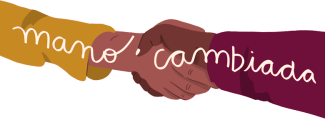
(« main échangée »)
Terme des communautés noires du Cauca du Nord pour la minga, le travail collaboratif dans les fermes, basé sur l'entraide et la solidarité.
There are many reasons why your response to the WITM survey matters. The survey offers the opportunity to share your lived experience of mobilizing funding to support your organizing; claim your power as an expert on how money moves and who it reaches; and contribute to collective and consistent advocacy to funders moving more and better funding. Over the last two decades, AWID’s WITM research has proven to be a key resource for activists and funders. We wholeheartedly invite you to join us in its third iteration to highlight the actual state of resourcing, challenge false solutions, and point out how funding must change for movements to thrive and meet the complex challenges of our times.
Marta est chercheur·se et activiste queer, transféministe et non binaire, originaire de l'ex-Yougoslavie, actuellement basé·e à Barcelone. Iel facilite des mouvements transnationaux, tisse des alternatives systémiques et est économiste féministe. Iel a cofondé et coordonné avec d’autres la Tapisserie mondiale des alternatives, un processus mondial qui cherche à identifier, documenter et relier les alternatives aux niveaux local, régional et mondial. À l’échelle locale, Marta est engagé·e au sein d’organisations antiracistes, transféministes, queer et migrantes. Iel détient également un doctorat en sciences et technologies environnementales de l'Université autonome de Barcelone, consacré aux perspectives féministes décoloniales d'une pluralité d'alternatives systémiques et à la création de systèmes alternatifs féministes basés sur les soins et la pérennité de la vie. Pendant son temps libre, iel aime boxer, jouer de la guitare et de la batterie dans un groupe de samba, faire de la photographie, de la randonnée, cuisiner pour ses proches et gâter ses deux chats.
|
383 people |
No. Valoramos muchísimo su trabajo, pero no estamos buscando respuestas de fondos de mujeres/feministas por el momento. Alentamos a compartir la encuesta con sus socios beneficiarios y con sus redes feministas.