Supporting feminist, women’s rights and gender justice movements to thrive, to be a driving force in challenging systems of oppression, and to co-create feminist realities.
Snippet - Section Two Funding Resources in One Place - EN
A Universe of Funders & Funding Commitments
From “WID” to “GAD” to Women’s Rights: The First Twenty Years of AWID
In 2002 AWID celebrated its 20th anniversary. Given the challenging political, economic and funding environment in which women's organizations must survive, a milestone such as this is worthy of recognition.
In the past two decades the geo-political landscape has been transformed and development theories have come and gone, but approaches to ensure women benefit from development processes have endured.
In its twenty-year history, AWID grew from a volunteer organization for U.S. "Women in Development" (WID) specialists to an international network striving to support proactive and strategic gender equality research, activism and policy dialogue.
On the occasion of its 20th anniversary, this paper charts not only the changes in AWID's organizational structure and goals but also the shifts in policy approaches to gender equality in a changing global environment, through the lens of a membership organization committed to improving the lives of women and girls everywhere.
Filter for funders that support initiatives in your geographical area.
WHRDs from Sub-Saharan Africa
In our 2015 Online Tribute to Women Human Rights Defenders No Longer With Us we are commemorating four women from Sub-Saharan Africa, three of whom were murdered due to their work and/or who they were in their gender identity and sexual orientation. Their deaths highlight the violence LGBT persons often face in the region and across the globe. Please join AWID in honoring these women, their activism and legacy by sharing the memes below with your colleagues, networks and friends and by using the hashtags #WHRDTribute and #16Days.
Please click on each image below to see a larger version and download as a file
Feminist and women’s rights organizations don’t just rely on institutional funding, we resource ourselves. Our organizing is powered by passion, political commitment, solidarity and collective care.
These resources are self- generated and autonomous, and often invisible in our budgets, but they are the backbone of our organizing.
In the current context, we have identified five major threats to the struggle towards feminist just economies.
1. Financialisation of the world economy.
“Financialisation refers to the increasing importance of financial markets, financial motives, financial institutions, and financial elites in the operation of the economy and its governing institutions both at the national and international levels”. - Gerald Epstein
Epstein Gerald A. 2006: Financialization and the World Economy. Edward Elgar Publishing.
Financial institutions exert a strong influence over economic governance and the direction of development policy. The growing dominance of the corporate sector and international financial institutions in defining local and global public policies, has resulted in the capture of the State in the interest of capital. The current financial system, including controversial credit and debt policies, are integral to the reproduction and expansion of capital accumulation processes.
This raises important questions of how to regulate and re-think the global financial system, not only to avoid serious negative consequences of debt-driven crises,but to allow for sustainable livelihoods and the realization of economic and social rights without retrogression.
For the past 20 years, trade agreements (both bilateral or multilateral) have expanded their role demonstrating increased interest in Intellectual Property Rights (IPR) to be given to corporations.
IPR has clearly benefitted transnational corporations with huge impacts on the ability of poorer nations and peoples to realize human rights, notably:
the right to food,
the right to conserve,
the right to use and sell seeds, and
the right to access to essential medicines.
In addition, agriculture import liberalisation resulting in an influx of cheap goods jeopardise women’s self-employed farmers in poor countries and food security. Investment protection clauses included in trade agreements limit the policy space of national governments to create and enforce regulations on issues as crucial as environmental protection, labour rights, and the duration of copyrights.
Feminist movements have been, and are, at the forefront of resistance to these agreements exposing its pitfalls.
3. Unprecedented scale of threat to ecosystems and biodiversity.
The commodification of the Earth’s resources and resulting environmental degradation and climate change produced by decades of aggressive industrialisation, plunder and extractivism of the world’s resources, have damaged biodiversity and ecological resilience. These damages are now threatening the existence of human society itself.
The international community has failed to address production and consumption patterns sitting at the root of the problem. Instead, governments –with the support of large corporations interested in making a profit - are leaning towards a “green economy” approach promoting “energy-efficient technologies” (including nuclear energy, biofuels, genetically modified organisms and geo-engineering) and carbon trade schemes as the silver bullet.
4.Commodification of land and accelerating global phenomenon of land and resource grabbing.
While the processes of land and resource appropriation is not new – in fact, they are central struggles in colonial histories- what is new is the advanced means by which land and natural resource wealth are becoming commodities in new markets.
International Financial Institutions play a central role in promoting land markets in developing countries. These institutions finance land reforms that enable powerful actors to use land for speculative gain in exchange of meagre promises of jobs and growth. Land-grabbing has far reaching negative impacts on local peoples’ access to essential goods and services apart from displacement and environmental degradation that are associated with it.
People who are resisting land grabbing, among them women human rights defenders, face diverse forms of violence including physical attacks and sexual abuse, on a daily basis.
5. Entrenched patriarchal foundations that structure the capitalist system
This patriarchal foundation is particularly hegemonic in today’s neoliberal models.
The many ways in which political economy and development are connected to sexuality or gender is evident: think how capitalism defines what can even be characterized as labour and ties human worth to wage-labour productivity.
For the most part, women’s position in the global economy continues to be one of gender-based labour exploitation with women’s work undervalued in precarious jobs, domestic subsistence, reproduction, and in unwaged household production. Because reproductive labour has been naturalized as women's unpaid work, it has provided an immense subsidy to capitalism at the same time as a source of gender oppression and subjugation.
This situation is aggravated by the fact that as social protection mechanisms begin to dwindle, women’s care burden increases.
Further, the phenomenon of global migration spurred on by thousands of economic refugees escaping oppressive poverty across the globe is not estranged to that of capitalist gender power relations. Remittances become a major source of development financing for the families and communities, but at a major cost for women migrants who struggle to earn a living wage in their new country.
In the same vein, we have seen how patriarchal capitalist systems are using violence and oppression to maintain their status quo. Rising global expenditures in militarism and violence, both perpetrated by state and non-state actors, is increasingly used to control dissent, women’s bodies and voice and settle economic, political and social disputes.
Across the world, violence, incarceration and discrimination disproportionately targets
women, communities of colour,
indigenous peoples,
people with disabilities,
sex workers,
impoverished people, and
LGBTQI people.
An intersectional analysis linking gender, race, ethnicity, age, ability, nationality, sexual orientation and gender identity, among other status is needed to challenge structural violence and its links with a capitalist global system.
A profound crisis in the current global governance system is also evident in the feeble inter-governmental agreements reached and how they often lack the most fundamental accountability mechanisms. The multilateral system that served global governance before is failing to respond to the current multiple crises. The same system continues to be deeply undemocratic, with increasing presence and power by corporations occupying the spaces where States used to be.
Rethinking, Renewing & Reactivating
These threats challenge feminists to re-think our framework and strategies. To renew and reactivate our commitment to movement building with others for a just economy.
They challenge us to consider broad agendas for socio-economic transformations, from a feminist perspective, in ways that address the realities of the majority of the impoverished. Now is the time to bring about change for a just economy and to address the persistent systemic challenges.
Snippet - COP30 - Feminist Demands for COP30 Col 1
What We Reject:
Market-based false solutions
Ecosystem service trading
Green neoliberal economies mining
Geo-engineering
Fossil fuels
Military spending over climate funds
Climate finance as loans
Key opposition actors
We are witnessing an unprecedented level of engagement of anti-rights actors in international human rights spaces. To bolster their impact and amplify their voices, anti-rights actors increasingly engage in tactical alliance building across sectors, regional and national borders, and faiths.
This “unholy alliance” of traditionalist actors from Catholic, Evangelical, Mormon, Russian Orthodox and Muslim faith backgrounds have found common cause in a number of shared talking points and advocacy efforts attempting to push back against feminist and sexual rights gains at the international level.
Holy See
Key activities: As the government of the Roman Catholic Church, the “Holy See” uses its unique status as Permanent Observer state at the UN to lobby for conservative, patriarchal, and heteronormative notions of womanhood, gender identities and “the family”, and to propagate policies that are anti-abortion and -contraception
Based in: Vatican City, Rome, Italy.
Religious affiliations: Catholic
Connections to other anti-rights actors: US Christian Right groups; interfaith orthodox alliances; Catholic CSOs
Organization of Islamic Cooperation (OIC)
Key activities: Self-described as the “collective voice of the Muslim world”, the OIC acts as a bloc of states in UN spaces. The OIC attempts to create loopholes in human rights protection through references to religion, culture, or national sovereignty; propagates the concept of the “traditional family”; and contributes to a parallel but restrictive human rights regime (e.g. the 1990 Cairo Declaration on Human Rights in Islam).
Based in: Jeddah, Saudi Arabia
Religious affiliations: Muslim
Connections to other anti-rights actors: Ultra conservative State missions to the UN, such as Russia
World Congress of Families
Key activities: International and regional conferences; research and knowledge-production and dissemination; lobbying at the United Nations “to defend life, faith and family”
Based in: Rockford, Illinois, U.S.
Religious affiliation: Predominantly Catholic and Christian Evangelical
Connections to other anti-rights actors: Sutherland Institute, a conservative think-tank; the Church of Latter-Day Saints; the Russian Orthodox Church’s Department of Family and Life; the anti-abortion Catholic Priests for Life; the Foundation for African Culture and Heritage; the Polish Federation of Pro-Life Movements; the European Federation of Catholic Family Associations; the UN NGO Committee on the Family; and the Political Network for Values; the Georgian Demographic Society; parliamentarians from Poland and Moldova, etc; FamilyPolicy; the Russian Institute for Strategic Studies; and HatzeOir; C-Fam; among others
Center for Family and Human Rights (C-Fam)
Key activities: Lobbying at the United Nations, particularly the Commission of the Status of Women to “defend life and family”; media and information-dissemination (Friday Fax newsletter); movement building; trainings for conservative activists
Based in: New York and Washington D.C., U.S.
Religious affiliations: Catholic
Connections to other anti-rights actors: International Youth Coalition; World Youth Alliance; Human Life International; the Holy See; coordinates the Civil Society for the Family; the Family Research Council (U.S.) and other Christian/Catholic anti-rights CSOs; United States CSW delegation
Family Watch International
Key activities: Lobbying in international human rights spaces for “the family” and anti-LGBTQ and anti-CSE policies; training of civil society and state delegates (for example, ‘The Resource Guide to UN Consensus Language on Family Issues’); information dissemination; knowledge production and analysis; online campaigns
Based in: Gilbert, Arizona, U.S.
Religious affiliations: Mormon
Connections to other anti-rights actors: leader of the UN Family Rights Caucus; C-Fam; Jews Offering New Alternatives to Homosexuality (JONAH); the National Association for Research and Therapy of Homosexuality (NARTH); World Congress of Families; CitizenGo; Magdalen Institute; Asociación La Familia Importa; Group of Friends of the Family (25 state bloc)
World Youth Alliance
Key activities: Advocacy in international policy spaces including the United Nations, the European Union, and the Organization of American States for “the family”, against sexual and reproductive rights; training youth members in the use of diplomacy and negotiation, international relations, grassroots activities and message development; internship program to encourage youth participation in its work; regular Emerging Leaders Conference; knowledge production and dissemination
Based in: New York City (U.S.) with regional chapter offices in Nairobi (Kenya), Quezon City (The Philippines), Brussels (Belgium), Mexico City (Mexico), and Beirut (Lebanon)
Religious affiliations: primarily Catholic but aims for interfaith membership
Connections to other anti-rights actors: C-Fam; Human Life International; the Holy See; Campaign Life coalition
Russian Orthodox Church
Key Activities: The Russian Orthodox Church (ROC), capitalizing on its close links to the Russian state, has operated as a “norm entrepreneur” in human rights debates. Russia and the ROC have co-opted rights language to push for a focus on “morality” and “traditional values” as supposed key sources of human rights. Russia led a series of “traditional values” resolutions at the Human Rights Council and has been at the forefront of putting forward hostile amendments to progressive resolutions in areas including maternal mortality, protection of civil society space, and the right to peaceful protest.
Connections to other anti-rights actors: Organization of Islamic Cooperation; Eastern European and Caucasus Orthodox churches, e.g. Georgian Orthodox Church; U.S. Christian Right including U.S. Evangelicals; World Congress of Families; Group of Friends of the Family (state bloc)
The 61st Human Right Council takes place amid, what has been called by the UN Secretary-General, an ‘imminent financial collapse.’ Powerful member states’ refuse to pay up their contributions to the UN: the United States alone accounts for 95% of the USD 1.6 billion shortfall in the UN’s 2025 budget. This continues to erode the Council’s ability to deliver on its mandate, limiting its capacity to support human rights mechanisms, monitor accountability, and respond to global crises.
This lack of accountability is starkly obvious with the global surge of military spending and ongoing genocides in Gaza, Sudan and Myanmar. From the farcical “Gaza Peace Plan,” and unbridled imperial intervention in Venezuela, led by the US, the mask that “there is just no money” for people- social support, healthcare, education is off.
Framework & Theme
The theme of the 14th AWID International Forum is: “Feminist Realities: our power in action”.
In our 14th Forum, we will celebrate and amplify Feminist Realities that are around us, in all stages of development.
We want to make this Forum our Feminist Reality - a place where you can inhabit a different world, where you bring your victories, the solutions you have devised; what makes you feel stronger, hopeful and ready to go on. It will be different from any other convening you have previously attended.
We urge you to join us in co-creating this world. It will be worth it!
Each Forum has a theme that reflects the needs of our membership and movements, and responds to our analysis of the current context.
The global context
Currently fascisms, fundamentalisms, authoritarianism and unfettered corporate power are gaining momentum globally. We see these threats converging with the State to shape public norms, narratives, and policies, entrenching a culture of fear, hate and incitement to violence in public discourse. States, previously the target of advocacy and rights claims, in many cases no longer feel accountable and in some cases themselves don’t have the power to uphold rights.
This time of volatility, complexity and uncertainty requires creativity in how we organize across movements, coherence in what we demand and daring in what we propose.
From Feminist Futures to Feminist Realities
AWID’s 2016 Forum centered on Feminist Futures and the conditions needed to bring such futures about. It was clear then, and remains evident now, the enormous challenge for many social justice movements to think outside of the current system for structural solutions. Imaginations can become narrowed from long experiences of inequality and oppression. But what we also heard then and we see all around us is that feminist movements are indeed living and promoting rights-and justice-oriented realities and solutions in big and small ways.
Indeed we see an urgency to mobilize from a place of hope, rather than from a lowest common denominator - hope that is grounded in the certainty that across the globe, however imperfectly, are experiences and practices that embody more just ways of being in the world and that by sharing, strengthening and building on these experiences, we can help them grow their influence.
These are not impossible dreams, but lived realities. This sense of possibility is a spark to re-examine and re-appreciate the transformative dimensions in our work.
A few examples of Feminist Realities across the globe
At AWID, we understand feminist realities as the living, breathing examples of the worlds we know are possible. We understand these diverse feminist realities as reclamations and embodiments of hope and power. They are embedded in the multiple ways that show us that there is a different way of living, thinking and doing-- from the daily expressions of how we live and relate to each other, to alternative systems of governance and justice. Feminist Realities resist dominant power systems such as patriarchy, capitalism, and white supremacy.
These are powerful propositions that orient us toward a vision of what is possible, and show how feminist organizing is blazing a path toward justice in movements and communities around the world.
In a deeply marginalized Black community in Jackson, Mississippi, an experiment in solidarity and cooperative economics is taking place through Cooperation Jackson. An ambitious plan to build community ownership outside of capitalist modes of production.
In West Africa, women farmers are resisting land grabbing and refusing industrialized agriculture projects, boldy claiming We Are The Solution, in a campaign to build agro-ecological solutions that center women farmers and their knowledges as the solutions to feed communities and mitigate climate change
Similarly, in India, 5,000 women have come together to develop community-based food sovereignty systems based on local knowledge, including grain and seed banks
Women in Mexico have created a moneyless economy project created by and for women and everyone they know. In El Cambalache everything has the same value: people exchange things they no longer need for things they want as well as knowledge, abilities and mutual aid that people would like to share. El Cambalache was built on the anti-systemic, anti-capitalist values of local social movements
In Rojava, Kurdish people are building democracy without the state and Kurdish women offer Jineology as a framework for challenging patriarchy, capitalism and the state, creating systems and institutions to put this framework into practice
In the UK, Anarcho Agony Aunts are a sex and dating advice show, covered from a feminist, antifascist, anarchist perspective. Hosts Rowan and Marijam are reclaiming space from the alt-right in giving people (mostly men) a space to ask tricky questions in a judgment-free zone.
The African Feminist Judgment Project drafts and disseminates alternative judgments for important African landmark cases on a range of legal issues. At the heart of the project is propositional feminist judicial practice and alternative feminist judgments that contribute to African jurisprudence, legal practice and judicial decision-making
The Usha Cooperative in India was founded when mainstream banks refused services to sex workers in Sonagachi. Sex workers self-organized to prioritize their economic concerns and set up their own financial institution. The Usha Cooperative is cooperative bank of over 20,000 sex workers and has provided over USD 4.7M in loans to 7,231 sex workers in a span of one year. With a membership entirely of sex workers, the bank provides real ownership and influence over the cooperative’s governance and management, pioneering ways for individuals and communities on the margins to build economic power on their own terms.
In Puerto Rico, a community land trust is helping to transform an informal settlement around a polluted and flood prone river channel into a sustainable community. It provides a new model for improving informal settlements in cities without them then becoming unaffordable for the original residents.
In several Latin American countries activists are providing peer-to-peer counselling and accompaniment on medical abortion, reclaiming women´s right to decide over their bodies as well as to medical knowledgde. (for safety reasons, no links are provided.
Building on those realities, we expect the 2020 Forum to:
Build the power of Feminist Realities, by naming, celebrating, amplifying and contributing to build momentum around experiences and propositions that shine light on what is possible and feed our collective imaginations
Replenish wells of hope and energy as much needed fuel for rights and justice activism and resilience
Strengthen connectivity, reciprocity and solidarity across the diversity of feminist movements and with other rights and justice-oriented movements
The Forum is a collaborative process
The Forum is more than a four-day convening. It is one more stop on a movement strengthening journey around Feminist Realities that has already begun and will continue well beyond the Forum dates.
A Collaborative Session: ‘What Do Movements Need Now? Resourcing Feminist Resistance in a Time of Contraction’
Hosted by MADRE, Fondo Semillas and Feminist Church
📅 Wednesday, April 29
🕒 4.00-5:30pm
🏢 Melbourne Convention and Exhibition Centre, Room #204
Freeing the Church, Decolonizing the Bible for West Papuan Women
By Rode Wanimbo (@rodwan986), Jayapura, Papua Province of Indonesia
“Lord, we are unworthy. We are the ones who committed sin for Eve ate the fruit in Eden. We are just women who grow sweet potatoes, look after pigs and give birth to children. We believe you died on the cross to set us free. Thank you, In Jesus’s name Amen.”
This is a typical prayer of women I have heard during my visits to ministries in several villages. Even I said the same prayer for many years.
I was born and grew up in Agamua, the Central Highlands of West Papua. My father belongs to the Lani tribe and my mother comes from Walak.
In Lani and Walak languages - languages spoken in the Central Highlands - tiru means a pillar. There are four tiru (pillars) standing firmly in the middle of the Lani roundhouse (honai), around wun’awe or a furnace. Tiru is always made of the strongest type of wood called a’pe (ironwood tree). The longer the wood gets heated and smoked from the fire in the honai, the stronger it becomes. Without tiru, the honai cannot stand firm. West Papuan women are these tiru.
West Papua is located in the western part of the New Guinea island, containing some of the world’s highest mountains, densest jungle, and richest mineral resources. It is home to over 250 groups and has an incredible biodiversity. Due to its natural wealth, West Papua has, over the centuries, been targeted by foreign occupiers. Until 1963, we were colonized by the Dutch. However in 1969, after a manipulative political act, we were transferred from the Dutch to Indonesia.
The first German missionaries arrived in Mansinam Island, Manokwari, in 1855. Then, in the 1950s, Christianity was brought to the Central Highlands of West Papua by Protestant missionaries of European descent from America, Canada, Australia and New Zealand.
According to Scripture in Genesis 1: 26-27, Man and Woman are created in the image of God. It means all humanity is made with the call and capacity to exercise dominion. Radah, the Hebrew word for dominion, means stewardship. Radah is not a call to exercise imperial power as declared by Pope Nicolas V, granting Catholic nations the right to “discover” and claim dominion over non-Christian lands. To diminish the capacity of humans to exercise dominion, is to diminish the image of God on earth (Lisa Sharon Harper, The Very Good Gospel).
The Evangelical Church of Indonesia (GIDI) was established as an institution in 1963. In the Sunday Service liturgy of GIDI, Women are considered unworthy to take any responsibility except collecting offerings. In 2003, after 40 years, the Department of Women was introduced within the structure of the Synod leadership.
In November 2013, I was entrusted to be a chairperson of the Women’s Department of the GIDI Synod.
Together with several other women leaders, we started a cell group that is committed to “decolonizing the Bible.” We learn together how to reconstruct the interpretation of biblical texts to champion women.
A feminist theologian named Elisabeth S Florenza calls it a feminist hermeneutic theory (Josina Wospakrik, Biblical Interpretation and Marginalization of Woman in the Churches of West Papua).
Besides the cell group, we interview our elderly women to collect our ancestors’ wisdom and values. As Bernard Narakobi in his book The Melanesian Way said: “Our history did not begin with contact with the Western explorers. Our civilization did not start with the coming of the Christian missionaries. Because we have an ancient civilization. It is important for us to give proper dignity and place to our history”.
Yum is a knotted net or woven bag handmade from wood fiber or leaves. Yum is highly valued for it symbolizes life and hope. When women of Lani and Walak get married, our maternal aunts put yum on our heads. It means we bear the responsibility for giving life and for providing food. Yum is used to carry garden produce as well as being used as a container to put a baby to sleep in as it gives warmth and a sense of security.
“West Papuan Women are Yum and Tiru” became the prime references as we contextualized women in the eyes of Jesus Christ in seminar and focus group discussions. From 2013 to 2018, we focused on reconstructing the view of women in GIDI and in gaining a healthy self-image. We are still in the process of understanding who we are to Jesus, rather than who we have been told we are by theologians and the fathers of the early Churches. Josina Wospakrik, a West Papuan Theologian said “The Gospel is incredibly rich but it was impoverished due to human ambitions and agendas.”
Since 2018, the GIDI Women Leadership team and I have formulated four priority programs: Decolonizing the Bible, Storytelling in a circle, Training of trainers for Literacy and Gender. The fourth, supported simple bookkeeping and savings groups workshops facilitated by Yapelin and Yasumat, which are faith based organizations established by GIDI leaders to reach the economic, social and health needs of women in the communities.
Storytelling in a Circle
In this programme we create a safe space for women to talk - each woman has a story. We all sit together and learn how to be good listeners.
“I became Christian and was taught that the government is God’s representative. Why did the government do nothing when the army burnt down my village and killed my relatives?” asked one woman in the storytelling circle. “My aunt was raped.” She stopped for a while. Could not talk. She cried. We all did.
The process of storytelling has driven us into deep conversation. We began to contextualize Biblical texts within our daily realities.
We started asking questions amongst ourselves: Where is God in our toughest times? Does the state government truly represent God on earth? Why does the Creator allow privileged people to destroy His own image in the name of Christianity and Development? During the process, I realized that I have been reading the Bible using somebody else’s glasses.
The church has to be a safe place to share stories and be a place of comfort to be still and rest. As we reflect on the testimonies, those who tell their stories begin the process of recovering from wounds and trauma.
Financial Literacy for Women
Culturally, West Papuans invest in relationships. The concept of saving is understood as an investment in relations, not in a bank account. And while the Indonesian central government has granted special autonomy to respond to West Papuans’ demand for self-determination, many government policies harm the quality of family life and they do not account for women’s lives. High illiteracy rates amongst women mean most women do not have access to a bank account. With no money saved, access to medical services becomes a struggle.
Through the priority programmes, Yapelin, with the active involvement and support of women, created saving groups in Bokondini and Jayapura. The saving groups are chaired by women who have access to a bank.
In coordination with Yayasan Bethany Indonesia (YBI) and Yayasan Suluh, a faith-based organization (FBO) based in Jayapura, we facilitated four literacy workshops. The literacy team facilitated the training of trainers in three different dioceses: Merauke, Sentani, and Benawa. We now have 30 facilitators in different congregations who run literacy programs.
Lack of financial support for our programs will not stop us. Being stigmatized as rebels will not stop us from standing up and speaking in church evaluation meetings and conferences. It is stressful but I am committed together with several women leaders to calling on the power-holders within to free the church.
The Gospel known as Good News should become news that liberates women from a very patriarchal circle of power, liberates women from social stigma and returns women to the original purpose of The Creator.
The Gospel must be a mirror to reflect who we are collectively. As Lisa Sharon Harper, in her book The Very Good Gospel said “The Gospel is not only about an individual’s reconciliation with God, self and communities. But also speaks on systemic justice, peace between people groups and freedom for the oppressed”.
Rode Wanimbo is the chairperson of the Women’s Department of Evangelical Church of Indonesia (GIDI).
“Offerings for Black Life”
By Sokari Ekine (@blacklooks), New Orleans
Coming from a place of healing and self-care is a political act that guides us to be focused and to move as one. In New Orleans, we created and will be creating altars in honour of those murdered by police and white supremacists vigilantes!
Organizing creatively, facing an increasing threat
Young feminist activists play a critical role in women’s rights organizations and movements worldwide by bringing up new issues that feminists face today. Their strength, creativity and adaptability are vital to the sustainability of feminist organizing.
At the same time, they face specific impediments to their activism such as limited access to funding and support, lack of capacity-building opportunities, and a significant increase of attacks on young women human rights defenders. This creates a lack of visibility that makes more difficult their inclusion and effective participation within women’s rights movements.
A multigenerational approach
AWID’s young feminist activism program was created to make sure the voices of young women are heard and reflected in feminist discourse. We want to ensure that young feminists have better access to funding, capacity-building opportunities and international processes. In addition to supporting young feminists directly, we are also working with women’s rights activists of all ages on practical models and strategies for effective multigenerational organizing.
Our Actions
We want young feminist activists to play a role in decision-making affecting their rights by:
Fostering community and sharing information through the Young Feminist Wire. Recognizing the importance of online media for the work of young feminists, our team launched the Young Feminist Wire in May 2010 to share information, build capacity through online webinars and e-discussions, and encourage community building.
Researching and building knowledge on young feminist activism, to increase the visibility and impact of young feminist activism within and across women’s rights movements and other key actors such as donors.
Promoting more effective multigenerational organizing, exploring better ways to work together.
Supporting young feminists to engage in global development processes such as those within the United Nations
Collaboration across all of AWID’s priority areas, including the Forum, to ensure young feminists’ key contributions, perspectives, needs and activism are reflected in debates, policies and programs affecting them.
« Surmonter l'adversité et guérir de la douleur » - Iniobong Usanga
Iniobong, membre de l’AWID depuis janvier 2015, est citoyenne irlandaise et d’origine nigérienne. En 2001, elle est arrivée en Irlande après avoir été forcée de quitter le Nigéria suite à des violences domestiques, sexuelles et reproductives.
« Je pense que personne ne mérite d’être l’esclave de quelqu’un. Cela ne devrait arriver à personne. » dit-elle.
Au début, son arrivée en Irlande, comme demandeuse d’asile et fille mère, a été très difficile : « les gens vous jugent sans vraiment connaître votre situation », commente-t-elle. A force de détermination, Iniobong a achevé ses études secondaires et a occupé de nombreux postes rémunérés et bénévoles.
Pendant des années, Iniobong a gardé toute cette histoire d’abus et de départ forcé pour elle. Par crainte des réactions de sa famille et aussi parce qu’elle ne voulait pas qu’on la juge, qu’on la plaigne ou lui mette une étiquette. En 2014, Iniobong a choisi de rompre la loi du silence, pour elle, et aussi « pour toutes celles et ceux qui endurent ce qu’elle a vécu, pour les survivant-e-s, pour les personnes qui n’ont plus d’espoir et celles qui veulent prendre un nouveau départ.»
« Je suis reconnaissante d’avoir une voix et de pouvoir m’exprimer librement. »
Iniobong fait aussi entendre sa voix pour militer pour les droits des femmes et des enfants qui subissent eux-mêmes différentes formes de violence. Avec l’aide de quelques ami-e-s, elle a fondé “Amour et attention aux gens du monde entier” (Love and Care for People Worldwide), une organisation non-gouvernementale qui aide les femmes, les enfants et les jeunes ayant subi des abus, et souffrant de pauvreté et d’autres formes d’exclusion sociale. “Je voulais apporter de l’espoir aux gens et leur faire savoir que nous soutiendrons leur détermination.” L’organisation propose différentes activités qui permettent de renforcer la confiance en soi des enfants et des femmes, de les éduquer et de développer leurs compétences professionnelles.
« Je ne pourrais jamais brader mon bonheur. C’est mon bonheur. Je continuerai de vivre pour moi-même et non pour satisfaire les autres. »
Ecoutez Iniobong raconter son histoire avec ses propres mots (en anglais)
"Overcoming adversity and healing the pain" - Iniobong Usanga
Iniobong, an AWID member since January 2015, is an Irish citizen with Nigerian roots. In 2001, she migrated to Ireland because she was forced to leave Nigeria after experiencing domestic, sexual and reproductive abuse.
“I don’t think anyone should be put in that situation where they are a slave to someone…. It shouldn’t happen to anyone”, she says.
Her arrival to Ireland as an asylum seeker and a single mother was extremely difficult at the beginning.
“People judge you even without knowing your situation”, she says. But due to her determination, Iniobong completed post-secondary education and has since worked in different paid and voluntary positions.
For years Iniobong kept her experience of abuse and forced migration to herself. She feared her family’s reactions and did not want to be judged, pitied or labelled.
In 2014, Iniobong chose to break her silence.
She spoke out for herself but also “for people who are currently experiencing what I had gone through, for survivors, for those who have given up hope and those who want to make a fresh start.”
“I am grateful because I have a voice and I can use it freely.”
Iniobong also uses her voice to advocate for the rights of women and children who are facing different kinds of violence.
With the help of some friends, she founded Love and Care for People Worldwide, a non-governmental organisation that supports women, children and youth affected by abuse, poverty and other forms of social exclusion. “I wanted to offer people hope and make them know their determination combined with some support.” The organisation offers diverse activities to help strengthen children’s and women’s self-confidence, learning and vocational skills.
“I would not sell my happiness for anyone. I have to be happy for me. And not continue living my life to please every other person but me.”
"Superando la adversidad y sanando el dolor" - Iniobong Usanga
Iniobong es una ciudadana irlandesa con raíces nigerianas, que forma parte de AWID desde enero de 2015. Llegó a Irlanda en 2001 tras ser obligada a abandonar Nigeria por sufrir violencia doméstica, sexual y reproductiva.
“Nada justifica que una persona sea puesta en la situación de ser esclava de otra. Es algo que no debería sucederle a nadie, declara.
Su llegada a Irlanda como solicitante de asilo y madre soltera fue muy difícil al principio. Las personas te juzgan incluso sin conocer tu situación, afirma. Con determinación, Iniobong completó sus estudios superiores y ha realizado numerosos trabajos, tanto remunerados como voluntarios.
Durante varios años, guardó silencio sobre sus experiencias de abuso y migración forzada. Sentía temor de la reacción de su familia y no quería ser juzgada, etiquetada o que sintieran lástima por ella. En 2014, Iniobong decidió romper el silencio, lo hizo por ella misma, pero también por aquellas personas que ahora están sufriendo lo que yo sufrí, por las supervivientes, por quienes han perdido la esperanza y por quienes desean comenzar de nuevo.
“Agradezco tener voz y poder usarla con libertad."
Iniobong también usa su voz para defender los derechos de aquellas mujeres, niñas y niños que están viviendo algún tipo de violencia. Con la ayuda de algunas amistades, fundó Love and Care for People Worldwide (Amor y protección para las personas de todo el mundo), una organización no gubernamental que apoya a las mujeres, niñas y niños afectados por el abuso, la pobreza y otras formas de exclusión social. Quería dar esperanzas a la gente, que conocieran su valor y que tuvieran cierto apoyo. La organización ofrece distintas actividades para ayudar a fortalecer la confianza de las mujeres, las niñas y niños, sus habilidades para aprender y sus destrezas vocacionales.
“No vendería mi felicidad por nadie. Es por mí que debo ser feliz y no dejar de vivir mi vida por complacer a nadie que no sea yo.”
Escuche la historia de Iniobong con sus propias palabras. (en inglés)
The Abortion Rights Campaign "Breaking the Silence" in Ireland
The Abortion Rights Campaign (ARC) - advocating for free, safe, and legal abortion in Ireland - has been an AWID member since May 2015. It is a grassroots, non-hierarchical, all-volunteer organization and is autonomous in its pro-choice activism.
ARC partners with numerous social justice, human rights and gender equality groups working on issues that intersect with and are impacted by Ireland’s failure to support full sexual and reproductive health and rights (SRHRs) for women since the 1983 8th Amendment of the Irish Constitution.
Although ARC only formed in January 2013, it currently actively partners with over 15 organizations throughout Ireland and internationally including the women’s councils, transgender, immigrant, traveler and regional/rural groups.
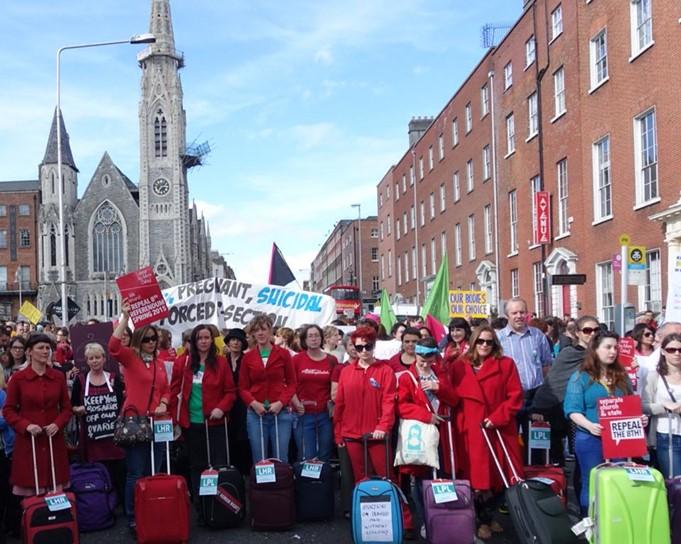
The march is part of ARC’s wider mission to secure access to free, safe, and legal abortion, while challenging the restrictive, stigmatized, and patriarchal environment surrounding SRHRs in Ireland.
Cathie Doherty, one of the co-conveners of ARC tells us, “There is an appetite in Ireland for real change, contrary to the statement from the Minister for Health and the Taoiseach. We need to end the hypocrisy of travel and the hypocrisy which forces women who cannot travel to carry pregnancies or to break the law by importing the abortion pill. We can change Ireland. We can have a society which treats us as the valuable human beings that we are.”
ARC works closely with women who have had abortions to tell their stories. They create a safe space where women can speak and be listened to. Ireland’s ‘Speak-Out’ organized in 2013 and again in 2014 gave a platform to women to talk about their abortions and reproductive health experiences abroad or illegally in Ireland. Some women have shared their stories with the press.
The Comedian and writer Tara Flynn recently spoke publicly about her experience in the Irish Times and said about the March for Choice that she will also MC for, “It’s time to acknowledge real women’s stories – women we all know – and actual facts: hundreds of thousands of women have had to travel and will continue to travel for healthcare they need, or put themselves at risk. Silence has got us nowhere. It’s time to talk.”
Dismantling Myths Through Social Media
For ARC, social media is an effective platform to campaign for and highlight bodily autonomy issues which often more traditional media fail to engage with.
“We strive to incorporate the use of new media and technologies into all of our advocacy work, with the aim of engaging as wide an audience as possible,” ARC said.
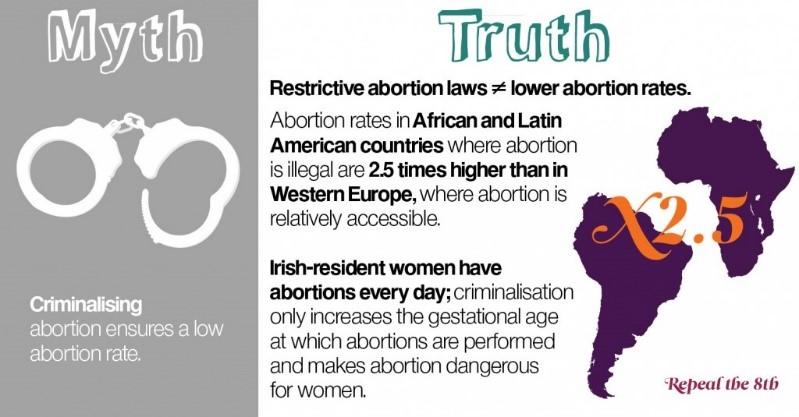
Ahead of International Women's Day in 2014, ARC ran the '8 days, 8 myths' campaign, dismantling the stigma and falsehoods surrounding abortion.
La Campaña por el Derecho al Aborto «Rompiendo el Silencio» en Irlanda
Abortion Rights Campaign [Campaña por el Derecho al Aborto, ARC] — que aboga por el aborto libre, seguro y legal en Irlanda — se afilió a AWID en mayo de 2015. Se trata de una organización de base, no jerárquica y formada por personal voluntario, que actúa de forma autónoma en su activismo por el derecho a decidir.
ARC trabaja en conjunto con numerosos grupos de justicia social, derechos humanos e igualdad de género en temáticas relacionadas entre sí y que se ven afectadas por el hecho de que desde 1983, cuando se aprobó la octava enmienda a la Constitución irlandesa, el país no ha brindado un apoyo pleno a la salud y los derechos sexuales y reproductivos de las mujeres.
Aunque la ARC se creó recién en enero de 2013, ya trabaja activamente con más de 15 organizaciones de toda Irlanda y también a nivel internacional, entre las que se cuentan Consejos de Mujeres y grupos trans*, de inmigrantes, de simpatizantes, regionales y rurales.
Marcha por el Derecho a Decidir
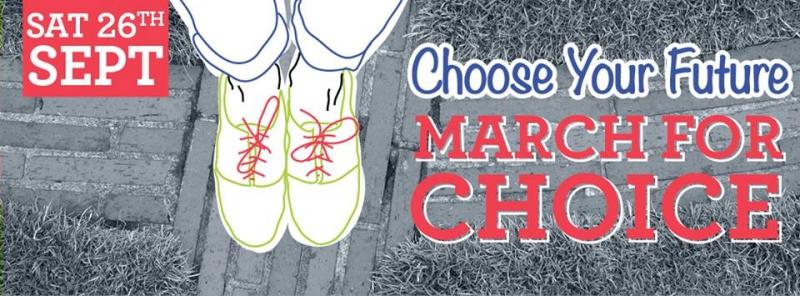
En el marco del Día de Acción Global por un Aborto Legal, Seguro y Gratuito, la ARC organizó su Cuarta Marcha Mundial por el Derechoa Decidir, el 26 de septiembre de 2015. La marcha es parte de la misión de ARC que incluye tanto garantizar el acceso al aborto libre, seguro y legal, como cuestionar el ambiente restrictivo, estigmatizado y patriarcal que rodea a la salud y los derechos sexuales y reproductivos en Irlanda.
Cathie Doherty, una de los co-convocantes de ARC afirma: «En Irlanda hay ganas de que se produzca un cambio real, en contra de lo que sostienen el Ministro de Sanidad y del Primer Ministro. Tenemos que acabar con la hipocresía de los viajes al exterior, que obliga a las mujeres que no pueden viajar a continuar con sus embarazos o a incumplir la ley importando píldoras para abortar. Podemos cambiar Irlanda. Podemos tener una sociedad que nos trate como seres humanos valiosos, que lo somos».
«Alza la voz» – Romper el silencio y acabar con el estigma
La ARC trabaja en estrecha colaboración con las mujeres que han abortado para que cuenten sus historias, creando un espacio seguro donde las mujeres pueden hablar y ser escuchadas. La acción «Speak Out» [Alza la voz] organizada en 2013 y nuevamente en 2014 facilitó una plataforma a las mujeres para que pudieran hablar sobre sus experiencias de abortos y atención a la salud reproductiva en el extranjero o ilegalmente en Irlanda.
Algunas mujeres compartieron sus historias con la prensa. La actriz y escritora Tara Flynn habló recientemente en público sobre su experiencia a través del periódico The Irish Times, en declaraciones sobre la Marcha por el Derecho a Decidir en la que se dispone a participar: «Es hora de admitir las historias de las mujeres reales — las mujeres que todo el mundo conoce — y los hechos concretos: cientos de miles de mujeres han tenido que viajar y continuarán viajando para obtener la atención médica que necesitan, o han puesto en riesgo su vida. El silencio no nos ha llevado a ninguna parte. Es hora de alzar la voz".
Desmontando mitos a través de las redes sociales
Para la campaña ARC, las redes sociales son una plataforma eficaz para hacer campaña y poner de relieve cuestiones que tienen que ver con la autonomía corporal, de las que no se ocupan los medios de comunicación más tradicionales.
«Nos esforzamos por incorporar el uso de los nuevos medios y las tecnologías en todo nuestro trabajo de incidencia, con el objetivo de involucrar a un público lo más amplio posible», afirmó una portavoz de la ARC.
En 2014, en la semana previa al Día Internacional de las Mujeres, ARC organizó la campaña «8 días, 8 mitos», para acabar con el estigma y las mentiras que rodean al aborto.
Cuarta Marcha Anual por el Derecho a Decidir (en inglés)
En Irlande, le « silence est rompu » : La Campagne pour le droit à l’avortement
Abortion Rights Campaign (ARC – Campagne pour le droit à l’avortement) – qui milite pour que l’avortement devienne gratuit, sûr et légal en Irlande – est membre de l’AWID depuis le mois de mai 2015. Cette organisation de base, non hiérarchique et entièrement composée de bénévoles mène son action en faveur de l’avortement en toute indépendance.
Elle collabore avec de nombreux groupes de défense de la justice sociale, des droits humains et de l’égalité de genre qui, tous, travaillent sur des thèmes liés à l’incapacité de l’Irlande à garantir pleinement la santé et les droits sexuels et reproductifs (SDSR) des femmes, notamment depuis l’adoption en 1983 du 8e amendement de la Constitution irlandaise. L’ARC n’existe que depuis janvier 2013, mais elle collabore déjà activement avec plus de 15 organisations basées dans toute l’Irlande ou d’envergure internationale, parmi lesquelles des conseils de femmes, des groupes de défense des droits des personnes transgenres, des migrant-e-s, des gens du voyage mais aussi des organisations régionales / rurales.
Marcher pour le droit de choisir
Dans le cadre de la Journée mondiale d’action pour l’accès à l’avortement sûr et légal, l’ARC a organisé sa 4e Marche annuelle pour l’avortement (site en anglais) le 26 septembre. Cette marche est une partie intégrante de la mission de l’ARC, une mission qui consiste d’une part à lutter pour que les femmes puissent avorter légalement, gratuitement et en toute sécurité et, d’autre part, à remettre en cause le contexte restrictif, stigmatisant et patriarcal dans lequel la SDSR est mise en œuvre en Irlande.
Selon Cathie Doherty, l’une des co-organisatrices de l’ARC, « l’Irlande aspire actuellement à un vrai changement, contrairement à ce que prétendent le ministre de la Santé et le Premier ministre. Nous devons cesser de prétendre que les femmes irlandaises ne vont pas à l’étranger pour avorter. Cette hypocrisie contraint les femmes qui ne peuvent pas adopter cette solution à mener à leur terme des grossesses non désirées ou à importer illégalement des pilules abortives. Nous pouvons faire évoluer l’Irlande. Nous pouvons également vivre dans une société qui nous traite comme les êtres humains estimables que nous sommes.»
Prendre la parole pour rompre le silence et mettre fin à la stigmatisation
L’ARC collabore étroitement avec de nombreuses femmes qui ont avorté, et ce dans le but de faire connaître leur histoire. Elle met à leur disposition un espace sûr au sein duquel elles peuvent parler et être écoutées. Des séances de prise de parole (« Speak-out ») ont été organisées en 2013 puis en 2014, dans le but d’offrir à ces femmes la possibilité de parler de l’avortement ou des soins de médecine procréative dont elles ont pu bénéficier à l’étranger ou, illégalement, en Irlande.
Certaines des participantes ont confié leur témoignage à des journalistes. L’écrivaine et comédienne Tara Flynn a récemment évoqué sa propre expérience dans un article de l’Irish Times (site en anglais). Elle a notamment affirmé qu’elle participerait à la Marche pour le droit de choisir, poursuivant en ces termes : « il est temps de reconnaître le vécu réel de toutes ces femmes – que nous connaissons – et d’admettre les faits tels qu’ils sont : des centaines de milliers de femmes ont été contraintes de prendre des risques ou d’aller à l’étranger pour recevoir les soins de santé dont elles avaient besoin. Le silence ne nous a mené à rien. Il est temps de parler. »
Mettre à bas les mythes grâce aux médias sociaux
L’ARC considère les médias sociaux comme une plateforme efficace pour mener son action et mettre en lumière les questions relatives à l’autonomie corporelle, un sujet que les médias traditionnels n’abordent généralement pas.
« Pour atteindre le public le plus large possible, nous [l’ARC] nous efforçons d’intégrer l’utilisation des nouveaux médias et des nouvelles technologies à tous les niveaux de notre travail de plaidoyer. »
En préparation de la Journée internationale des femmes 2014, l’ARC a mené la campagne « 8 days, 8 myths » (« 8 jours, 8 mythes »), dans le but de saper les fondements de la stigmatisation et des préjugés dont sont victimes les femmes qui avortent.
Présentation de la 4e Marche annuelle pour le droit de choisir (en anglais)
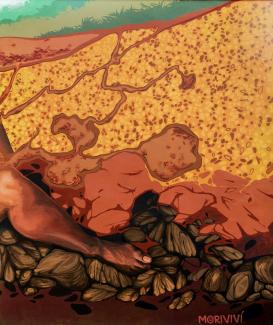
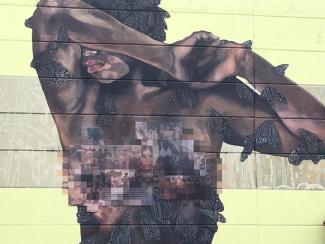
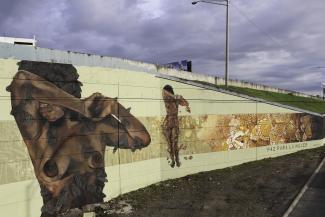
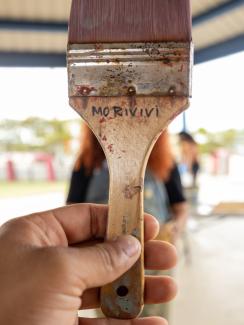
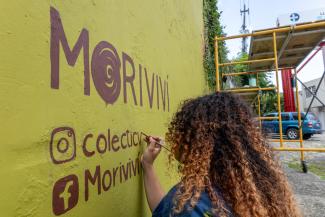
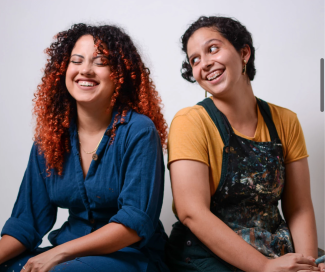
Colectivo Moriviví is an all women artistic collective. Our artistic production consists of muralism, community-led muralism, and protest performance/actions. Our work is about democratizing art and bringing the narratives of Puerto Rican communities to the public sphere to create spaces in which they are validated. We believe that through artivism we can promote consciousness on social issues and strengthen our collective memory.
“Cacibajagua” 2017, Mural Project. Jiangxi, China“Cacibajagua” 2017, Mural Project. Jiangxi, China“Paz para la Mujer” 2015, collaboration with Coordinadora Paz para la Mujer Organization. Santurce, Puerto Rico
“Paz para la Mujer” 2015, collaboration with Coordinadora Paz para la Mujer Organization. Santurce, Puerto Rico
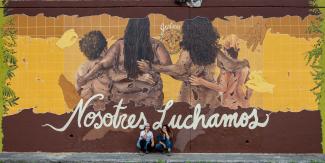
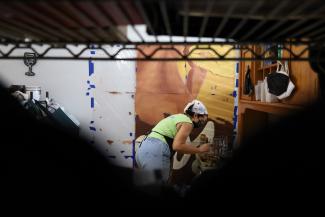
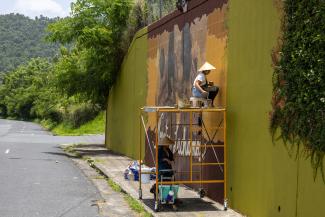
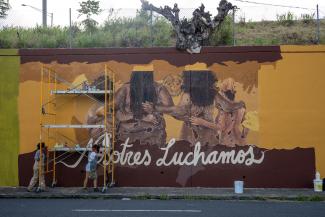
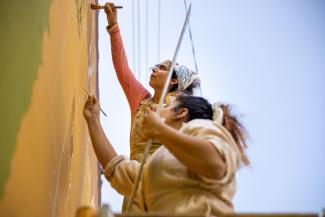
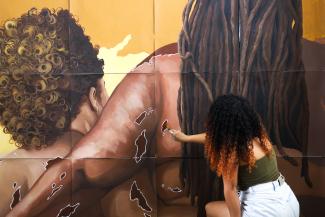
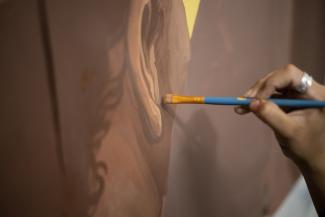
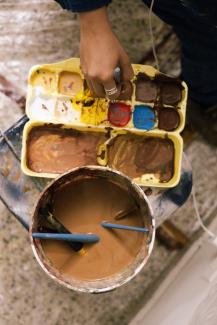
As part of their participation in AWID’s Artist Working Group, Colectivo Morivivi gathered a diverse group of members, partners and staff to facilitate a collaborative process of dreaming into, informing, and deciding on the content for a community mural through a multi-stage co-creation process. The project began with a remote conceptualization with feminists from different parts of the planet brought together by AWID, and then it evolved to its re-contextualization and realization in Puerto Rico. We were honored to have the input of local artists Las Nietas de Nonó(@lasnietasdenono), the participation of local women in the Community Painting Session, the logistics support from the Municipality of Caguas, and FRIDA Young Feminist Fund’s additional support to the collective.
The mural explores the transcendence of borders by presenting bodies like a map, in an embrace that highlights the intersection of the different feminist manifestations, practices and realities.
We also thank Kelvin Rodríguez, who documented and captured the different stages of this project in Puerto Rico:
About Colectivo Morivivi
Moriviví is a collective of young female artists, working on public art since April 2013. Based in Puerto Rico, we’ve gained recognition for the creation of murals and community led arts.
The group started out in local Urban Art Festivals. As our work became more popular, organizations and community leadership started to reach out to us. We began as eight high schoolers who wanted to paint a mural together. However, in eight years of hard work, we’ve faced many challenges. Now we are in a period of transition. During this following year, we aim to restructure the collective internally. Our goal is to open new opportunities for collaborators and back-up our decision making process with a new evaluation system. In the long run, we aspire to become an alternative school of art practice for those interested in immersing themselves in community art production.