Movement Building
Related Content
حالة التمويل للحركات النسوية ووقائعها تتغير بسرعة. هل هذا الاستطلاع لمرة واحدة؟
كلا. يبني هذا الاستطلاع على المعلومات التي حشدتها جمعية حقوق المرأة في التنمية حول كيفية الحصول على تمويل أكبر وأفضل للحركات النسوية وحركات التغيير الاجتماعي وهذه الدورة الثالثة لاستطلاع "أين التمويل للتنظيمات النسوية". نهدف للقيام بالاستطلاع مرة كل ثلاثة أعوام.
Snippet - WITM Who should - PT
Quem deve realizar este inquérito?
O inquérito destina-se a grupos, organizações e movimentos que trabalham especificamente ou principalmente pelos direitos das mulheres, pessoas LBTQI+ e pela justiça de género, em todos os contextos, em todos os níveis e em todas as regiões. Se este for um dos pilares principais do seu grupo, da sua comunidade, da sua rede ou de qualquer outro tipo de organização, quer esteja registada ou não, seja nova ou já estabelecida, convidamo-lo a participar neste inquérito.

* De momento, não solicitamos respostas de indivídues ou de fundos feministas e de mulheres.
Snippet - CSW69 - Feminist Solidarity Space - EN
Feminist Solidarity Space
✉️ By registration for larger groups. Drop-ins for smaller groups. Register here
📅 Tuesday, March 11, 2025
🕒 12.00-2.00pm and 4.00-6.00pm EST
🏢 Chef's Kitchen Loft with Terrace, 216 East 45th St 13th Floor New York
Organizer: AWID
Snippet - CSW69 - Challenging the Status Quo - EN
Challenging the Status Quo
A Critical Dialogue on Gender Equality and Human Rights
✉️ Online registration available. Register here
📅 Friday, March 21, 2025
🕒 2.30pm EST
🏢 Church Center of the United Nations, 11th Floor. 777 United Nations Plaza, New York, NY 10017
🎙️AWID speaker: Anissa Daboussi, Manager, Advancing Universal Rights and Justice team
Organizer: IWRAW AP, OURs, AWID, SRI
AWID IN 2015: Building Collective Impact

In 2015 AWID grew and diversified.
We ramped up preparations for the 13th AWID international Forum, focused a lot of energy on the Post 2015 Development Agenda and Financing for Development processes, and continued the core work of our priority areas:
- Challenging Religious Fundamentalisms
- Women Human Rights Defenders
- Economic Justice
- Resourcing Women’s Rights
- Young Feminist Activism
A sneak peak inside the report
The context
- We continue witnessing the rapid breakdown in democracy and democratic institutions, with spaces for dissent shrinking.
- Multiple and concurrent systemic crises (energy, food, finance and climate) continue to deepen inequalities and pose major challenges.
- Corporations are a leading power in determining the development agenda.
- Violence against WHRDs remains an urgent problem.
- Religious fundamentalisms are pervasive and increasingly powerful.
- New forms of online gender-based violence have emerged.
In response, we are moving out of our silos.
Increasingly, women’s rights and other movements worldwide are articulating the systemic and intersectional nature of these and other problems. We are making better connections with the agendas of other social and environmental movements for solidarity, alliance building and collective responses. We are also seeing greater visibility of these movements fighting for justice on the ground.
Our Impact
- For effective strategizing and advocacy, we need facts
- To exchange knowledge and join hands in solidarity, we need a strong online community
- To build our collective power, we need to work together
- To influence international processes, we need to increase our access and voice
- To reposition power we need to give visibility and emphasize the important role that feminist and women’s rights movements are already playing
Our Members
As at 31st December, 2015 we had:

Read the full report
Snippet - WCFM type of funding- EN

Type of funding:
Be it core funding, programmes & projects or rapid response/ emergency grants.
Isabel Marler
Biography
Isabel is a feminist from the United Kingdom with over a decade of experience in feminist responses to fascisms, fundamentalisms, and anti-rights trends. At AWID, her work centers on knowledge-building and has included leading the production of the Rights at Risk series in collaboration with the Observatory on the Universality of Rights (OURs). She holds a Master’s degree in Gender Studies from the School of Oriental and African Studies (SOAS) and previously worked with Women Living Under Muslim Laws (WLUML). She is passionate about cross-movement work, movement-centered knowledge-building, and the use of creative expression to disrupt systems of oppression. Outside of work, Isabel is active in various disability justice spaces for collective care, learning, and advocacy.
Position
Advancing Universal Rights and Justice Lead
Add to stories
Off
Snippet WITM survey result - EN
DATA SNAPSHOTS
Where is the money for feminist organizing?
1,174 feminist, women's rights & LGBTQI+ organizations
from 129 countries participated in AWID's 2024 survey.
The data reveals the state of resourcing for feminist movements between 2021-2023, amid current major defunding trends in aid and philanthropy.
Our collective power knows no boundaries, but our bank accounts do.
Sanyu Awori
Biography
Sanyu is a Pan-African feminist based in Nairobi, Kenya. She has spent the last decade supporting labour, feminist and human rights movements advocating for corporate accountability, economic justice and gender justice. She has worked with the Business & Human Rights Resource Centre, IWRAW Asia Pacific and the Commonwealth Human Rights Initiative. She has a Master’s of Laws in Human Rights Law and a Bachelor’s of Laws from the University of Nottingham. Her writing has been published in the Business and Human Rights Journal, Human Rights Law Review, Open Global Rights, Open Democracy and more. In her free time, she loves walking in the forest and chasing butterflies.
Position
Manager, Building Feminist Economies
Add to stories
Off
Snippet - COP30 - The People's Summit
The People's Summit
The climate summit by movements, for movements.
📅 November 12 - November 16, 2025
📍 Universidade Federal do Pará, Belém
Brenda Salas Neves
Biography
Brenda Salas Neves is a feminist queer strategist born and raised in the southern Andes. They organize to shift narratives and mobilize resources to support racial and climate justice movements around the world. They have produced media projects to uplift migrant power and rise against U.S. military intervention across Latin America, with Deep Dish TV and the Portland Central America Solidarity Committee. They are a proud member of the Audre Lorde Project and a graduate of the United World Colleges (UWC) movement.
Position
Secretary
Add to stories
Off
Snippet - COP30 - Ecozine card - EN
📰 Feminist Transnational Solidarity: an Antidote to Ecocide
This collaborative zine originated from a series of sharing circles that brought together feminists from around the world throughout 2022. The purpose was to exchange ideas and mutually learn how communities are responding to the climate crisis in various local contexts.
Can organizations be members of AWID?
Yes, we encourage institutional membership.
AWID currently has hundreds of prominent, innovative organizations working on issues related to women’s rights and development as members. Criteria for membership are the same as for individuals, although membership fees and membership benefits are different, and are geared to address the needs of our member organizations.
Snippet 8 - What's happening at HRC61 Intro
- Independent Expert on foreign debt
Report on International assistance and cooperation - Special Rapporteur on food
Report on land and the right to food - Special Rapporteur on persons with disabilities
Report on equal participation of persons with disabilities in political life - Special Rapporteur on privacy
International collection of personal data
2009: The UN holds Conference on the impact of the economic crisis
2009 UN Conference on the World Financial and Economic Crisis and its Impacts on Development
- The 2009 conference was an outcome of the 2008 Doha conference. The Doha Declaration had mandated that the United Nations hold a conference, to be organized by the President of the General Assembly, on the world financial and economic crisis and its impact on development.
- During the conference women’s groups, through the WWG, highlighted the impact of the global financial crisis on vulnerable groups. In their statement to the members, the WWG proposed necessary actions to be taken by member states to redress the effects of the crisis to women. They stated that other social groups affected by the crisis are key to a response that is harmonized with international standards and commitments to gender equality, women’s rights and human rights and empowerment.
Protection of the Family
The Issue
Over the past few years, a troubling new trend at the international human rights level is being observed, where discourses on ‘protecting the family’ are being employed to defend violations committed against family members, to bolster and justify impunity, and to restrict equal rights within and to family life.
The campaign to "Protect the Family" is driven by ultra-conservative efforts to impose "traditional" and patriarchal interpretations of the family, and to move rights out of the hands of family members and into the institution of ‘the family’.
“Protection of the Family” efforts stem from:
- rising traditionalism,
- rising cultural, social and religious conservatism and
- sentiment hostile to women’s human rights, sexual rights, child rights and the rights of persons with non-normative gender identities and sexual orientations.
Since 2014, a group of states have been operating as a bloc in human rights spaces under the name “Group of Friends of the Family”, and resolutions on “Protection of the Family” have been successfully passed every year since 2014.
This agenda has spread beyond the Human Rights Council. We have seen regressive language on “the family” being introduced at the Commission on the Status of Women, and attempts made to introduce it in negotiations on the Sustainable Development Goals.
Our Approach
AWID works with partners and allies to jointly resist “Protection of the Family” and other regressive agendas, and to uphold the universality of human rights.
In response to the increased influence of regressive actors in human rights spaces, AWID joined allies to form the Observatory on the Universality of Rights (OURs). OURs is a collaborative project that monitors, analyzes, and shares information on anti-rights initiatives like “Protection of the Family”.
Rights at Risk, the first OURs report, charts a map of the actors making up the global anti-rights lobby, identifies their key discourses and strategies, and the effect they are having on our human rights.
The report outlines “Protection of the Family” as an agenda that has fostered collaboration across a broad range of regressive actors at the UN. It describes it as: “a strategic framework that houses “multiple patriarchal and anti-rights positions, where the framework, in turn, aims to justify and institutionalize these positions.”
Related Content
Can I submit a session proposal?
The call for session proposal is now closed.
We launched a Call for Activities on November 19 2019 and the last date to receive proposals was February 14, 2020.
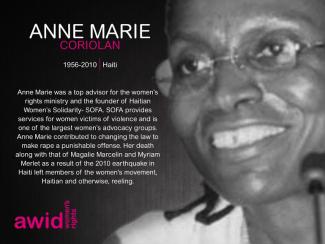
Anne Marie Coriolan
Why did AWID choose Taipei as the location for the Forum?
We see Taipei as the location in the Asia Pacific region that will best allow us to build that safe and rebelious space for our global feminist community.
Taipei offers a moderate degree of stability and safety for the diversity of Forum participants we will convene. It also has strong logistical capacities, and is accessible for many travellers (with a facilitated e-visa process for international conferences).
The local feminist movement is welcoming of the Forum and keen to engage with feminists from across the globe.
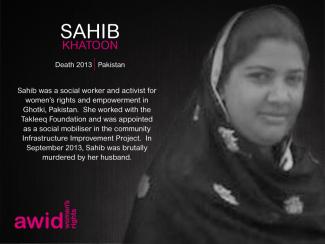
Sahib Khatoon