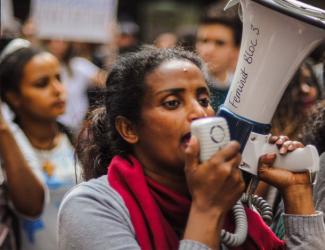


Anit-Racism Movement (ARM) / Flickr (CC BY-NC-ND 2.0)

Priority Areas

Supporting feminist, women’s rights and gender justice movements to thrive, to be a driving force in challenging systems of oppression, and to co-create feminist realities.

Resourcing Feminist Movements

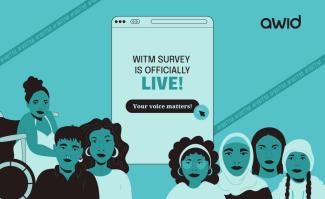
Banner image announcing that WITM Survey is live.


The “Where is the Money?” #WITM survey is now live! Dive in and share your experience with funding your organizing with feminists around the world.

Learn more and take the survey


Around the world, feminist, women’s rights, and allied movements are confronting power and reimagining a politics of liberation. The contributions that fuel this work come in many forms, from financial and political resources to daily acts of resistance and survival.


AWID’s Resourcing Feminist Movements (RFM) Initiative shines a light on the current funding ecosystem, which range from self-generated models of resourcing to more formal funding streams.

Through our research and analysis, we examine how funding practices can better serve our movements. We critically explore the contradictions in “funding” social transformation, especially in the face of increasing political repression, anti-rights agendas, and rising corporate power. Above all, we build collective strategies that support thriving, robust, and resilient movements.


Our Actions

Recognizing the richness of our movements and responding to the current moment, we:

  • Create and amplify alternatives: We amplify funding practices that center activists’ own priorities and engage a diverse range of funders and activists in crafting new, dynamic models  for resourcing feminist movements, particularly in the context of closing civil society space.

  • Build knowledge: We explore, exchange, and strengthen knowledge about how movements are attracting, organizing, and using the resources they need to accomplish meaningful change.

  • Advocate: We work in partnerships, such as the Count Me In! Consortium, to influence funding agendas and open space for feminist movements to be in direct dialogue to shift power and money.

Related Content

#7 - Sexting like a feminist Tweets Snippet AR

أداؤك في المضاجع مهاراتك في ضبط المراجع…

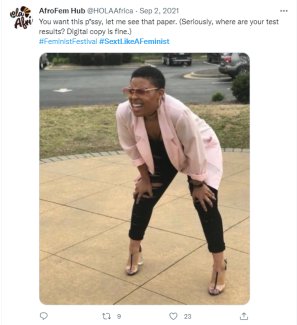
You want this pussy? Let me see that paper. (Seriously, where are your test results? Digital copy is fine.)

منجزاتك الأكاديمية جسر عبور نحو شهوتك الجنسيّة (جدّيًا، سلِّم الأوراق المطلوبة، الكترونية كانت أم ورقيّة)

Snippet - COP30 - International Eco-Socialist Encounter - EN

International Eco-Socialist Encounter

Panels, workshops, plenaries and spaces for exchange between collectives, activists and organizations in struggle to collectively walk the path towards an agenda and a program of struggle for ecosocialism.

📅 November 8 - November 11, 2025
📍 Buenos Aires, Argentina

Register here

Beijing Unfettered: the Power of Young Feminist Movements

In partnership with young feminist activists and youth-led organizations, AWID co-organized Beijing Unfettered in parallel to and independently from Beijing+25. 

Learn more

Snippet - COP30 - Resistance Hubs

Resistance Hubs for Climate Justice

Snippet - WID2026 - Join the Global _EN

Join the Global Feminist Community!

Sign up to be an AWID member to connect with 9,600+ global feminist movements and co-create a range of platforms and spaces designed especially for activists and organizations from teach-ins to solidarity spaces and member mixers. 

The AWID Membership community is available as an app. Download the app and start connecting with movements! 

Confronting Extractivism & Corporate Power

Women human rights defenders (WHRDs) worldwide defend their lands, livelihoods and communities from extractive industries and corporate power. They stand against powerful economic and political interests driving land theft, displacement of communities, loss of livelihoods, and environmental degradation.


Why resist extractive industries?

Extractivism is an economic and political model of development that commodifies nature and prioritizes profit over human rights and the environment. Rooted in colonial history, it reinforces social and economic inequalities locally and globally. Often, Black, rural and Indigenous women are the most affected by extractivism, and are largely excluded from decision-making. Defying these patriarchal and neo-colonial forces, women rise in defense of rights, lands, people and nature.

Critical risks and gender-specific violence

WHRDs confronting extractive industries experience a range of risks, threats and violations, including criminalization, stigmatization, violence and intimidation.  Their stories reveal a strong aspect of gendered and sexualized violence. Perpetrators include state and local authorities, corporations, police, military, paramilitary and private security forces, and at times their own communities.

Acting together

AWID and the Women Human Rights Defenders International Coalition (WHRD-IC) are pleased to announce “Women Human Rights Defenders Confronting Extractivism and Corporate Power”; a cross-regional research project documenting the lived experiences of WHRDs from Asia, Africa and Latin America.

We encourage activists, members of social movements, organized civil society, donors and policy makers to read and use these products for advocacy, education and inspiration.

Share your experience and questions!

Tell us how you are using the resources on WHRDs Confronting extractivism and corporate power.

◾️ How can these resources support your activism and advocacy?

◾️ What additional information or knowledge do you need to make the best use of these resources?

Share your feedback


Thank you!

AWID acknowledges with gratitude the invaluable input of every Woman Human Rights Defender who participated in this project. This project was made possible thanks to your willingness to generously and openly share your experiences and learnings. Your courage, creativity and resilience is an inspiration for us all. Thank you!

Related Content

Mettre fin aux violences faites aux femmes, « une bataille qui vaut toujours la peine d’être menée ! »

Mettre fin aux violences faites aux femmes, « une bataille qui vaut toujours la peine d’être menée ! »

D’origine libanaise et palestinienne, Lina Abirafeh (membre individuelle de l'AWID) est née dans un contexte de conflits, de déplacements de population et de problématiques de genre. Déterminée à mettre un terme à la violence à l’égard des femmes, elle dit : « Nous devrions tou-te-s lutter fermement contre la violence faite aux femmes ! C’est la violation des droits humains la plus répandue dans le monde, et elle dure depuis bien trop longtemps. C’est une bataille qui vaut la peine d’être menée, même si nous n’en voyons pas les résultats de notre vivant ! »

Lina, qui a obtenu un doctorat du Département pour le développement international de la London School of Economics, voit sa thèse actuellement publiée dans un ouvrage (en anglais) intitulé Gender and International Aid in Afghanistan: The Politics and Effects of Intervention (Genre et aide internationale en Afghanistan : les politiques et effets de l’intervention). Pendant près de 20 ans, elle s’est attachée à travailler sur des questions de violence contre les femmes, particulièrement dans des situations d’urgence et dans plus de 20 pays dont l’Afghanistan, la Papouasie-Nouvelle-Guinée, la République démocratique du Congo, Haïti, le Mali, le Népal et la République centrafricaine. Lina a également collaboré avec de nombreuses agences de l’ONU, avec la Banque Mondiale, et avec différentes organisations non-gouvernementales internationales et nationales. Elle intègrera au mois de septembre la Lebanese American University (LAU) à Beyrouth en tant que Directrice de l’Institute for Women’s Studies (IWSAW) in the Arab World (institut d’études des femmes dans le monde arabe).

 « Nous sommes tou-te-s concerné-e-s. Nous sommes donc tou-te-s responsables. » - Lina Abirafeh

Lina se fait aussi une joie de communiquer avec d’autres membres ! 

Vous pouvez voir la présentation (en anglais) TEDx de Lina sur son travail concernant la violence sexuelle au cours de crises humanitaires.


Source
AWID

Ending violence against women, "it's still worth a fight!"

Ending violence against women, "it's still worth a fight!"

Lina Abirafeh (an AWID individual member) is Lebanese and Palestinian, born into conflict, displacement and gender issues. She is committed to ending violence against women and says “we all should be! It is the most pervasive human rights violation in the world, and it has endured far too long. Even if we don’t see the results in our lifetime, it’s still worth a fight!

Lina received a PhD from the London School of Economics Department of International Development, her research being published in a book entitled Gender and International Aid in Afghanistan: The Politics and Effects of Intervention. For nearly 20 years she has been dedicated to working on issues pertaining to violence against women, specifically in emergency contexts and in over 20 countries including Afghanistan, Papua New Guinea, Democratic Republic of Congo, Haiti, Mali, Nepal, and Central African Republic. Lina has also worked with numerous UN agencies, the World Bank, as well as with diverse international and national non-governmental organizations. In September 2015, she joined the Lebanese American University (LAU) in Beirut as Director of the Institute for Women’s Studies (IWSAW) in the Arab World.
“We are all affected. So we are all responsible.” - Lina Abirafeh
Lina is also looking forward to connecting with other members!
 
Watch Lina’s talk for TEDx on her work regarding sexual violence in humanitarian emergencies


Region
West Asia
Source
AWID

Para terminar con la violencia contra las mujeres, ¡aún vale la pena luchar!

Para terminar con la violencia contra las mujeres, ¡aún vale la pena luchar!

Lina Abirafeh (afiliada individual de AWID) es libanesa y palestina. Nació en medio del conflicto, el desplazamiento y la discriminación de género y está comprometida con la eliminación de la violencia contra las mujeres. «¡Todas las personas deberíamos tener el mismo compromiso!», afirma. «Es la violación a los derechos humanos más generalizada en el mundo y persiste desde hace mucho tiempo. Aun cuando no veremos los resultados durante nuestra vida, vale la pena luchar».

Lina obtuvo un título de doctorado del departamento de desarrollo internacional de London School of Economics, para el que presentó una investigación publicada (en inglés) en el libro Gender and International Aid in Afghanistan: The Politics and Effects of Intervention [Género y ayuda internacional en Afganistán: La política y los efectos de la intervención]. Durante casi 20 años Lina se ha dedicado a trabajar por los temas referidos a la violencia contra las mujeres, especialmente a la ejercida en contextos de emergencia y en más de 20 países, incluidos Afganistán, Papua Nueva Guinea, República Democrática del Congo, Haití, Malí, Nepal y República Centroafricana. Ha trabajado también con numerosos organismos de las Naciones Unidas, el Banco Mundial y diversas organizaciones no gubernamentales nacionales e internacionales. En septiembre se incorporará a la Lebanese American University [universidad libanesa americana] de Beirut como directora del instituto para los estudios de la mujer en el mundo árabe (IWSAW).
 
«Todas las personas nos vemos afectadas; por eso todas somos responsables.» - Lina Abirafeh
 
Lina también anhela conectarse con otras/os afiliadas/os de AWID. 
 
Mira la charla de Lina (en inglés) por TEDx sobre su labor para evitar la violencia sexual en escenarios de emergencia humanitaria.


Source
AWID

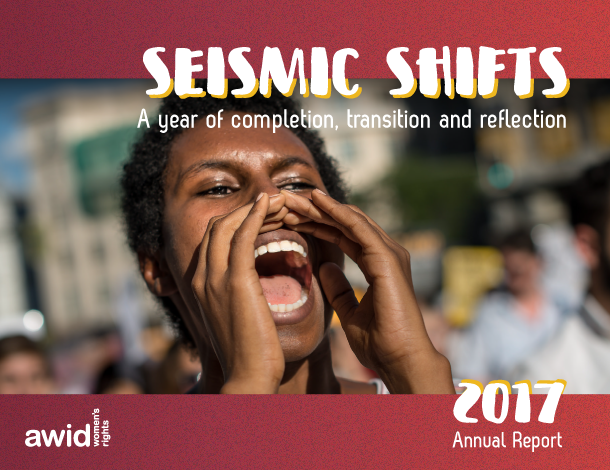
Seismic shifts: A year of completion, transition and reflection | Annual report 2017

The past five years have been huge for AWID.

We have contributed to some major victories, like expanding the women’s rights funding landscape with ground-breaking, far-reaching research and advocacy. At the same time, we have experienced some devastating setbacks, including the assassination of Women Human Rights Defenders (WHRDs) like Berta Cacares of Honduras, Gauri Lankesh of India and Marielle Franco of Brazil, as well as the rise of anti-rights mobilizing in human rights spaces.

Five years ago, we committed to our movement-building role by producing knowledge on anti-rights movement trends, as well as on issues that feminists often engage with less, like illicit financial flows. We advocated side by side with our movement partners, strengthening young feminist and inter-generational activism, and expanding the holistic protection of WHRDs. As we close out the strategic plan, we are proud of our accomplishments and our growth as an organization. We end 2017 with renewed commitment, insights and learning for the continued struggle ahead!


Margarita Salas Guzmán

Biography

Margarita is a feminist and LGBTIQA activist from Latin America; her passion is social transformation and collective wellbeing. She holds degrees in Psychology, Communications and Public Administration, as well as certificates in Public Policy, Leadership, Management & Decision Making. In her professional capacity, Margarita has had extensive experience with grassroots organizations, national and regional NGOs, universities and the public sector, developing facilitation, capacity building, political advocacy, communications & policy assessment.

Position
Special Projects Manager
Add to stories
Off

Patience Chabururuka

Biography

Patience is a global human resources professional with over a decade of experience in human resources (HR) management in the not-for-profit sector. Patience previously worked at Mercy Corps as the Global HR Officer for Africa supporting the full employee life cycle for expatriates in the Eastern and Southern African region and provided HR technical guidance to Human Resources leaders in country offices within the African region. Before joining the global people team, she was the Country Human Resources and Safeguarding Focal Point, she was part of the senior management team leading on all human resources and safeguarding matters. Prior to Mercy Corps she led the HR and Operations department at SNV Netherlands Development Organization and was a member of the country management team. She also has HR Consultancy experience which she gained while she was still studying for her BSc Honors degree in Human Resource Management. She has a passion for HR, loves working with people and she takes wellbeing and safeguarding as her core values and in her professional work. As someone who loves sports, you can also find Patience at the basketball court, the tennis court or on the soccer field.

Position
Human Resources Coordinator
Add to stories
Off

Nana Abuelsoud

Biography

Nana is a feminist organizer and a reproductive rights and population policy researcher based in Egypt. She is a member of Realizing Sexual and Reproductive Justice (RESURJ), a member of the Advisory Board of the A Project in Lebanon, and a member of the Community Committee of Mama Cash. Nana holds an MSc in Public Health from KIT Institute and Vrije University in Amsterdam. In her work, she follows and contextualizes national population policies while building evidence that addresses modern eugenics, regressive international aid, and authoritarianism. Previously, she was part of the Geneva Foundation for Medical Education and Research, the Egyptian Initiative for Personal Rights, and Ikhtyar Feminist Collective in Cairo.

Add to stories
Off

Do you produce an annual report?

Yes, we do produce annual reports.

All our annual reports are accessible online.

See all annual reports from AWID

2011: The fifth High-level dialogue kick starts Post-2015 discussions

The Fifth High- Level Dialogue on Financing for Development, 7 – 8 December 2011, marked the beginning of the Post 2015 development agenda discussions, and the link to financing for development. The conference gave a special focus to increasing aid to finance the MDG’s. In his closing remarks, the Secretary General called on members to begin to consider the post-2015 development framework. 

I am not able to submit a written proposal, are you accepting any other formats?

As part of our commitment to accessibility in all aspects of the AWID Forum we are accepting audio/video formats for those individuals/organizations/groups who can't submit a written application. 

If you choose to send your proposal in an audio/video format, kindly follow the same order to answer the questions as detailed in the Activity Proposal Form.

To submit an audio/video file please Contact us, selecting Forum Call for Activities as the subject of your email.

Contact us