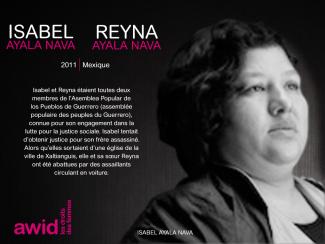
Isabel and Reyna Ayala Nava
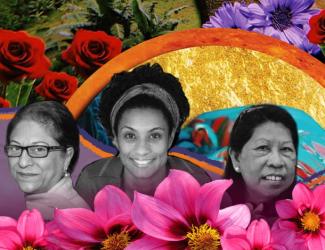
L’hommage se présente sous forme d’une exposition de portraits d’activistes du monde entier qui ne sont plus parmi nous qui ont lutté pour les droits des femmes et la justice sociale.
Cette année, tout en continuant à convoquer la mémoire de celleux qui ne sont plus parmi nous, nous souhaitons célébrer leur héritage et souligner les manières par lesquelles leur travail continue à avoir un impact sur nos réalités vécues aujourd’hui.
49 nouveaux portraits de féministes et de défenseur·e·s viennent compléter la gallerie. Bien que de nombreuses des personnes que nous honorons dans cet hommage sont décédé·e·s du fait de leur âge ou de la maladie, beaucoup trop d’entre iels ont été tué·e·s à cause de leur travail et de qui iels étaient.
Visiter notre exposition virtuelle
Les portraits de l'édition 2020 ont été illustrés par Louisa Bertman, artiste et animatrice qui a reçu plusieurs prix.
L’AWID tient à remercier nos membres, les familles, les organisations et les partenaires qui ont contribué à cette commémoration. Nous nous engageons auprès d’elleux à poursuivre le travail remarquable de ces féministes et défenseur·e·s et nous ne ménagerons aucun effort pour que justice soit faite dans les cas qui demeurent impunis.
« Ils ont essayé de nous enterrer. Ils ne savaient pas que nous étions des graines » - Proverbe mexicain
Le premier hommage aux défenseur-e-s des droits humains a pris la forme d’une exposition de portraits et de biographies de féministes et d’activistes disparu·e·s lors du 12e Forum international de l’AWID en Turquie. Il se présente maintenant comme une gallerie en ligne, mise à jour chaque année.
Depuis, 467 féministes et défenseur-e-s des droits humains ont été mis·es à l'honneur.
Nouveaux
Les participant.e.s se rassembleront physiquement sur un certain nombre de sites en dehors du site de Bangkok, dans différentes parties du monde, chaque jour du Forum. Tous ces sites auto-organisés seront virtuellement connectés au site du Forum à Bangkok pour des sessions conjointes et hybrides. Tout comme pour les personnes se connectant en ligne, les participant.e.s au Hub pourront animer des sessions, participer à des conversations et profiter d'un programme riche et diversifié.
Les lieux de rencontre seront annoncés en 2024.
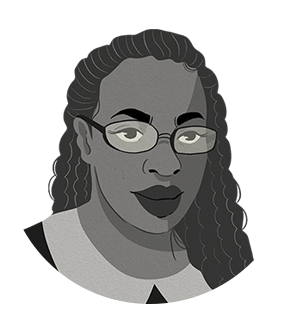
Chinelo Onwualu es una consultora editorial que posee casi 10 años de experiencia en la elaboración de comunicaciones estratégicas para entidades sin fines de lucro de todo el mundo. Algunos de sus clientes han sido ActionAid Nigeria, The BBC World Trust, Open Society Initiative for West Africa (OSIWA) y AWID. Posee una maestría en Periodismo de la Universidad de Siracusa, y ha trabajado como escritora, editora e investigadora en Nigeria, Canadá y Estados Unidos. Es además la editora de no ficción de la revista Anathema y cofundadora de Omenana, una revista de ficción especulativa africana. Sus cuentos se han publicado en diversas antologías galardonadas y ha sido nominada para los Premios Británicos de Ciencia Ficción, el Premio Nommo a la Ficción Africana Especulativa y el Premio Africano del Día de la Narrativa Breve. Es de Nigeria y reside en Toronto con su pareja e hijx.
“Lord, we are unworthy. We are the ones who committed sin for Eve ate the fruit in Eden. We are just women who grow sweet potatoes, look after pigs and give birth to children. We believe you died on the cross to set us free. Thank you, In Jesus’s name Amen.”
This is a typical prayer of women I have heard during my visits to ministries in several villages. Even I said the same prayer for many years.
I was born and grew up in Agamua, the Central Highlands of West Papua. My father belongs to the Lani tribe and my mother comes from Walak.
In Lani and Walak languages - languages spoken in the Central Highlands - tiru means a pillar. There are four tiru (pillars) standing firmly in the middle of the Lani roundhouse (honai), around wun’awe or a furnace. Tiru is always made of the strongest type of wood called a’pe (ironwood tree). The longer the wood gets heated and smoked from the fire in the honai, the stronger it becomes. Without tiru, the honai cannot stand firm. West Papuan women are these tiru.
West Papua is located in the western part of the New Guinea island, containing some of the world’s highest mountains, densest jungle, and richest mineral resources. It is home to over 250 groups and has an incredible biodiversity. Due to its natural wealth, West Papua has, over the centuries, been targeted by foreign occupiers. Until 1963, we were colonized by the Dutch. However in 1969, after a manipulative political act, we were transferred from the Dutch to Indonesia.
The first German missionaries arrived in Mansinam Island, Manokwari, in 1855. Then, in the 1950s, Christianity was brought to the Central Highlands of West Papua by Protestant missionaries of European descent from America, Canada, Australia and New Zealand.
According to Scripture in Genesis 1: 26-27, Man and Woman are created in the image of God. It means all humanity is made with the call and capacity to exercise dominion. Radah, the Hebrew word for dominion, means stewardship. Radah is not a call to exercise imperial power as declared by Pope Nicolas V, granting Catholic nations the right to “discover” and claim dominion over non-Christian lands. To diminish the capacity of humans to exercise dominion, is to diminish the image of God on earth (Lisa Sharon Harper, The Very Good Gospel).
The Evangelical Church of Indonesia (GIDI) was established as an institution in 1963. In the Sunday Service liturgy of GIDI, Women are considered unworthy to take any responsibility except collecting offerings. In 2003, after 40 years, the Department of Women was introduced within the structure of the Synod leadership.
In November 2013, I was entrusted to be a chairperson of the Women’s Department of the GIDI Synod.
Together with several other women leaders, we started a cell group that is committed to “decolonizing the Bible.” We learn together how to reconstruct the interpretation of biblical texts to champion women.
A feminist theologian named Elisabeth S Florenza calls it a feminist hermeneutic theory (Josina Wospakrik, Biblical Interpretation and Marginalization of Woman in the Churches of West Papua).
Besides the cell group, we interview our elderly women to collect our ancestors’ wisdom and values. As Bernard Narakobi in his book The Melanesian Way said: “Our history did not begin with contact with the Western explorers. Our civilization did not start with the coming of the Christian missionaries. Because we have an ancient civilization. It is important for us to give proper dignity and place to our history”.
Yum is a knotted net or woven bag handmade from wood fiber or leaves. Yum is highly valued for it symbolizes life and hope. When women of Lani and Walak get married, our maternal aunts put yum on our heads. It means we bear the responsibility for giving life and for providing food. Yum is used to carry garden produce as well as being used as a container to put a baby to sleep in as it gives warmth and a sense of security.
“West Papuan Women are Yum and Tiru” became the prime references as we contextualized women in the eyes of Jesus Christ in seminar and focus group discussions. From 2013 to 2018, we focused on reconstructing the view of women in GIDI and in gaining a healthy self-image. We are still in the process of understanding who we are to Jesus, rather than who we have been told we are by theologians and the fathers of the early Churches. Josina Wospakrik, a West Papuan Theologian said “The Gospel is incredibly rich but it was impoverished due to human ambitions and agendas.”
Since 2018, the GIDI Women Leadership team and I have formulated four priority programs: Decolonizing the Bible, Storytelling in a circle, Training of trainers for Literacy and Gender. The fourth, supported simple bookkeeping and savings groups workshops facilitated by Yapelin and Yasumat, which are faith based organizations established by GIDI leaders to reach the economic, social and health needs of women in the communities.
In this programme we create a safe space for women to talk - each woman has a story. We all sit together and learn how to be good listeners.
“I became Christian and was taught that the government is God’s representative. Why did the government do nothing when the army burnt down my village and killed my relatives?” asked one woman in the storytelling circle. “My aunt was raped.” She stopped for a while. Could not talk. She cried. We all did.
The process of storytelling has driven us into deep conversation. We began to contextualize Biblical texts within our daily realities.
We started asking questions amongst ourselves: Where is God in our toughest times? Does the state government truly represent God on earth? Why does the Creator allow privileged people to destroy His own image in the name of Christianity and Development? During the process, I realized that I have been reading the Bible using somebody else’s glasses.
The church has to be a safe place to share stories and be a place of comfort to be still and rest. As we reflect on the testimonies, those who tell their stories begin the process of recovering from wounds and trauma.
Culturally, West Papuans invest in relationships. The concept of saving is understood as an investment in relations, not in a bank account. And while the Indonesian central government has granted special autonomy to respond to West Papuans’ demand for self-determination, many government policies harm the quality of family life and they do not account for women’s lives. High illiteracy rates amongst women mean most women do not have access to a bank account. With no money saved, access to medical services becomes a struggle.
Through the priority programmes, Yapelin, with the active involvement and support of women, created saving groups in Bokondini and Jayapura. The saving groups are chaired by women who have access to a bank.
In coordination with Yayasan Bethany Indonesia (YBI) and Yayasan Suluh, a faith-based organization (FBO) based in Jayapura, we facilitated four literacy workshops. The literacy team facilitated the training of trainers in three different dioceses: Merauke, Sentani, and Benawa. We now have 30 facilitators in different congregations who run literacy programs.
Lack of financial support for our programs will not stop us. Being stigmatized as rebels will not stop us from standing up and speaking in church evaluation meetings and conferences. It is stressful but I am committed together with several women leaders to calling on the power-holders within to free the church.
The Gospel known as Good News should become news that liberates women from a very patriarchal circle of power, liberates women from social stigma and returns women to the original purpose of The Creator.
The Gospel must be a mirror to reflect who we are collectively. As Lisa Sharon Harper, in her book The Very Good Gospel said “The Gospel is not only about an individual’s reconciliation with God, self and communities. But also speaks on systemic justice, peace between people groups and freedom for the oppressed”.
Rode Wanimbo is the chairperson of the Women’s Department of Evangelical Church of Indonesia (GIDI).
Coming from a place of healing and self-care is a political act that guides us to be focused and to move as one. In New Orleans, we created and will be creating altars in honour of those murdered by police and white supremacists vigilantes!


< Anatomy of a Survivor's Story
As world leaders gather in Brazil, it’s vital that feminist movements especially from the Global Majority have autonomous spaces to gather, strategize, and disrupt.
These Hubs challenge the elitism of climate talks, center lived experiences, and aim to build collective power across borders. They offer a critical counterbalance to top-down, often exclusionary international negotiations. The Hubs aim to foster community-driven solutions, amplify feminist demands, and ensure that feminist principles of care and solidarity shape the climate agenda. It’s not just about being present at COP30, it’s about reshaping the conversation on climate justice on feminist terms.
Si tienes pasaporte de alguno de los siguientes países (el tiempo de estadía permitido varía según el país), NO necesitas visa para asistir al Foro de Taipéi:
Alemania, Andorra, Australia, Austria, Bélgica, Belice, Bulgaria, Brunei, Canadá, Chile, Ciudad del Vaticano, Croacia, Chipre, Dinamarca, Eslovaquia, Eslovenia, Estados Unidos de América, Estonia, España, Esuatini, Filipinas, Finlandia, Francia, Grecia, Guatemala, Haití, Honduras, Hungría, Irlanda, Islandia, Israel, Italia, Japón*, Letonia, Liechtenstein, Lituania, Luxemburgo, Malasia, Malta, Islas Marshall, Mónaco, Nauru, Nueva Zelanda, Nicaragua, Noruega, Países Bajos, Palaos, Paraguay, Polonia, Portugal, Reino Unido, República Checa, República de Corea, República Dominicana, Rumania, Rusia, San Cristóbal y Nieves, San Marino, Santa Lucía, San Vicente y las Granadinas, Singapur, Suecia, Suiza y Tuvalu.
Las personas con cualquier otro pasaporte NECESITARÁN VISA para ir a Taipéi.
Por favor ten en cuenta:
Es probable que, una vez que te hayas inscripto para asistir al Foro, te llegue un código relacionado con el evento que te permitirá tramitar tu visa en forma electrónica, cualquiera sea tu ciudadanía.
Brindaremos más información sobre este tema cuando se abra el proceso de inscripción.

Panel : Dans le cadre d'une table ronde, explorez une question ou un défi sous différents angles, ou partagez un apprentissage ou une expérience, puis posez des questions à l'auditoire, si le temps le permet.
Talk-show : Organisez une conversation plus spontanée dans le cadre d'un talk-show. Les talk-shows peuvent être une conversation entre plusieurs personnes, animée par un.e présentatrice.eur de talk-show. Les questions du public peuvent déterminer l'orientation de la conversation.
Discussion : Elles peuvent prendre la forme de cafés du monde, de cercles restreints ou fishbowl et d'autres méthodologies qui facilitent l'implication active des participant.e.s dans les conversations. Il s’agit d’un format très participatif.
Atelier : Sessions interactives qui invitent les participant.e.s à acquérir de nouvelles compétences dans tous les domaines de la vie et de l'activisme.
Session stratégique : Il s'agit d'une invitation à réfléchir à une question ou à une stratégie, en profondeur, avec d'autres personnes. Un espace pour apprendre les un.e.s des autres : ce qui fonctionne, ce qui ne fonctionne pas, et comment développer de nouvelles stratégies collectives pour créer les mondes dont nous rêvons.
Cercle de partages (également connu sous le nom de Birds of a Feather) : Idéal pour les petits groupes, dans un cadre plus intime, afin d'écouter les un.e.s et les autres, de susciter la discussion et d'aborder avec soin des sujets qui peuvent être spécifiques, sensibles et complexes.
Arts - Atelier participatif : Activités participatives impliquant les arts et l'expression créative. Qu'il s'agisse d'art visuel, de théâtre, de film, de peinture murale, de danse, de musique, d'artisanat collectif ou de création artistique, etc., nous accueillons toutes les idées célébrant l'art et la créativité féministes en tant que formes de changement social, de guérison, d'expression et de transformation.
Arts - Performances, installations et expositions : Nous accueillons les propositions qui offrent aux participant.e.s du Forum de nouvelles expériences et perspectives, qui élargissent nos horizons et qui nous incitent à penser, ressentir et organiser d'une nouvelle manière.
Guérison : Diverses activités adaptées à la fois aux groupes et aux individus, allant de l'apprentissage de techniques de relaxation à la discussion sur la prévention de l'épuisement professionnel, des pratiques de soins du corps, de l'esprit et de l'âme tenant compte des traumatismes à la guérison et des failles au sein de nos mouvements.
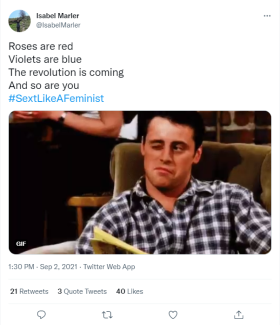
Les fleurs sont en bouton
Le printemps est ici
La révolution gronde
Et toi tu gémis
¡Bienvenidxs a Crear | Résister | Transform: un festival para movimientos feministas!
AWID está comprometida con la creación de un espacio virtual que nos invite y desafíe a todxs a funcionar desde un lugar de valentía, curiosidad, generosidad y responsabilidad compartida.
Te invitamos a crear conjuntamente con nosotrxs espacios libres de acoso y violencia, donde todas las personas sean respetadas en su identidad y expresión de género, raza, capacidad, clase, religión, idioma, etnia, edad, ocupación, tipo de educación, sexualidad, tamaño corporal y apariencia física. Espacios donde reconozcamos las desigualdades que prevalecen en nuestro mundo, y nos esforcemos por transformarlas.
Esto significa escucharnos, comprendernos y vincularnos. Sentirnos cerca, a pesar de la virtualidad. Para eso, contaremos con interpretación y abriremos canales (como el chat y otras herramientas) para reaccionar y compartir. Para lograr escucharnos mejor, les invitamos a utilizar audífonos o auriculares durante la sesión. Si puedes hacerlo, te sugerimos cerrar tus correos electrónicos y cualquier otra posible distracción mientras estás en la conversación.
Celebremos los distintos saberes y las múltiples formas en que estos se expresan. Nos acercamos al espacio con curiosidad y apertura para aprender de otrxs y permitiéndonos desaprender y reaprender a partir del intercambio, sentando las posibilidades para la construcción colectiva de conocimiento.
Estamos comprometidxs con un enfoque holístico de la accesibilidad, conscientes de las diferentes necesidades físicas, mentales, de idioma y de seguridad. Queremos un espacio que acoja a gente de contextos, creencias, capacidades y experiencias diversas. Seremos proactivxs, pero también te pedimos que nos comuniques tus necesidades, para que, dentro de nuestras posibilidades, nos ocupemos de satisfacerlas.
Asumimos compromisos individuales y colectivos de respetar la privacidad y contar con el consentimiento de otrxs para difundir imágenes o contenido generado durante la conversación.
Crear un ambiente más seguro, respetuoso y disfrutable para las conversaciones es responsabilidad de todxs.
Si notas que alguien se está comportando de forma discriminatoria u ofensiva, por favor, contacta a la persona de referencia que se indicará al comienzo de la sesión.
Cualquier participante que se exprese con lenguaje opresivo o imágenes ofensivas será eliminadx de la videoconferencia y no será admitidx nuevamente. No interactuaremos con esa persona de ninguna manera.
A tool for feminist activists at COP30 fighting for transformative, equitable and community-centred solutions to address the climate crisis.
Pour la première fois, le Forum de l'AWID propose trois modes de participation :
Les participant.e.s se réuniront à Bangkok, en Thaïlande. Nous sommes impatient.e.s de vous y retrouver!
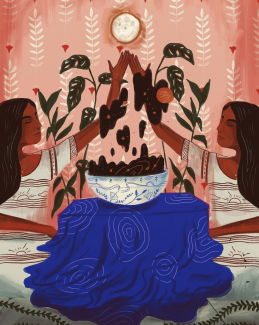
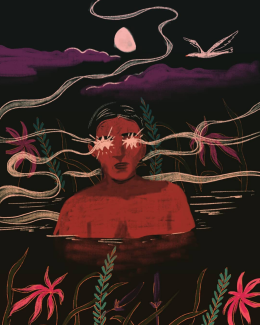
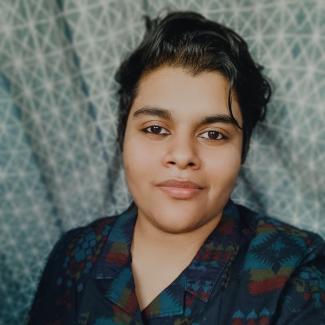
Les membres de l’AWID exploreront et feront une évaluation critique du rôle que l’entraide peut jouer pour financer et apporter des ressources aux mouvements, en se livrant à un collage collectif.
📅 Mercredi 12 novembre 2025
📍 Espace COP Populaire
Site web en anglais, espagnol et portugais
نرحب بالطلبات عبر مجموعة كاملة من المواضيع والتقاطعات المهمة للحركات النسوية وحركات العدالة الجندرية.
Zuhour Mahmoud es la estratega de comunicación de Kohl. Es una escritora y editora y una DJ ocasional radicada en Berlín. Su trabajo se centra en los enfoques críticos a la música, la tecnología y la política y sus ciclos de vida en la esfera digital.