
Estela Ambrosio Luna

En septembre 2016, 1800 féministes et défenseur-e-s des droits des femmes venu-e-s des quatre coins de nos mouvements se réunissaient sur les côtes de Bahia à l’occasion du 13ème Forum international de l’AWID.
Cette section met l’accent sur les victoires, les enseignements et les ressources qui ont couronné nos conversations. Nous vous invitons à l’explorer, la partager et laisser vos impressions.
L’un des principaux éléments à retenir de ce Forum a été la nécessité d’élargir et d’approfondir notre travail de collaboration entre mouvements pour faire face à une montée des fascismes et des fondamentalismes, une exacerbation de la cupidité des entreprises et un changement climatique en progression.
Nos Initiatives Jeunes-pousses ont aidé 20 idées émérgées au Forum à évoluer en actions concrètes
La vidéo « Protéger les personnes et la planète » et le guide « Arrimer la résistance à l'action » mettent en lumière le courage des défenseur-e-s des droits humains et présentent des stratégies concrètes pour résister au pouvoir des entreprises
Avec nos animations L'état de nos mouvements féministes et La justice climatique et environnementale, les mouvements ont maintenant des outils créatifs pour appuyer leur travail de plaidoyer.
La compilation des expressions artistiques des mouvements continue d’inspirer une organisation plus forte et plus créative dans le monde entier.
Les mouvements peuvent aussi bénéficier d’une nouvelle méthodologie pour envisager nos horizons féministes. (à venir bientôt !)
A travers son prochain plan stratégique et le processus de son Forum, l’AWID s’engage à poursuivre et approfondir les rapports, les apprentissages et les processus amorcés lors du Forum 2016, tout en s’inspirant de l’actualité.
Les Forums de l’AWID ont vu le jour en 1983, à Washington DC. Depuis, ils revêtent de nombreux aspects et incarnent, selon les personnes, tantôt un processus itératif visant à affiner nos analyses, notre vision et nos actions, un évènement clé galvanisant les féminismes des participant-e-s et leurs organisations ou un espace politique offrant refuge et solidarité aux défenseur-se-s des droits humains.
Oui, nous voulons connaître votre situation, que vous ayez reçu du financement pendant une, deux ou les trois années de la période 2021–2023.

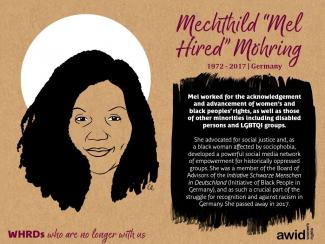
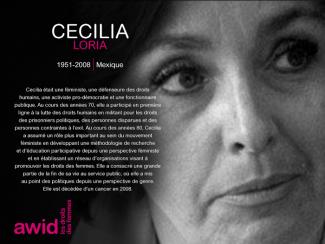
These transgender women were murdered because of their activism and their gender identity. There are insufficient laws recognizing trans* rights, and even where these laws exist, very little is being done to safeguard the rights of trans* people. Please join AWID in honoring these defenders, their activism and legacy by sharing the memes below with your colleagues, networks and friends and by using the hashtags #WHRDTribute and #16Days.
Please click on each image below to see a larger version and download as a file


Absolutely. These questions are optional, we value your right to remain anonymous. Please fill the survey regardless of your decision to share the name and contact information of your group, organization and/or movement.
We all can dance
by Mechthild Möhring (aka serialmel)
How I punt myself at the narrow hard knitting I once retrieved. I'm dancing in the kitchen when I'm alone. Gracile and powerful. When I'm in company I'm clumsy. My body scandalizes, scandalizes the laws of look I feel, scandalizes the words which banished me. "Of course she can dance, it's in her blood as a Black person." "If she is able to dance nicely she is good in bed" they whisper, they murmur, no - they say it openly into my face. They smirk and rub themselves against me and let me move back. I stumble and fall. My feet reject their duty. Bearish I get out of breath. Smiling I place myself out of events and notice how my face freezes into a mask.
Translated into English by Tsepo Bollwinkel
Original in German
Tanzen können wir alle
Von Mechthild Möhring (aka serialmel)
Wie ich mich stosse an den engen, harten Maschen, in die ich mich einst zurückgezogen habe. Ich tanze in der Küche, wenn ich allein bin. Grazil und kraftvoll. Wenn ich in Gesellschaft bin, bin ich unbeholfen. Mein Körper eckt an, an die Gesetze des Blicks, den ich spüre, an die Worte, die mich bannten. „Natürlich kann sie tanzen, als Schwarze hat sie das im Blut.“ „Wenn sie gut tanzen kann, dann ist sie auch gut im Bett“ flüstern sie, raunen sie, nein, sie sagen es mir laut ins Gesicht. Sie grinsen und reiben sich an mir und lassen mich zurückweichen. Ich stolpere und falle. Meine Füsse verweigern ihren Dienst. Tollpatschig gerate ich ausser Atem. Lächelnd setze ich mich an den Rand des Geschehens und bemerke, wie mein Gesicht zur Maske erstarrt.
This section highlights key resources recommended by AWID so you can conduct your own WITM research.
In this section
Online tools
Once you gather these resources, you can estimate the costs for your research using our “Ready to Go? Worksheet”

The Ready to Go? Worksheet helps you estimate resources, staff and budget needed for your research

Analizaremos las respuestas a la encuesta para extraer conclusiones y tendencias, y presentaremos los resultados durante el 15º Foro Internacional de AWID en Bangkok y en línea, en diciembre de 2024. Para asistir al Foro, puedes inscribirte aquí.
Una identidad de género latinoamericana
El término travesti se trata de una identidad de género latinoamericana sin equivalente en otros idiomas, y exclusivamente femenina. Es una persona designada varón al nacer que se identifica como mujer, y siempre deben abordarse con el pronombre “ella”.
Travesti no es solo una identidad de género ubicada fuera del binarismo de género, también es una identidad cultural arraigada en los movimientos latinoamericanos. El término inicialmente fue peyorativo, pero luego fue re-apropiado como símbolo de resistencia y dignidad. Toda travesti es trans porque no se identifica con el género asignado al nacer, sin embargo no toda travesti se considera mujer trans, ya que travesti ya es una identidad de género en sí misma.
Referencia: Berkins, Lohana. (2006). Travestis: una Identidad Política . Trabajo presentado en el Panel Sexualidades contemporáneas en las VIII Jornadas Nacionales de Historia de las Mujeres/ III Congreso Iberoamericano de Estudios de Género Diferencia Desigualdad. Construirnos en la diversidad, Villa Giardino, Córdoba, 25 al 28 de octubre de 2006.
This section will guide you on how to ensure your research findings are representative and reliable.
In this section:
- Collect your data
1. Before launch
2. Launch
3. During launch- Prepare your data for analysis
1. Clean your data
2. Code open-ended responses
3. Remove unecessary data
4. Make it safe- Create your topline report
- Analyze your data
1. Statistical programs
2. Suggested points for analysis
If you also plan to collect data from applications sent to grant-making institutions, this is a good time to reach out them.
When collecting this data, consider what type of applications you would like to review. Your research framing will guide you in determining this.
Also, it may be unnecessary to see every application sent to the organization – instead, it will be more useful and efficient to review only eligible applications (regardless of whether they were funded).
You can also ask grant-making institutions to share their data with you.
Your survey has closed and now you have all this information! Now you need to ensure your data is as accurate as possible.
Depending on your sample size and amount of completed surveys, this step can be lengthy. Tapping into a strong pool of detail-oriented staff will speed up the process and ensure greater accuracy at this stage.
Also, along with your surveys, you may have collected data from applications sent to grant-making institutions. Use these same steps to sort that data as well. Do not get discouraged if you cannot compare the two data sets! Funders collect different information from what you collected in the surveys. In your final research report and products, you can analyze and present the datasets (survey versus grant-making institution data) separately.
There are two styles of open-ended responses that require coding.
Questions with open-ended responses
For these questions, you will need to code responses in order to track trends.
Some challenges you will face with this is:
If using more than one staff member to review and code, you will need to ensure consistency of coding. Thus, this is why we recommend limiting your open-ended questions and as specific as possible for open-ended questions you do ask.
For example, if you had the open-ended question “What specific challenges did you face in fundraising this year?” and some common responses cite “lack of staff,” or “economic recession,” you will need to code each of those responses so you can analyze how many participants are responding in a similar way.
For closed-end questions
If you provided the participant with the option of elaborating on their response, you will also need to “up-code” these responses.
For several questions in the survey, you may have offered the option of selecting the category “Other” With “Other” options, it is common to offer a field in which the participant can elaborate.
You will need to “up-code” such responses by either:
Analyze the frequency of the results
For each quantitative question, you can decide whether you should remove the top or bottom 5% or 1% to prevent outliers* from skewing your results. You can also address the skewing effect of outliers by using median average rather than the mean average. Calculate the median by sorting responses in order, and selecting the number in the middle. However, keep in mind that you may still find outlier data useful. It will give you an idea of the range and diversity of your survey participants and you may want to do case studies on the outliers.
* An outlier is a data point that is much bigger or much smaller than the majority of data points. For example, imagine you live in a middle-class neighborhood with one billionaire. You decide that you want to learn what the range of income is for middle-class families in your neighborhood. In order to do so, you must remove the billionaire income from your dataset, as it is an outlier. Otherwise, your mean middle-class income will seem much higher than it really is.
Remove the entire survey for participants who do not fit your target population. Generally you can recognize this by the organizations’ names or through their responses to qualitative questions.
To ensure confidentiality of the information shared by respondents, at this stage you can replace organization names with a new set of ID numbers and save the coding, matching names with IDs in a separate file.
With your team, determine how the coding file and data should be stored and protected.
For example, will all data be stored on a password-protected computer or server that only the research team can access?
A topline report will list every question that was asked in your survey, with the response percentages listed under each question. This presents the collective results of all individual responses.
Tips:
- Consistency is important: the same rules should be applied to every outlier when determining if it should stay or be removed from the dataset.
- For all open (“other”) responses that are up-coded, ensure the coding matches. Appoint a dedicated point person to randomly check codes for consistency and reliability and recode if necessary.
- If possible, try to ensure that you can work at least in a team of two, so that there is always someone to check your work.
Now that your data is clean and sorted, what does it all mean? This is the fun part where you begin to analyze for trends.
Are there prominent types of funders (government versus corporate)? Are there regions that receive more funding? Your data will reveal some interesting information.
Smaller samples (under 150 responses) may be done in-house using an Excel spreadsheet.
Larger samples (above 150 responses) may be done in-house using Excel if your analysis will be limited to tallying overall responses, simple averages or other simple analysis.
If you plan to do more advanced analysis, such as multivariate analysis, then we recommend using statistical software such as SPSS, Stata or R.
NOTE: SPSS and Stata are expensive whereas R is free.
All three types of software require staff knowledge and are not easy to learn quickly.
Try searching for interns or temporary staff from local universities. Many students must learn statistical analysis as part of their coursework and may have free access to SPSS or Stata software through their university. They may also be knowledgeable in R, which is free to download and use.

• 2 - 3 months
• 1 or more research person(s)
• Translator(s), if offering survey in multiple languages
• 1 or more person(s) to assist with publicizing survey to target population
• 1 or more data analysis person(s)
• List of desired advisors: organizations, donors, and activists
• Optional: an incentive prize to persuade people to complete your survey
• Optional: an incentive for your advisors
Survey platforms:
• Survey Monkey
• Survey Gizmo (Converts to SPSS for analysis very easily)
Examples:
• 2011 WITM Global Survey
• Sample of WITM Global Survey
• Sample letter to grantmakers requesting access to databases
Visualising Information for Advocacy:
• Cleaning Data Tools
• Tools to present your data in compelling ways
• Tutorial: Gentle Introduction to Cleaning Data
Com base na nossa história de 20 anos de mobilização de mais fundos de melhor qualidade para a mudança social liderada por feministas, a AWID convida a participar da nova edição da nossa pesquisa principal:
(WITM)
PARTICIPE NO INQUÉRITO!Veja o tutorial
Please select your language in the upper right corner of the page.
Avant de prendre sa retraite, elle a occupé de nombreux postes de haut niveau, notamment celui de membre de la cour d’appel et juge en chef adjointe de l’Ouganda. Elle a été la première femme ougandaise à occuper le poste de magistrat en chef entre 1973 et 1986 et la première femme à être nommée juge à la Haute Cour de justice en 1986.
Elle fut l'une des premières femmes à recevoir le titre de chevalier pontifical de l'histoire de l'Église catholique en Afrique. Elle est morte d'une crise cardiaque.

L'une des dirigeantes fondatrices de la coopérative était Lohana Berkins, une militante, défenseuse et promotrice de l'identité trans. Lohana a joué un rôle crucial dans la lutte pour les droits des personnes trans et travestis.
Grâce à sa lutte, entre autres choses, l'approbation de la loi sur l'identité de genre a été obtenue. C'est l'une des lois les plus progressistes au monde, garantissant les droits fondamentaux des personnes trans et des travestis. Désormais, les personnes peuvent changer de nom et de sexe avec un affidavit et ont accès à des soins de santé complets sans intervention/approbation judiciaire ou médicale (Outright International, 2012).