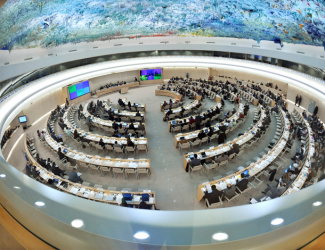
A general view of participants at the 16th session of the Human Rights Council in Geneva, Switzerland.
Analyses Spéciales
L´AWID est une organisation féministe mondiale qui consacre ses efforts à la justice de genre, au développement durable et aux droits humains des femmes
Le Conseil des droits de l'homme (CDH) est un organe intergouvernemental clé du système des Nations Unies, responsable de la promotion et la protection des droits humains autour du globe. Il se réunit trois fois par an en session ordinaire, en Mars, Juin et Septembre. Le Bureau du Haut-Commissariat des Nations Unies aux Droits de l’Homme (HCDH) constitue le secrétariat pour le CDH.
Le CDH :
Débat et adopte des résolutions sur les questions globales des droits humains ainsi que sur la situation des droits humains dans des pays particuliers
Examine les plaintes des victimes de violations des droits humains et des organisations activistes, au nom des victimes de violations des droits humains
Nomme des experts indépendants (que l'on connaît sous le nom de « Procédures Spéciales ») pour réviser les cas de violation des droits humains dans des pays spécifiques, ainsi que pour examiner et suivre des questions globales relatives aux droits humains
Prend part à des discussions avec les experts et les gouvernements sur les questions de droits humains
Évalue les bilans des États membres de l'ONU en matière de droits humains tous les quatre ans et demi, dans le cadre de l'examen périodique universel.
La prochaine session du CDH a lieu à Genève, en Suisse, du 30 juin au 17 juillet 2020.
AWID travaille avec des partenaires féministes, progressistes et du domaine des droits humains pour partager nos connaissances clé, convoquer dialogues et évènements avec la société civile, et influencer les négociations et les résultats de la session.
Avec nos partenaires, notre travail consiste à :
◾️ Suivre, surveiller et analyser les acteurs, discours et stratégies anti-droits et leur impact sur les résolutions du CDH.
◾️ Co-développer un plaidoyer collectif pour contrer les acteurs anti-droits et discuter plus en détails les résultats du Rapport de tendances 2017 du OURs
◾️ Soutenir, coordoner et développer de manière collaborative le Caucus féministe qui émerge au CDH.
Contenu lié
Our arepa: Resistance from the Kitchen
by Alejandra Laprea, Caracas, Venezuela (@alejalaprea)
I live in a country of the impossible, where there are no bombs yet we are living in a war.
A war that exists only for those of us living in this territory.
I live in a country no one understands, which few can really see, where various realities co-exist, and where the truth is murdered time and again.
I live in a country where one has to pay for the audacity of thinking for oneself, for taking on the challenge of seeing life another way.
I live in a country of women who have had to invent and reinvent, time and again, how they live and how to get by.
I live in Venezuela, in a time of an unusual and extraordinary threat.
Since 2012 my country has been subjected to an unconventional war. There are no defined armies or fire power. Their objective is to dislocate and distort the economy, affecting all households, daily life, the capacity of a people to dream and build a different kind of politics, an alternative to the patriarchal, bourgeois, capitalist democracy.
Venezuelan women are the primary victims of this economic war. Women who historically and culturally are responsible for providing care, are the most affected and in demand. However, in these years of economic and financial embargo, Venezuelan women have gone from being victims to the protagonists on the front lines defending our territory.
Battles are fought from the barrios, kitchens, and small gardens. We defend the right of girls and boys to go to school, and to be given something so simple as some arepas for breakfast.
Arepas are a kind of corn cake that can be fried, roasted or baked and served sweet or savoury as a side or main dish. It is a staple in the diet of all Venezuelans.
In Venezuela, arepas mean culture, family, food sovereignty, childhood nostalgia, the expert hands of grandmothers molding little balls, the warmth that comforts you when recovering from illness.
Arepas connect us as a people with the pre-Colombian cultures of corn, a resistance that has endured for more than five centuries. They are the Caribbean expressed differently on firm ground.
They are an act of resistance.
When my mother was a girl, they would start grinding the dry corn early in the morning to make arepas. The women would get up and put the kernels of corn in wooden mortars and pound it with heavy mallets to separate the shells. Then they would boil, soak, and grind the corn to make dough, and finally they would mold it into round arepas. The process would take hours and demand a lot of physical effort.
In the mid-20th century a Venezuelan company industrialized the production of corn meal. For an entire generation that seemed like an act of liberation, since there was now a flour that you could simply add water to and have hot arepas in 45 minutes time.
But that also meant that the same generation would lose the traditional knowledge on how to make them from scratch. My grandmother was an expert arepa maker, my mother saw it as a girl, and for me the corn meal came pre-packaged.
In the war with no military, the pre-cooked corn meal came to be wielded as an instrument of war by the same company that invented it, which was not so Venezuelan anymore: today the Polar group of companies is transnational.
We women began to recuperate our knowledge by talking with the eldest among us. We searched in the back of the closets for our grandmothers’ grinders, the ones we hadn’t thrown away out of affection. Some families still prepared the corn in the traditional way for important occasions. In some towns there were still communal grinding stations which had been preserved as part of local history or because small family businesses refused to die. All of these forms of cultural resistance were activated, and we even went so far as to invent new arepas.
Today we know that in order to resist we cannot depend on one food staple. Although corn arepas continue to be everyone’s favourite, we have invented recipes for arepas made of sweet potato, cassava, squash, and celery root.
We have learned that we can use almost any root vegetable to make arepas. Cooperative businesses have developed semi-industrial processes to make pre-cooked corn meal. In other words, we have recuperated our arepas and their preparation as a cultural good that belongs to all.
My artivism aims to decolonize our senses in everyday life. I like to create spaces that communicate how we weave together our different struggles, and that render visible dissident (re)existences, other possible worlds, and living bodies here in the SOUTH.
As we continue to fight in our struggles, let us remember how essential it is that we support each other, believe each other, and love ourselves and our sisters. When this system fucks us over, we must take time to look after our (physical and mental) health, that of our sisters, and to understand that each one of us carries unique stories, making us fighters in resist
Marga RH (@Marga.RH)
Until dignity becomes a habit
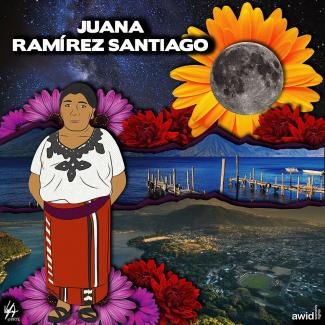
These portraits are inspired by the voices of resistance and protest movements in Latin America, especially by the key role that feminised bodies play in these struggles. It is a tribute to the grassroots feminist movements in resistance.
Juana was one of the founders and current Board Member of Red de Mujeres Ixiles de Nebaj, an Indigenous women’s rights organization that is a member of the Mesoamerican Initiative of WHRDs (IM-Defensoras).
She was also a midwife and a mother of 7 children. Juana had received death threats that were reported to the Prosecutor’s office. Juana is the third Indigenous WHRD murdered in the area during 2018. The Guatemala Ombudsman reports that a total of 20 HRDs were killed in the country this year.
Juana Ramírez Santiago was shot dead by unidentified attackers while crossing a bridge in Nebak, Quiché, Guatemala. Investigations to identify the perpetrators are ongoing.
We have always worked towards ensuring that our Forums are co-developed with partners, movements and our priority constituencies.
For our upcoming Forum, we aim to deepen and strengthen that spirit and practice of co-creation and collaboration. We also recognize the need to improve the balance between the inclusion of many voices and experiences with room for participants and staff to breathe, take pause and enjoy some downtime.
This Forum will be different in the following ways:
We will have far less organized Forum activities because we want people to have time to engage, experience, process, talk to each other, etc. This is key to communicate: you can come to the Forum, be very engaged and active and not facilitate any organized activity (or “session”).
We will have Open Spaces - at least one whole afternoon without any organized activities - but also physical spaces available throughout the Forum for people to self-organize meetings, etc.
We have a Content and Methodology Committee made up of feminists from different regions with expertise on participatory methodologies to support us and all those leading activities at the Forum to use creative and engaging formats for the Forum activities.
Реалии обеспечения ресурсами и состояние финансирования феминистских движений быстро меняются – является ли этот опрос единичным?
Нет, не является. Он основан на 20-летней истории AWID по мобилизации более объемного и качественного финансирования для социальных изменений под руководством феминисток(-ов) и является третьим этапом исследования «Где деньги для феминистских организаций?». Наша цель – проводить опрос «Где деньги?» каждые 3 года.
Snippet FEA Criminalization of sex workers (ES)
La mayoría de los Estados miembros de la Unión Europea tienen leyes y prácticas que penalizan o controlan a las trabajadoras sexuales de formas inaceptables para ellas. La criminalización de las trabajadoras sexuales y/o sus clientes solo contribuye a aumentar la vulnerabilidad de las trabajadoras sexuales, que ya enfrentan el estigma, la discriminación y la exclusión por parte del Estado y de la sociedad a diario, especialmente las mujeres trabajadoras, lxs trabajadorxs trans, migrantes y/o racializadxs. En España por ejemplo, el gobierno esta actualmente intentando pasar una Ley Orgánica para la Abolición de la Prostitución, que resultara en mas clandestinidad y violencia. Ven a conocer las historias de trabajadoras sexuales y organizadores sindicales que luchan para decriminilizar el trabajo sexual y promover derechos laborales y condiciones de trabajo digno para lxs trabajadxs sexuales.
Our values - Human Rights
Derechos humanos
Sostenemos la completa aplicación del principio de derechos, incluidos aquellos consagrados en leyes internacionales, y afirmamos la convicción de que todos los derechos humanos están interrelacionados y son interdependientes e indivisibles. Estamos comprometidxs a trabajar por la erradicación de todas las discriminaciones basadas en el género, la sexualidad, la religión, la edad, la capacidad, la etnia, la raza, la nacionalidad, la clase, u otros factores.
Exposición en el Jardín de los Placeres
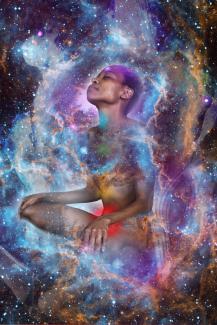
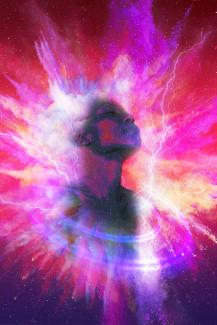
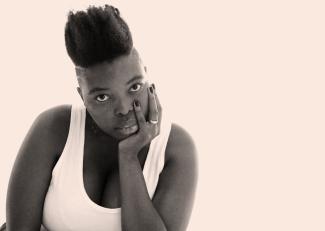
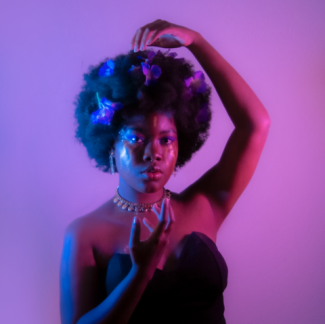
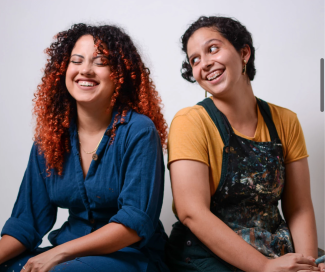
Estas obras son un trabajo colaborativo de fotografías e ilustraciones realizadas por Siphumeze y Katia durante el confinamiento. Muestran narrativas negras queer de sexo y placer, bondage, sexo seguro, juguetes, salud mental y sexo, y mucho más. Fueron creadas para acompañar la antología Touch.
“Mental Health” [«Salud mental»]“Sex and Spirituality” [«Sexo y espiritualidad»]“Orgasm” [«Orgasmo»]
About the Artists:
Siphumeze Khundayi es una creadora de arte, fotógrafa y facilitadora interesada en las formas creativas de unir el diálogo y la práctica artística en relación con la identidad queer africana.
Es directora creativa de HOLAAfrica!, una colectiva en línea mujerista panafricanista.
Sus trabajos de performance individual y en colaboración han sido presentados en numerosos festivales y espacios teatrales, tales como el Ricca Ricca Festival de Japón.
En 2017 y 2018 dirigió dos producciones que fueron nominadas a los Naledi Theatre Awards y, en 2020, obtuvo un premio Standard Bank Ovation.
Como fotógrafa, participó en Italia en una exposición grupal titulada Flowers of my Soul, organizada por The Misfit Project. Produjo tres publicaciones para HOLAAfrica!, y sus trabajos fueron publicados dentro y como tapa del Volume Two: As You Like de las Gerald Kraak Anthologies.
Katia Herrera es una artista visual digital de 21 años, de la ruidosa ciudad de Santo Domingo, en la República Dominicana. A pesar de que se autodefine como introvertida, su obra es notablemente estruendosa en un mundo que intenta acallar las voces negras. Con títulos como “Black Woman” [«Mujer Negra»], “You Own the Moon” [«La Luna es Tuya»], “Earth Goddess” [«Diosa de la Tierra»], “Forever” [«Por Siempre»] y “Universe Protector” [«Protectora del Universo»], el legado de Herrera estará marcado por su pasión por poner de manifiesto la resistencia y la perseverancia de las personas negras del pasado y del presente, en contraposición a la narrativa de que la piel negra debería solamente ser asociada con la esclavitud.
Una de sus obras más hermosas y vivazmente tituladas, “Universe Protector”, representa al alma negra como una entidad divina plena de fortaleza, poder y grandeza. En su juventud, su amor por el diseño gráfico se vio estimulado por el talento artístico de su madre y su padre, y por el programa Photoshop que habían descargado en su computadora para su trabajo profesional de fotografía.
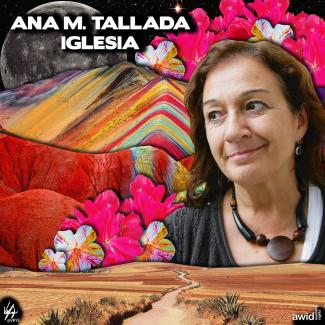
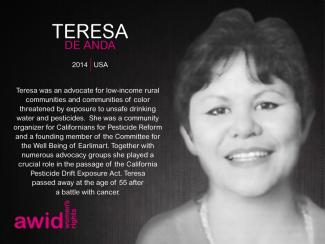
Ana fue una firme defensora de los derechos de las mujeres y trabajó con una amplia diversidad de mujeres, desde aquellas que están redes de base hasta las que son parte del sector privado.
Creía que había que tender puentes entre sectores. Ana fue integrante de la Red Nacional de Promoción de la Mujer (RNPM), y tuvo participación activa en el desarrollo de muchos programas sociales que abordan temas como la salud y los derechos sexuales y reproductivos.
How can I fund my participation in the AWID Forum? Many activists will not be able to afford the cost of the Forum – is AWID doing anything to provide assistance?
Please visit the "Funding ideas" page to get some ideas and inspiration for how you can fund your participation at the next Forum, including the limited support AWID will be able to provide.
Posso entrar em contacto se tiver dúvidas ou questões?
Se tiver alguma dúvida ou questão, entre em contacto connosco através deste formulário, indicando "Inquérito WITM" (WITM Survey) no título da sua mensagem.
Snippet FEA Unio Otras Photo 3 (FR)
Membership why page - Kirthi Jayakumar quote
En participant à une activité exclusive pour les membres, j'ai été particulièrement touchée de voir que chacun·e y avait sa place et qu’il n’y avait pas le moindre jugement. Toute la session a été dynamique et vivante.- Kirthi Jayakumar, Fondatrice, The Gender Security Project, Inde
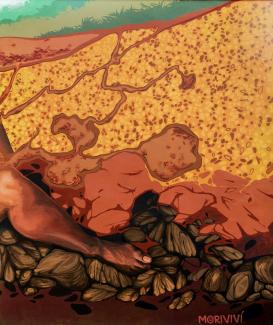
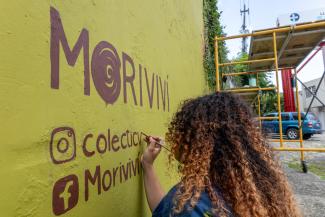
Colectivo Morivivi
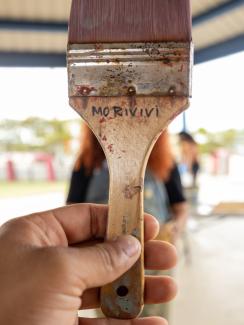
Colectivo Moriviví est un collectif artistique de femmes. Notre production artistique comprend du muralisme, du muralisme communautaire et des performances/actions de manifestation. Notre travail consiste à démocratiser l'art et à amener les récits des communautés portoricaines dans la sphère publique afin de créer des espaces où ils seront validés. Nous croyons qu’à travers l'artivisme, nous pouvons promouvoir la sensibilisation aux questions sociales et renforcer notre mémoire collective.
“Cacibajagua” 2017, Projet mural. Jiangxi, Chine“Cacibajagua” 2017, Projet mural. Jiangxi, Chine“Paz para la Mujer” (“Paix pour la Femme”) 2015, collaboration avec l’organisation Paz para la Mujer. Santurce, Porto Rico
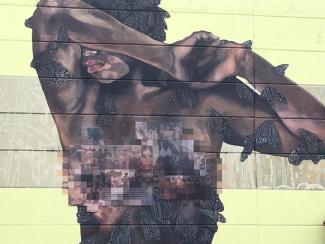
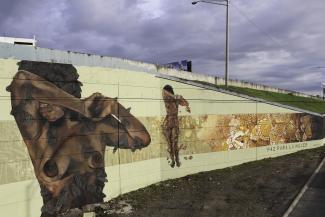
“Paz para la Mujer” (“Paix pour la Femme”) 2015, collaboration avec l’organisation Paz para la Mujer. Santurce, Porto Rico
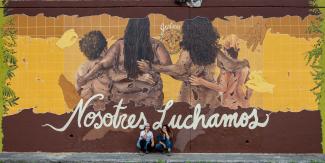
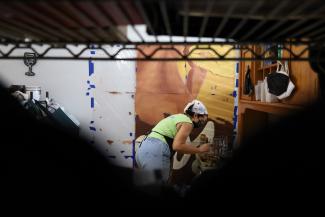
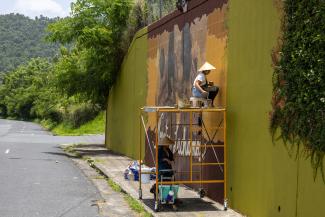
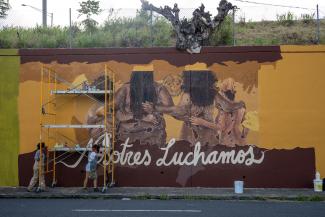
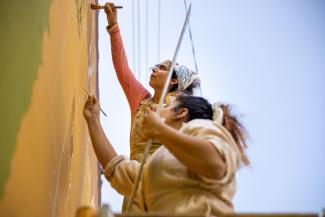
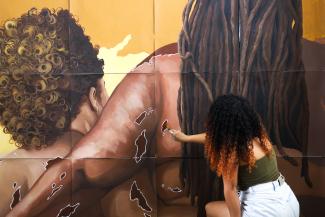
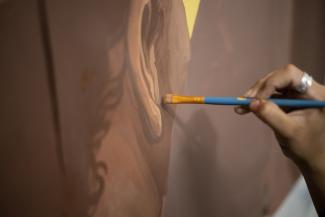
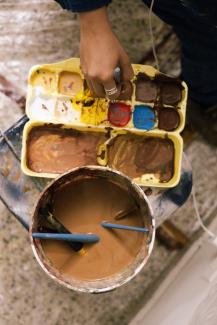
Dans le cadre de sa participation au Groupe de Travail d’Artistes d'AWID, le Colectivo Moriviví a réuni un groupe divers de membres, partenaires et personnel pour faciliter un processus collaboratif visant à imaginer, documenter et déterminer le contenu d'une fresque communautaire par le biais d'un processus de co-création en plusieurs étapes. Le projet a commencé par une conceptualisation à distance avec des féministes de différentes régions du monde réuni·e·s par l'AWID, avant d'évoluer vers sa re-contextualisation et sa réalisation à Porto Rico. Nous avons eu l'honneur de bénéficier de la contribution des artistes locaux·ales Las Nietas de Nonó(@lasnietasdenono), de la participation des femmes locales à la session de peinture communautaire, du soutien logistique de la municipalité de Caguas et du soutien supplémentaire du FRIDA | The Young Feminist Fund.
La fresque explore la transcendance des frontières en présentant les corps tels des cartes, dans une étreinte qui met en évidence l'intersection des différentes manifestations, pratiques et réalités féministes.
Nous remercions également Kelvin Rodríguez, qui a documenté et capturé les différentes étapes de ce projet à Porto Rico :
À propos du Colectivo Morivivi
Moriviví est un collectif de jeunes femmes artistes qui travaille sur l'art public depuis Avril 2013. Basé·e·s à Porto Rico, nous sommes reconnu·e·s pour la création de fresques et d'arts dirigés par la communauté.
Le groupe a débuté dans les festivals d'art urbain locaux. Au fur et à mesure que notre travail devenait plus populaire, les organisations et les dirigeant.e.s communautaires ont commencé à nous contacter. Au départ, nous étions huit lycéen·ne·s qui voulaient peindre une fresque ensemble. Cependant, en huit ans de travail acharné, nous avons été confronté·e·s à de nombreux défis. Nous sommes aujourd’hui dans une période de transition. Au cours de l'année qui vient, nous souhaitons restructurer le collectif en interne. Notre objectif est d'ouvrir de nouvelles opportunités pour les collaborateurs·trices et d'étayer notre processus de prise de décisions par un nouveau système d'évaluation. À long terme, nous aspirons à devenir une école alternative de pratiques artistiques pour celles et ceux souhaitant s'immerger dans la production artistique communautaire.
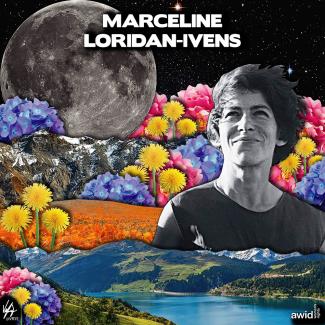
Née en 1928, Marceline était actrice, scénariste et réalisatrice.
En 2003, elle avait réalisé « La petite prairie aux bouleaux », mettant en vedette Anouk Aimée, ainsi que plusieurs autres documentaires. Survivante de l'holocauste, elle n'avait que quinze ans lorsque son père et elle furent arrêtés et envoyés dans des camps de concentration nazis. Les trois kilomètres qui la séparaient de son père à Auschwitz alors qu’elle-même était à Birkenau furent une distance insurmontable, décrite dans l’un de ses romans majeurs « Et tu n’es pas revenu ».
En parlant de son travail, elle a un jour déclaré: « Tout ce que je peux dire c’est que tout ce que je peux écrire, tout ce que je peux dévoiler, c’est à moi de le faire. »
Will there be pre-Forum convenings this time around?
We have been contacted by global and regional partners about some ideas for pre-Forum convenings and we will share more information about these ideas soon.
If you plan to organize a meeting before the Forum please let us know!
Many beautiful things emerged from the 2016 Black Feminisms Forum (BFF) that was organized by an Advisory Group and funded by AWID. Some of the independent organizing that arose from the BFF include Black feminist organizing in Brazil. While we won’t have another BFF this year, we remain committed to sharing some key learnings with anyone interested in continuing work around Black feminist organizing.
La communauté AWID est une plateforme en ligne de réseautage social conçue tout spécialement pour l’AWID. Espace féministe ayant vocation à connecter, résister et célébrer, c’est un endroit où les conversations féministes critiques, le pouvoir et la puissance du collectif et la solidarité sont à l’œuvre. Cet espace est également ouvert pour dialoguer après les différents événements, pour penser, assimiler, digérer les apprentissages politiques difficiles, et pour prendre soin de la communauté.
Devenez membre de l’AWID pour pouvoir faire partie de la Communauté AWID dès aujourd’hui.