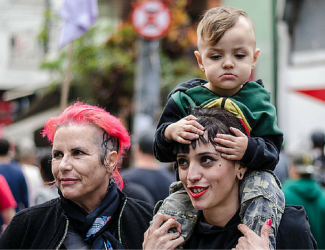
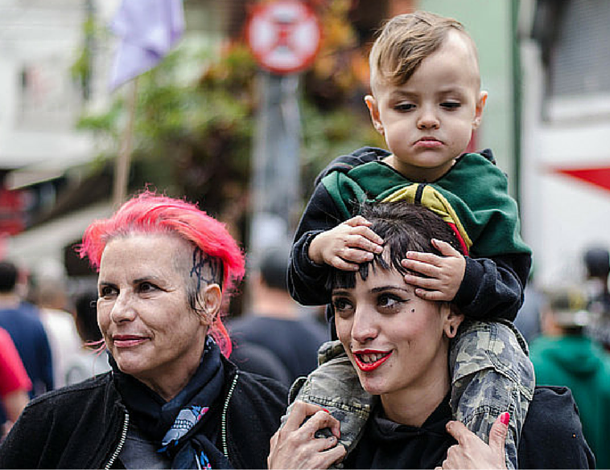
Flickr/Leonardo Veras (CC BY 2.0)

Análisis Especiales

AWID es un organización feminista internacional de membresía, que brinda apoyo a los movimientos que trabajan para lograr la justicia de género y los derechos de las mujeres en todo el mundo.

Protección de la familia

El contexto

Esta sección de análisis especial ofrece un análisis feminista crítico y acceso a los recursos clave relacionados con la «protección de la familia» en los espacios internacionales de derechos humanos.

Durante los últimos años, venimos observando una nueva y preocupante tendencia en el ámbito internacional de derechos humanos, donde se están empleando discursos sobre la «protección de la familia» para defender violaciones cometidas contra miembros de la familia, de modo de reforzar y justificar la impunidad y para coartar la igualdad de derechos en el seno de la familia y la vida familiar. 

La campaña para «proteger a la familia» es impulsada por proyectos conservadores que tienen como fin imponer interpretaciones «tradicionales» y patriarcales de familia; quitando los derechos de las manos de sus miembros para ponerlos en las de la institución «familia».

Los proyectos de «protección de la familia» tienen su origen en los siguientes fenómenos:

  • el auge del tradicionalismo,
  • el auge del conservadurismo cultural, social y religioso, y
  • posturas hostiles a los derechos humanos de las mujeres, los derechos sexuales, los derechos de las niñas y los niños y los derechos de las personas con identidades de género y orientaciones sexuales no normativas.  

Desde 2014 un grupo de estados opera como bloque en espacios de derechos humanos, bajo el nombre «Group of Friends of the Family» [Grupo de amigos de la familia], y a partir de entonces se han aprobado resoluciones sobre la «Protección de la familia» todos los años.

Esta agenda se ha extendido más allá del Consejo de Derechos Humanos (HRC, por sus siglas en inglés).  Hemos visto cómo el lenguaje regresivo sobre «la familia» se ha introducido en la Comisión de la Condición Jurídica y Social de las Mujeres (CSW, por sus siglas en inglés), y hemos asistido a intentos por incluir este lenguaje en las negociaciones sobre los Objetivos de Desarrollo Sostenible.


Nuestro enfoque

AWID trabaja con asociadxs y aliadxs para resistir conjuntamente las agendas regresivas de «Protección de la familia» y otras, y para defender la universalidad de los derechos humanos.

En respuesta a la creciente influencia de actores regresivos en los espacios de derechos humanos, AWID se ha unido con aliadxs para formar el Observatorio de la Universalidad de los Derechos (OURs, por sus siglas en inglés).  OURs es un proyecto colaborativo que monitorea, analiza y comparte información sobre iniciativas anti-derechos tales como la «Protección de la familia».

Derechos en Riesgo, el primer informe de OURs, traza un mapa de los actores que conforman el cabildeo global anti-derechos e identifica sus discursos y estrategias principales, señalando los efectos que estos discursos y estrategias están teniendo sobre nuestros derechos humanos.

El informe expone a la «Protección de la familia» como una agenda que ha promovido la colaboración entre una amplia gama de actores regresivos en las Naciones Unidas. La describe como un marco estratégico que aloja «múltiples posiciones patriarcales y anti-derechos, cuyo marco, a su vez, apunta a justificar e institucionalizar estas posiciones».
Contenido relacionado

Snippet - WITM About the survey - EN

ABOUT THE SURVEY

  • GLOBAL & DIVERSE: Reflecting on resourcing realities of feminist organizing at a global scale and disaggregated by region
  • CONTEXTUALIZED: Centering voices, perspectives and lived experiences of feminist movements in all their richness, boldness and diversity in their respective contexts
  • CO-CREATED: Developed and piloted in close consultations with AWID members and movement partners
  • COMPLEMENTARY: Contributing to and amplifying existing evidence on the state of resourcing for feminist, women’s rights and gender justice organizing by activists, feminist funders and allies
  • MULTI-LINGUAL: Accessible in Arabic, English, French, Portuguese, Russian and Spanish.
  • PRIORITIZING PRIVACY & SECURITY: We are committed to maintaining the confidentiality and integrity of your data. Read our Privacy Policy to learn more about the measures we take to ensure the protection of your information
  • ACCESSIBLE: Accessible to people with a diverse range of hearing, movement, sight, and cognitive abilities, taking approximately 30 minutes to complete
  • REPLICABLE: Replicable by movements in their respective contexts; WITM survey tools and datasets will be publicly available to support more feminist research and collective advocacy.

CFA 2023 - Themes - EN

Themes

We welcome applications across the full range of thematic areas and intersections important to feminist and gender justice movements. In the application form, you will be able to mark more than one theme that fits your activity.

  • Free Bodies, Free Spirits: all things bodily autonomy, gender and sexuality, reproductive health and rights, freedom from gender-based violence, freedom to live in safety, pleasure and joy in our diverse bodies, identities and communities, and much, much more.
  • Resisting Anti-Rights: locally and globally, feminists are leading the way in resisting all forms of intersectional oppressions, including fascisms, fundamentalisms, and authoritarian regimes; we have a lot to share and strategize with each other about.
  • Movements and Organizing: let us get to know each other’s movements. From navigation of power (internal and external) to protection strategies in the face of the repression of women and gender-diverse human rights defenders, from alliance-building to creative and successful forms of organizing, let’s learn and be inspired by each other.
  • Economic Justice and Feminist Economies: this theme encompasses all feminist efforts to transform our economies, from challenging dominant extractive models and defending labor rights to embodying and living feminist economic practices and alternatives in everyday life.
  • Funding/Resourcing Activism: securing much-needed funding is a shared challenge for movements across the world; let us together unpack the feminist funding ecosystem, from critical analysis to first-hand experiences and practical ways to fund feminist work.
  • Climate, Environmental Justice, Land and Water: ecological and climate justice has deep roots in many of our movements and communities; from ancient traditions to futuristic visions, from ecology villages to campaigns to end extractivism and health justice, we invite a full scope of activities on all aspects of climate and environmental justice.
  • Militarization, War and Conflict: we aim to spotlight feminist organizing, analysis and experiences often on the frontline of crisis response and helping to sustain life, community and justice in the harshest times of war and protracted conflict.
  • Decolonization: decolonization is central to each and every one of our themes, yet it also stands on its own, as a key feminist agenda of resistance and world-building in many colonial and post-colonial realities.
  • Digital Realities and Feminist Tech: we welcome an opportunity to celebrate the incredible feminist initiatives that transform digital worlds, challenge big tech power structures, and democratize technology as truly by and for the people.
  • Healing Justice: there is an incredible diversity of approaches to collective care and healing justice. Worldwide, healers and movements are reclaiming healing justice as a political principle, a set of practices, a learning journey, a way of life, and much more.
  • Add your theme here!

Sexting Like a Feminist: Humor in the Digital Feminist Revolution Snippet Small

Sexting Like a Feminist: Humor in the Digital Feminist Revolution

by Chinelo Onwualu

On September 2nd, 2021, the amazing feminist and social justice activists of AWID’s Crear | Résister | Transform festival came together not only to share resistance strategies, co-create, and transform the world, but also to talk dirty on Twitter.
 

Read more


Snippet - WITM Acknowledgements - EN

Acknowledgements

AWID gratefully acknowledges the many people whose ideas, analysis and contributions have shaped the “Where is the Money for Feminist Organizing?” research and advocacy over the years.

First and foremost, our deepest thanks goes to the AWID members and activists who engaged in WITM consultations and piloted this survey with us, sharing so generously of their time, analysis and hearts.

Our appreciation to feminist movements, allies and feminist funds, including but not limited to: Black Feminist Fund, Pacific Feminist Fund, ASTRAEA Lesbian Foundation for Justice, FRIDA Young Feminist Fund, Purposeful, Kosovo Women’s Network, Human Rights Funders Network, Dalan Fund and PROSPERA International Network of Women's Funds - for your rigorous research on the state of resourcing, sharp analysis and continued advocacy for more and better funding and power for feminist and gender justice organizing in all contexts.

Join the global community of feminists speaking up about the state of resourcing, demanding more and better funding and power for feminists everywhere

Clone of CFA 2023 - Hybrid like never before: in person - EN

In-person

Participants will come together in Bangkok, Thailand. We can’t wait!
#7 - Sexting like a feminist Tweets Snippet ES

¡Vente bien! Y muestra tus fuentes…

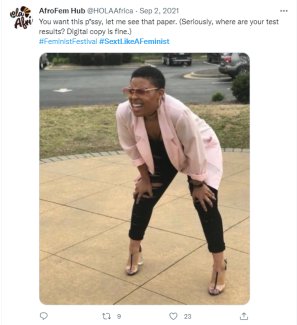
You want this pussy? Let me see that paper. (Seriously, where are your test results? Digital copy is fine.)

Si quieres esta concha, déjame ver ese papel (En serio, ¿dónde está el resultado de tu prueba? En versión digital está bien)

Our group, organization and/or movement is not registered, should we take the survey anyway?

Absolutely, we want to hear about your experience with resourcing.
CFA 2023 - Hubs - thai

ใหม่

จุดศูนย์กลาง: การเดินทางข้ามพรมแดน

ผู้เข้าร่วมประชุมจะได้เข้าร่วมตามสถานที่ต่างๆนอกเพื้นที่ในการจัดงานที่กรุงเทพฯ  และตามส่วนต่างๆของ โลกในแต่ละวันของการประชุม สถานที่ประชุมที่ผู้เข้าร่วมจัดการเองทั้งหมดนั้นจะเชื่อมต่อกับสถานที่จัดงาน
จริงในกรุงเทพฯเช่นเดียวกับบุคคลที่เชื่อมต่อทางออนไลน์        ผู้เข้าร่วมในจุดศูนย์กลาง Hub นี้จะสามารถ ดำเนินรายการในหัวข้อกิจกรรมต่างๆ เข้าร่วมอภิปราย แลกเปลี่ยน และเพลิดเพลินไปกับโปรแกรม ที่หลากหลาย

ที่ตั้งจุดศูนย์กลาง Hub จะประกาศในปี 2567
#2 - Sexting like a feminist Tweets Snippet FR

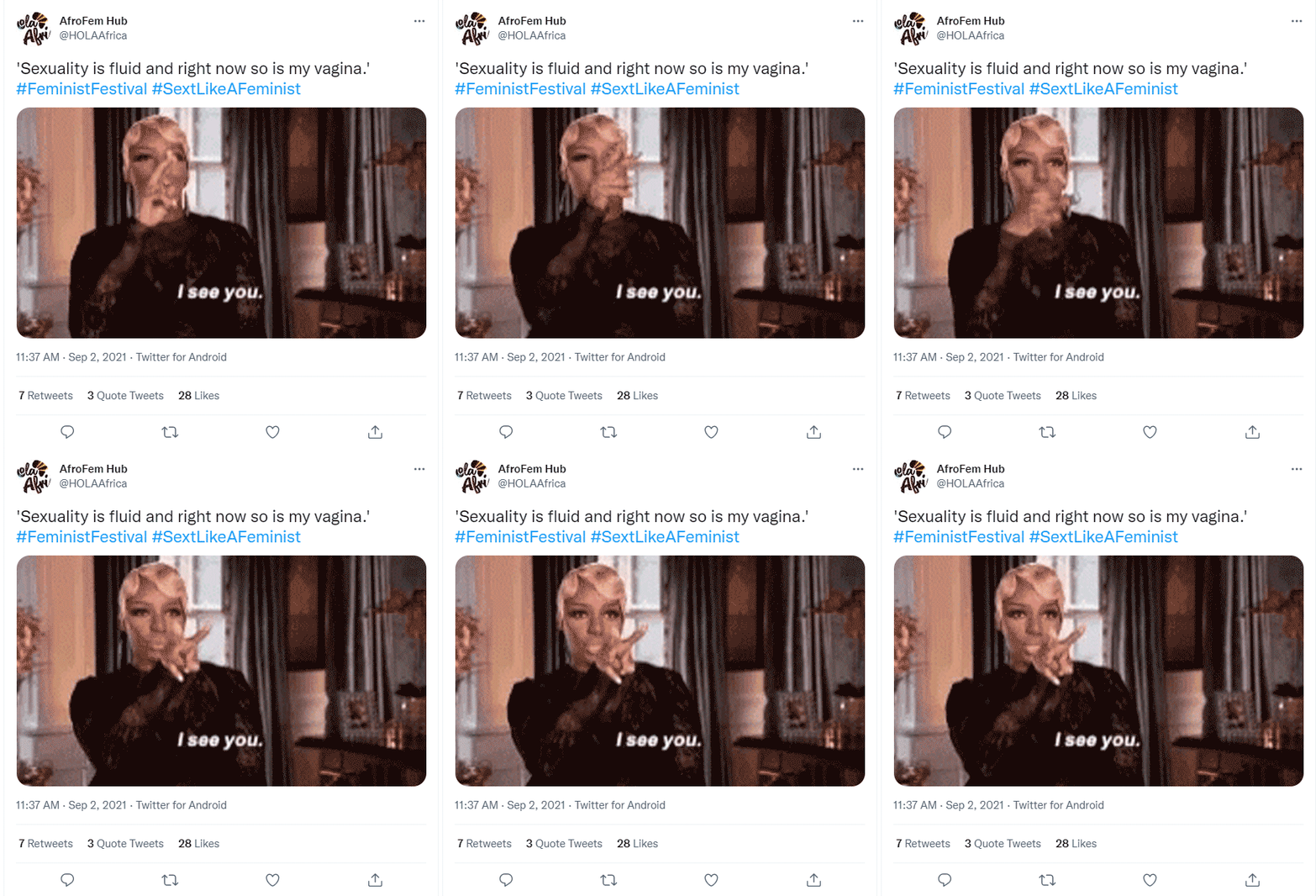
Un indice visuel est toujours utile

« La sexualité est fluide, et là mon vagin aussi. »
#FeministFestival #SextLikeAFeminist

¿Qué entienden por financiamiento externo?

El financiamiento externo incluye donaciones y otras formas de financiamiento provenientes de fundaciones filantrópicas, gobiernos, donantes bilaterales, multilaterales y corporativos y de donantes individuales, ya sea que estos se encuentren radicados en tu país o en el exterior. Excluye aquellos recursos que las agrupaciones, organizaciones o movimientos generan de manera autónoma como, por ejemplo, cuotas de membresía, contribuciones voluntarias del personal, afiliadxs o adherentes, colectas comunitarias, alquiler de espacios propios o venta de servicios. Para consultar más referencias, en la propia encuesta se encuentran incluidas las definiciones de los distintos tipos de financiamiento y descripciones breves de distintos tipos de donantes.