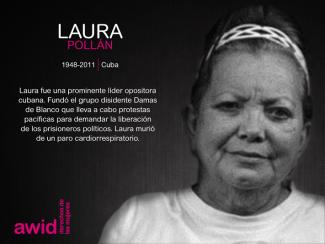
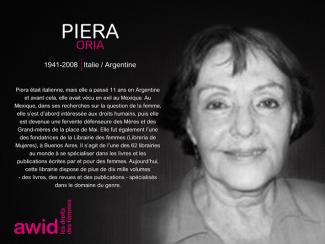
Left
Half
Left

Análisis Especiales

AWID es un organización feminista internacional de membresía, que brinda apoyo a los movimientos que trabajan para lograr la justicia de género y los derechos de las mujeres en todo el mundo.

La memoria como resistencia: Un Tributo

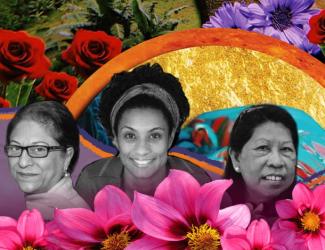
El Tributo de AWID es una exhibición de arte que honra a feministas, a activistas por los derechos de las mujeres y de la justicia social de todo el mundo que ya no están con nosotrxs. 


En 2020, hacemos un cambio

El Tributo de este año cuenta y comparte las historias y narraciones de quienes crearon conjuntamente realidades feministas, ofrecieron visiones de alternativas a los sistemas y actores que nos oprimen, y propusieron nuevas formas de organizarnos, de movilizarnos, de luchar, de trabajar, de vivir y de aprender.

Se agregan a la galería 49 retratos nuevos de feministas y defensorxs de derechos humanos. Aunque muchxs feministas y defensorxs han fallecido debido a edad avanzada o enfermedad, muchísimxs han sido asesinadxs debido a su trabajo y por ser quienes eran. 

Esta violencia creciente (de parte de Estados, empresas transnacionales, crimen organizado, sicarios no identificados, etc.) no se dirige solo a activistas individuales sino a nuestro trabajo común y a las realidades feministas. 

Al compartir las historias de lxs activistas en este Tributo,  mantenemos vivo su legado y nos inspiran para el trabajo futuro de nuestros movimientos. 

Visita nuestra exhibición en línea

Lors retratos de 2020 fueron diseñados por la ilustradora y animadora galardonada, Louisa Bertman

En AWID nos gustaría agradecer a las familias y organizaciones que nos compartieron sus historias personales, y así haber contribuido a este memorial. Nos unimos a ellxs para continuar el extraordinario trabajo de estxs activistas y defensorxs, y en el esfuerzo para asegurarnos de que se logre justicia en los casos que permanecen en la impunidad

"Ellos trataron de enterrarnos pero no sabían que éramos semillas."‐ Proverbio Mexicano


Presentamos el Tributo por primera vez en 2012

Primero tomó forma como una exposición física de retratos y biografías de feministas y activistas que habían fallecido, en el 12º Foro Internacional de AWID, en Turquía. Ahora vive como una galería en línea, que actualizamos cada año. 

Desde 2012 hemos presentado más de 467 feministas y defensorxs.

Visita nuestra exhibición en línea

Contenido relacionado

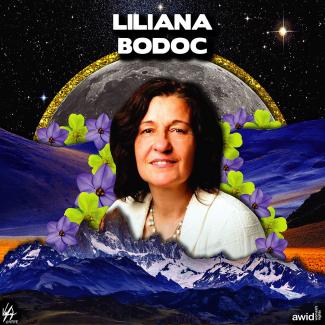
Liliana Bodoc

Liliana fue una maestra argentina, una tejedora y una escritora muy reconocida.

Su trilogía La saga de los confines recibió varios premios y es única en el género fantástico por su uso y reimaginación de la mitología de los pueblos indígenas de América del Sur.

El compromiso de Liliana con el feminismo se expresaba en las diversas, ricas y fuertes voces de mujeres en su escritura y especialmente en su extensa obra para lectorxs jóvenes. También tomó posición públicamente en favor del aborto, la justicia económica y la equidad de género.


Liliana Bodoc, Argentina

Snippet FEA collaborator and allies Photo 2 (ES)

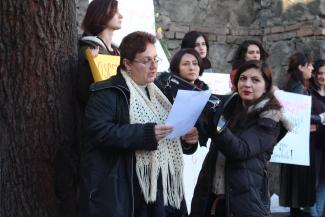
La foto muestra a ocho mujeres de pie juntas durante una protesta. Muchos sostienen pancartas mientras Sopo acerca el megáfono a la boca de una trabajadora de pelo corto y rojo, con bufanda blanca y abrigo negro, que lee un manifiesto.

Snippet - WITM Our objectives - AR

أهداف استطلاع "أين المال"

تقديم تحليل محدّث، قوي، مبني على الأدلة ومسيّر نحو النشاط عن وقائع التمويل النسوي للتنظيمات النسوية ووضع البيئة التمويلية النسوية لأعضاء وعضوات AWID، الشركاء/ الشريكات في الحركة والممولين/ات.

1

تحديد وإظهار الفرص للتحول لتمويل أفضل وأكبر للحركات النسوية، لكشف الحلول الزائفة ووقف التوجه الذي يجعل التمويل يتحرك ضد الأجندات التقاطعية أو أجندات العدالة الجندرية.

2

تحديد الرؤى المقترحات والأجندات النسوية، لتمويل يحقق العدالة.

3

لتعبئة الاستطلاع

Background

Why this resource?

While active participants on the front lines of protests and uprisings in the Middle East and North Africa (MENA), women became invisible, absent from processes of formation of the new states, and excluded from decision-making roles, responsibilities, and positions in the aftermath of the uprisings. Except in rare cases, men dominated leadership positions in transitional structures, including the constitutional reform and electoral committees[i]. Subsequent elections brought very few women to parliamentary and ministerial positions.

Additionally, a strong and immediate backlash against women and women’s rights has clearly emerged in the aftermath. The rise of new religious fundamentalist groups with renewed patriarchal agendas aiming to obliterate previous gains of the women’s movements even in countries with longer histories of women’s rights, such as Tunisia, has been very alarming.

The varying contexts of governance and transition processes across the MENA countries presents an important opportunity for women human rights defenders to shape the future of these democracies. However, the lack of prioritization of women’s rights issues in the emerging transitions and the aforementioned backlash have posed a variety of complex challenges for the women’s movements. Faced with these enormous challenges and possibilities, women’s rights activists have been struggling to forge ahead a democratic future inclusive and only possible with women’s rights and equality. The particular historical and contextual legacies that impact women’s movements in each country continue to bear on the current capacities, strategies, and overall preparedness of the women’s movements to take on such a challenge. Burdened with daily human rights violations in one context, with lack of resources and tools in another, with organizational tensions in a third, in addition to the constant attacks on them as activists, women human rights defenders have voiced their desire to be more equipped with knowledge and tools to be effective and proactive in engaging with these fast-changing environments. Conceptual clarity and greater understanding of notions and practices of democratization, transitional justice tools and mechanisms, political governance and participation processes, international and local mechanisms, movement building strategies, constitutional reform possibilities, and secularization of public space and government are important steps to defining future strategic action.

It is clear that feminists and women’s rights activists cannot wait for women’s rights to be addressed after transitions – issues must be addressed as the new power configurations are forming. Experiences of earlier moments of transition, namely from colonial rule, have clearly demonstrated that women’s rights have to be inherently part of the transition movement towards a more just and equal society.

What is included?

This publication represents a research mapping of key resources, publications and materials on transitions to democracy and women’s rights in different countries of the world that have undergone such processes, such as: Indonesia, Chile, South Africa, Nepal, Mexico, Argentina, Poland, Ukraine, as well as within the Middle East and North Africa (MENA). It provides bibliographic information and short summaries of resources which succinctly identify the contextual changes and challenges facing women in those particular transitional moments, as well as clearly delineates the ways in which women’s rights activists sought to confront those challenges and what lessons were learned.

A key criterion in the selection process was the primacy of a women’s rights/feminist perspective; the few exceptions to this rule offer a unique and, we hope, useful, perspective on the issues that women’s rights organizations and activists face in the region.  The texts have been selected to provide a wide range of information, relevant to women human rights defenders working from the grassroots to the international level, across issues (including different case studies and examples), from different perspectives (international human rights bodies, academic institutions, NGO contributions, activists’ experiences, etc.), and at a wide range of levels of complexity, in order to respond to the needs of as many readers as possible.

The mapping clusters resources under six major categories:

  • Transitions to Democracy
  • Political Participation
  • Movement Building
  • Transitional Justice
  • Constitutional/Legal Reform
  • Responses to Fundamentalisms


[i]This and other context points are drawn from the report from Pre AWID Forum meeting on Women’s Rights in Transitions to Democracy: Achieving Rights, Resisting Backlash, collaboratively organized by AWID, the Equality Without Reservation Coalition, Global Fund for Women and Women’s Learning Partnership

Anna Campbell (şehid Hêlîn Qerecox)

Anna a grandi à Lewes, dans le Sussex (Royaume-Uni). Après avoir décidé de ne pas poursuivre sa licence d’anglais à l'Université de Sheffield, elle a déménagé à Bristol et est devenue plombière.

Elle a passé une grande partie de son temps à défendre les personnes marginalisées et défavorisées, à assister à des rassemblements antifascistes et à offrir son soutien aux femmes de la Dale Farm lorsqu'elles furent menacées d'expulsion. Végétalienne et amie des animaux, elle a participé à des missions de sabotage de chasses et son nom est honoré sur le monument commémoratif « Arbre de vie » de l’organisation PETA. Anna s'est rendue à Rojava en mai 2017 pour lutter en faveur du renforcement du pouvoir des femmes, de la pleine représentation de toutes les ethnies et de la protection de l'environnement.

Anna est décédée le 15 mars 2018, après avoir été atteinte par une frappe aérienne turque dans la ville d'Afrin, dans le nord de la Syrie. Anna se battait auprès des forces de protection des femmes (YPJ) quand elle a été tuée.


Anna Campbell (şehid Hêlîn Qerecox), UK

Snippet FEA Workers demonstrations in Georgia 3 (FR)

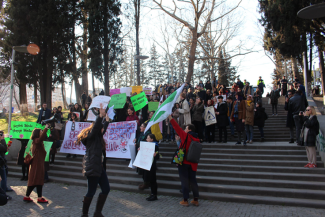
La photo montre une manifestation où une foule tient des affiches vertes et blanches.

Кому следует принять участие в опросе?

Группы, организации и движения, работающие исключительно или главным образом в интересах женщин, девочек, гендерной справедливости, прав ЛГБТКИ+ людей во всех регионах и на всех уровнях, как недавно созданные, так и давно существующие.

Body

Twitter Test

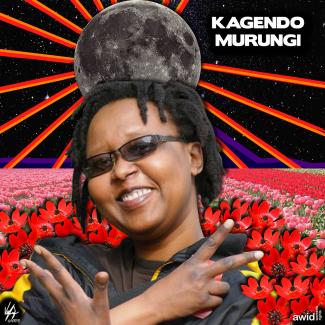
Kagendo Murungi

Kagendo is remembered fondly by family and friends as a fierce African feminist activist, artist, and filmmaker.

She dedicated over 20 years to advocate for the rights and dignity of African LGBTIQ and gender non conforming people.

Kagendo’s colleagues remember her as someone with a jovial personality, fierce conviction, and love for life. Kagendo died due to natural causes at her home in Harlem on December 27th, 2017.

On Kagendo’s passing Kenyan writer and activist Shailja Patel noted “Kagendo's lifelong commitment to connecting the dots between all oppressions, showing how colonialism fostered homophobia on the African continent, making Kenya a country where queer Kenyans and free women could live and thrive.”


Kagendo Murungi, Kenya

Snippet FEA different lines of work FOR S4 (EN)

Lines of work:

FOR

Join Us - old 5 Apr 2023 (changed by Ritu)

Join Us

By joining AWID, you are becoming part of worldwide feminist organizing, a collective power that is rooted in working across movements and is based on solidarity.

Become a member

O nosso grupo, organização e/ou movimento não recebeu ou mobilizou financiamento de financiadores externos. Devemos participar no inquérito?

Sim! Reconhecemos e valorizamos diferentes motivos pelos quais as feministas nos seus respetivos contextos não dispõem de financiamento externo: desde não serem elegíveis para se candidatar a subsídios e/ou receber dinheiro do exterior, até dependerem de recursos gerados autonomamente como uma estratégia política por si só. Queremos saber mais sobre vocês, independentemente da vossa experiência com financiamento externo.

Funding Ideas

This page provides ideas and inspiration for how you can fund your participation at the 14th AWID International Forum. 

As you plan the activity you would like to do at the Forum, please also consider how you will fund your participation. Typical Costs include: accommodation, travel, visa, forum registration fees, etc.

It is important to note that this Forum will have many ‘open spaces’ and moments for movements to learn and exchange, but fewer formal sessions. (See “Ways to describe the Forum in your fundraising” below for language to use in your outreach.) 

Work with your current funders:

Reach out to your current donors first : Your best option is always a current funder that you have.

Make sure to do it in advance : We recommend contacting them by early 2020 at the latest. Many funders who support feminist organizations have some budget allocated for Forum travel. Others may be able to include it in renewal grants or through other travel funds.

If your group has funders, tell them that you want to attend the AWID Forum to learn, experience, exchange and network- even if your activity does not get selected for the final program. In order to be able to support your participation, your donors will need to know about it well in advance so tell them right away! (they are already deciding which funds they will distribute in 2020).

Seeking new funders:

If you do not currently have donor support or are not able to secure grants for Forum travel, consider reaching out to new donors. 

Deadlines and requirements vary by funder, and a  grant review process can take many months. If you’re considering applying for new grants, do so as soon as possible.

Creative inspiration:

Feminist movements have long gotten creative with funding our own activism. Here are some ideas that we have gathered to inspire alternative ways of fundraising:

  • Mobilize your community to support participation: fundraise with small contributions from members through community dinners, dance parties, and local shows, events and tours
  • Mobilize your networks by organizing giving circles and crowdsourcing using various online tools like gofundme, indiegogo, plumfund, or kickstarter
  • Cultivate local sources of income, including from individual donors and membership dues    
  • Consider co-funding through strategic partnerships with other community and social justice groups.

For more inspiration, see AWID’s ongoing series on autonomous resourcing, including specific ideas for conference raising participation funds. 

Access Fund:

AWID strives to make the Forum a truly global gathering with participation from diverse movements, regions and generations. To this end, AWID mobilizes resources for a limited Access Fund (AF) to assist Forum participants with the costs of attending the Forum.

AWID’s Access Fund will provide support to a limited number of Forum participants and session/activity facilitators. You can indicate in your application if you would like to apply to the AWID Access Fund. This is not guaranteed, and we strongly encourage you to seek alternative funding for your participation and travel to the Forum.

Even if you apply for the AWID Access Fund, we encourage you to continue to explore other options to fund your participation in the Forum.  Access Fund decisions will be confirmed by the end of June 2020. Please remember that these resources are very limited, and we will be unable to support all applicants. 


Ways to describe the Forum in your fundraising: 

As you reach out to funders or your own networks, here is some sample messaging that may be helpful. Feel free to adapt it in whatever way is useful for you!

The AWID Forum is a co-created feminist movement space that energizes participants in their own activism, and strengthens connections with others across multiple rights and justice movements. Participants get to draw from wells of hope, energy and radical imagination, as well as deepen shared analysis, learning, and build cross-movement solidarity to develop more integrated agendas and advance joint strategies.

Our organization is seeking funds to attend the Forum in order to connect with other activists and movements from around the world, strengthen our strategies, and share our work. We are inspired by past participants, who have described the power of this global feminist gathering:

“Over four days … voices weaved together into a global perspective on the state of gender equality. And when I say global, I mean simultaneous translation into seven languages kind of global  ....”

“It was reminding us that we are not alone. The Forum provided a means of translating collectivity into our movements. Whether across ideologies, identities or borders, our strength is in our vision and our support of one another.”

It is important to note that this Forum will have many ‘open spaces’ and moments for movements to learn and exchange, but fewer formal sessions. While many attendees will not be presenting in formal sessions, there will be invaluable space to learn, strategize, and experience feminist movements’ collective power in action.

Budget considerations: 

When calculating your costs and how much you need to raise, it is important to factor in costs that may come up. Here’s an example of key items to consider:

  • Airfare
  • Forum registration fees (please note that even if you are granted Access Funds by AWID, you will have to cover your registration fee yourself)
  • Visa costs
  • Travel health insurance
  • Local travel to and from the airport (taxis or other transportation)
  • Layover costs, such as hotels and meals if your plane travel requires a long layover
  • Accommodation, including giving yourself a day to recover on either end if you have traveled far
  • Technology, including WiFi access or fees for international communication as needed during travel (AWID will provide WiFi during the Forum)
  • Materials costs for any items (visuals, reports, artwork!) you want to bring, share, or exchange at the Forum 
  • Incidentals and/or per diems to cover food and other items that come up (all lunches and coffee/tea breaks, plus one dinner will be provided by AWID during Forum days) 
  • Accessibility, such as any additional support that may be important to make your travel more comfortable, safe, and secure

We look forward to seeing you at the Forum!


The Forum is a collaborative process

The AWID Forum will now take place 11-14 January 2021 in Taipei .

It is more than a four-day convening. It is one more stop on a movement strengthening journey around Feminist Realities that has already begun and will continue well beyond the Forum dates.

Join us on this journey!
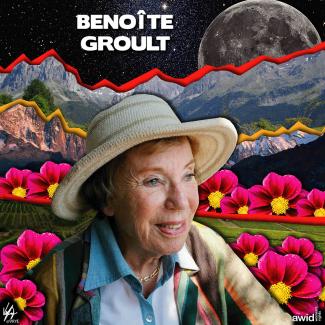
Benoîte Groult

Benoîte fue una periodista, escritora y activista feminista francesa.

Benoîte publicó más de 20 novelas y numerosos ensayos sobre feminismo.

En 1975 se publicó su primer libro, Ainsi Soit-Elle (que podría traducirse «Como ella es»). En él analizaba la historia de los derechos de las mujeres, así como la misoginia y la violencia contra las mujeres.

En su último libro, Ainsi Soit Olympe de Gouges, analizaba los derechos de las mujeres durante la Revolución Francesa, centrándose en la pionera feminista francesa. Olympe de Gouges fue guillotinada en 1793 por desafiar la autoridad masculina; dos años antes había publicado una declaración sobre los derechos de las mujeres («Déclaration Des droits de la Femme et de la Citoyenne»). 


Benoïte Groult, France