Philippe Leroyer | Flickr (CC BY-NC-ND 2.0)

Women Human Rights Defenders

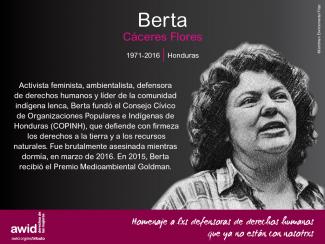
WHRDs are self-identified women and lesbian, bisexual, transgender, queer and intersex (LBTQI) people and others who defend rights and are subject to gender-specific risks and threats due to their human rights work and/or as a direct consequence of their gender identity or sexual orientation.

WHRDs are subject to systematic violence and discrimination due to their identities and unyielding struggles for rights, equality and justice.

The WHRD Program collaborates with international and regional partners as well as the AWID membership to raise awareness about these risks and threats, advocate for feminist and holistic measures of protection and safety, and actively promote a culture of self-care and collective well being in our movements.


Risks and threats targeting WHRDs  

WHRDs are exposed to the same types of risks that all other defenders who defend human rights, communities, and the environment face. However, they are also exposed to gender-based violence and gender-specific risks because they challenge existing gender norms within their communities and societies.

By defending rights, WHRDs are at risk of:

  • Physical assault and death
  • Intimidation and harassment, including in online spaces
  • Judicial harassment and criminalization
  • Burnout

A collaborative, holistic approach to safety

We work collaboratively with international and regional networks and our membership

  • to raise awareness about human rights abuses and violations against WHRDs and the systemic violence and discrimination they experience
  • to strengthen protection mechanisms and ensure more effective and timely responses to WHRDs at risk

We work to promote a holistic approach to protection which includes:

  • emphasizing the importance of self-care and collective well being, and recognizing that what care and wellbeing mean may differ across cultures
  • documenting the violations targeting WHRDs using a feminist intersectional perspective;
  • promoting the social recognition and celebration of the work and resilience of WHRDs ; and
  • building civic spaces that are conducive to dismantling structural inequalities without restrictions or obstacles

Our Actions

We aim to contribute to a safer world for WHRDs, their families and communities. We believe that action for rights and justice should not put WHRDs at risk; it should be appreciated and celebrated.

  • Promoting collaboration and coordination among human rights and women’s rights organizations at the international level to  strengthen  responses concerning safety and wellbeing of WHRDs.

  • Supporting regional networks of WHRDs and their organizations, such as the Mesoamerican Initiative for WHRDs and the WHRD Middle East and North Africa  Coalition, in promoting and strengthening collective action for protection - emphasizing the establishment of solidarity and protection networks, the promotion of self-care, and advocacy and mobilization for the safety of WHRDs;

  • Increasing the visibility and recognition of  WHRDs and their struggles, as well as the risks that they encounter by documenting the attacks that they face, and researching, producing, and disseminating information on their struggles, strategies, and challenges:

  • Mobilizing urgent responses of international solidarity for WHRDs at risk through our international and regional networks, and our active membership.

Related Content

Crear | Résister | Transform: A Walkthrough of the Festival! | Content Snippet EN

As heteropatriarchal capitalism continues to force us into consumerism and compliance, we are finding that our struggles are being siloed and separated by physical as well as virtual borders.

And with the additional challenges of a global pandemic to overcome, this divide-and-conquer strategy has been favorable for the proliferation of exploitation across many areas.

Yet, From September 1 to September 30, 2021, Crear | Résister | Transform: a festival for feminist movements! took us on a journey of what it means to embody our realities in virtual spaces. At the festival, feminist activists from across the world came together, not only to share experiences of hard-won freedoms, resistances, and cross-borders solidarities, but to articulate what a transnational form of togetherness could look like. 

It is this togetherness that has the potential to defy borders, weaving a vision for a future that is transformative because it is abolitionist and anti-capitalist. Spread out over a month, across digital infrastructures that we occupied with our queerness, our resistance, and our imaginaires, the festival showed a way to deviate from the systems that make us complicit in the oppression of others and ourselves. 

Though Audre Lorde taught us that the master’s tools will never dismantle the master’s house, Sara Ahmed showed us that we can misuse them. Because we had to make space for assembly, in spite of all the other demands on our time, it became possible to imagine a disruption to the reality of heteropatriarchal capitalism.

Now, if we understand assembly as a form of pleasure, then it becomes possible to make the link between transgressive pleasure and transnational/transdigital resistance. Between the kinds of pleasure that challenges borders on the one hand, and queerness, campiness, land and indigenous struggle, anti-capitalism, and anti-colonial organizing on the other. 

This issue attempted to capture a sense of how the festival’s exercise in assembly took on multiple shapes and imaginations. Beyond direct collaborations with some of its speakers and dreamers, we brought on a plethora of other voices from the Global South to be in conversation with many of its themes and subjects. Below is a map of some of the festival’s panels that most inspired us.

Mirna Teresa Suazo Martínez

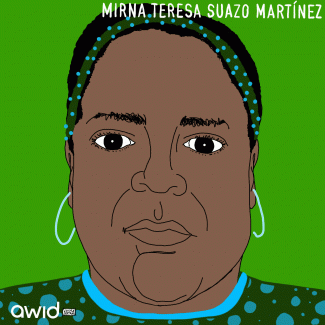
Mirna Teresa Suazo Martínez era parte de la comunidad garífuna (afrodescendiente e indígena) de Masca, en la costa norte del Caribe de  Honduras. Era una líder comunitaria, y una ferviente defensora del territorio indígena, tierra que fue vulnerada cuando el Instituto Nacional Agrario de Honduras otorgó licencias territoriales a gente ajena a la comunidad.

Este acto deplorable derivó en repetidos acosos, abusos y violencia contra la comunidad de Masca, dado que los intereses económicos de diferentes grupos se unieron a los de las fuerzas armadas y las autoridades hondureñas. Según la Organización Fraternal Negra Hondureña (OFRANEH), la estrategia de estos grupos es expulsar y exterminar a la población indígena.

«Masca, la comunidad Garífuna localizada junto al valle del Cuyamel, forma parte de la zona de influencia de una de las supuestas ciudades modelo, situación que ha disparado las presiones territoriales a lo largo de la costa Garífuna.» - OFRANEH, 8 de septiembre de 2019

Mirna Teresa, presidenta del Patronato de la comunidad de Masca en Omoa, también rechazaba con firmeza la construcción de dos plantas hidroeléctricas sobre el río que lleva el mismo nombre que su comunidad, Masca.

«La comunidad garífuna atribuye el agravamiento de la situación en su región a su oposición  contra la explotación turística, el monocultivo de palma africana y  el narcotráfico, al mismo tiempo que busca construir una vida alternativa a través del cultivo del coco y de otros productos de autoconsumo.» - Voces Feministas, 10 de septiembre de 2019

Mirna Teresa fue asesinada el 8 de septiembre de 2019 en su restaurante «Champa los Gemelos».

Fue una de las seis defensoras garífunas asesinadas solo entre septiembre y octubre de 2019. Según OFRANEH, las autoridades no han investigado estos crímenes.

«En el caso de las comunidades Garífunas, buena parte de los homicidios están relacionados con la tenencia y el manejo de la tierra. No obstante, las rencillas entre el crimen organizado han tenido como resultado asesinatos, como los recientemente ocurridos en Santa Rosa de Aguán.» - OFRANEH, 8 de septiembre de 2019
CFA 2023 - breadcrumbs Menu _ awid-forum-fr

Snippet - COP30 - Global Day of Action - EN

Global Day of Action

Movements marching globally for climate justice.

📅 Saturday, November 15, 2025
📍 Multiple Locations

More info here

Gracias por visitar AWID. 

Les agradecemos su interés por visitar el sitio web de AWID. Para obtener más información sobre nuestro trabajo, visiten https://www.awid.org/es

Snippet Kohl - Plenaria | Organizarse para vencer

Plenaria Organizarse para vencer

con Nazik Abylgaziva, Amaranta Gómez Regalado, Cindy Weisner y Lucineia Freitas

YOUTUBE

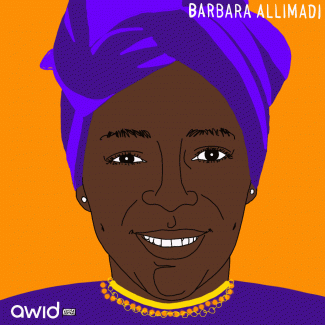
Barbara Allimadi

Barbara Allimadi était une militante politique et des droits humains originaire d’Ouganda. En 2012, elle a coorganisé une manifestation contre l’agression policière télévisée d’Ingrid Turinawe, opposante politique dont le sein a été pressé par un officier de police. Durant la manifestation, Barbara et d’autres activistes se sont déshabillées et n’ont gardé que leur soutien-gorge devant le poste central de police de Kampala. Cet épisode fut par la suite  désigné par la tristement célèbre « manifestation en soutien-gorge » en Ouganda. 

« Nous avons opté pour une manifestation en soutien-gorge. Nous avons pensé qu’elle serait la plus appropriée par rapport aux faits. Ce n’est pas comme si nous étions en train de dire que nous ne nous respections pas. Nous étions dégoûtées par les actes commis. »  - Barbara Allimadi, 2013 (Daily Monitor)

Diplômée en électronique et en ingénierie des communications de l’Université métropolitaine de Londres, Barbara était ingénieure réseau au Royaume-Uni et une fervente amatrice de musique reggae. Elle retourna en Ouganda en 2007, au moment du décès de sa mère. 

En 2019, elle fut désignée Coordonnatrice pour les affaires internationales et la diaspora de l’Alliance for National Transformation (alliance pour la transformation nationale, ANT), un parti politique lancé la même année par un leader d’opposition.    

« Nous voulons disposer d’une vie sûre et de biens, sans souffrance, sans blessure ni même de mort aux mains des forces de sécurité, qui sont censées nous protéger. Nous voulons surtout un environnement stable et propice dans lequel nous pourrons réaliser nos rêves et nos ambitions. » - Barbara Allimadi, vidéo de l’ANT

Barbara est décédée le 27 avril 2020. 


Hommages :

« J’étais tellement fière de ma sœur pour plein de raisons, mais surtout pour sa recherche téméraire de la paix, de la démocratie, de la justice et de l’égalité en Ouganda. Au summum de son activisme, elle conduisait de nombreuses marches dans les rues de Kampala, jusqu’aux postes de police et au Parlement. » - Doris Allimadi, sœur de Barbara

« C’est avec une tristesse profonde que nous avons appris le décès précoce de Barbara Allimadi. Elle était une force vaillante, infatigable et courageuse pour le mouvement de libération en Ouganda. Nous adressons nos sincères condoléances à sa famille. Elle nous manquera terriblement. » - Akina Mama wa Afrika (tweet du 28 avril 2020)

« Le décès de Barbara est extrêmement triste pour nous, et pour toute sa famille. Elle s’est dévouée entièrement à lutter pour la justice, la liberté et les droits des autres, tout en servant la société civile jusqu’à sa récente adhésion au parti. » Maj Gen Mugisha Muntu, coordonnateur national de l’ANT

« Une soeur magnifique, charmante, drôle, charismatique et inspirante. Mes enfants ont perdu leur tante. L’Ouganda a perdu une combattante pour les libertés, brave et courageuse. Barbara disait autrefois “tant que vous pouvez respirer, continuez à agir pour atteindre vos rêves”  » - Doris Allimadi, sœur de Barbara

CFA 2023 - Who, where, when - ES

Cuándo: del 2 al 5 de diciembre de 2024
Dónde: Bangkok, Tailandia, y en línea
Quiénes: Aproximadamente unxs 2.500 feministas de todo el mundo participarán en persona, y otrxs 3.000 participarán de manera virtual

Snippet - COP30 - Feminist Demands for COP30 Col 1

What We Reject:

  • Market-based false solutions
  • Ecosystem service trading
  • Green neoliberal economies mining
  • Geo-engineering
  • Fossil fuels
  • Military spending over climate funds
  • Climate finance as loans

Resourcing Feminist Movements

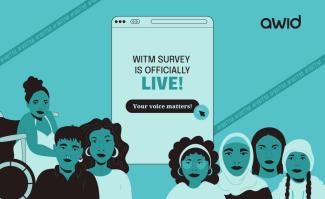
Banner image announcing that WITM Survey is live.


The “Where is the Money?” #WITM survey is now live! Dive in and share your experience with funding your organizing with feminists around the world.

Learn more and take the survey


Around the world, feminist, women’s rights, and allied movements are confronting power and reimagining a politics of liberation. The contributions that fuel this work come in many forms, from financial and political resources to daily acts of resistance and survival.


AWID’s Resourcing Feminist Movements (RFM) Initiative shines a light on the current funding ecosystem, which range from self-generated models of resourcing to more formal funding streams.

Through our research and analysis, we examine how funding practices can better serve our movements. We critically explore the contradictions in “funding” social transformation, especially in the face of increasing political repression, anti-rights agendas, and rising corporate power. Above all, we build collective strategies that support thriving, robust, and resilient movements.


Our Actions

Recognizing the richness of our movements and responding to the current moment, we:

  • Create and amplify alternatives: We amplify funding practices that center activists’ own priorities and engage a diverse range of funders and activists in crafting new, dynamic models  for resourcing feminist movements, particularly in the context of closing civil society space.

  • Build knowledge: We explore, exchange, and strengthen knowledge about how movements are attracting, organizing, and using the resources they need to accomplish meaningful change.

  • Advocate: We work in partnerships, such as the Count Me In! Consortium, to influence funding agendas and open space for feminist movements to be in direct dialogue to shift power and money.

Related Content

Sexting Like a Feminist: Humor in the Digital Feminist Revolution | Title Snippet

Sexting como feminista: el humor en la revolución digital feminista

por Chinelo Onwualu

CFA 2023 - breadcrumbs Menu _ cfa-forum-fr

Snippet - COP30 - Ecozine card - ES

📰 Solidaridad Feminista Transnacional: un Antídoto contra el Ecocidio

Esta publicación (zine) colaborativa surgió de una serie de círculos de intercambio que reunieron a feministas de todo el mundo durante 2022. El propósito fue intercambiar ideas y aprender mutuamente de qué manera las comunidades responden a la crisis climática en diversos contextos locales.

Descarga la zine

#9 - Sexting like a feminist Tweets Snippet FR

C’est toujours bien de définir les règles.

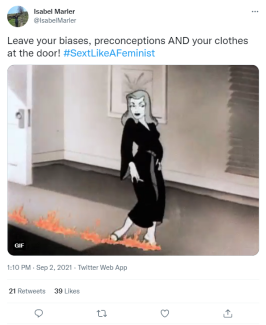
Leave your biases, preconception, and your clothes at the door!

Laisse tes préjugés, tes suppositions ET tes fringues à l’entrée!

CFA 2023 - Submit application card - FR

Nous acceptons les candidatures dans toute la gamme des domaines thématiques et des intersections importantes pour les mouvements féministes et de justice de genre. 

Proposer une Activité

COP30: Homepage Banner

COP30: Reclaim climate action from corporate capture

As world leaders gather in Brazil, feminist movements are advocating, gathering and disrupting the status quo- at COP30 and beyond! We're heading alongside other feminists to Belém, Brazil for COP30, from 10 November – 21 November 2025, where we will continue to denounce false solutions. 

Learn more!