.

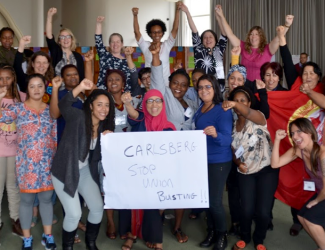
Women human rights defenders (WHRDs) worldwide defend their lands, livelihoods and communities from extractive industries and corporate power. They stand against powerful economic and political interests driving land theft, displacement of communities, loss of livelihoods, and environmental degradation.
Extractivism is an economic and political model of development that commodifies nature and prioritizes profit over human rights and the environment. Rooted in colonial history, it reinforces social and economic inequalities locally and globally. Often, Black, rural and Indigenous women are the most affected by extractivism, and are largely excluded from decision-making. Defying these patriarchal and neo-colonial forces, women rise in defense of rights, lands, people and nature.
WHRDs confronting extractive industries experience a range of risks, threats and violations, including criminalization, stigmatization, violence and intimidation. Their stories reveal a strong aspect of gendered and sexualized violence. Perpetrators include state and local authorities, corporations, police, military, paramilitary and private security forces, and at times their own communities.
AWID and the Women Human Rights Defenders International Coalition (WHRD-IC) are pleased to announce “Women Human Rights Defenders Confronting Extractivism and Corporate Power”; a cross-regional research project documenting the lived experiences of WHRDs from Asia, Africa and Latin America.
"Women Human Rights Defenders confronting extractive industries: an overview of critical risks and Human Rights obligations" is a policy report with a gender perspective. It analyses forms of violations and types of perpetrators, quotes relevant human rights obligations and includes policy recommendations to states, corporations, civil society and donors.
"Weaving resistance through action: Strategies of Women Human Rights Defenders confronting extractive industries" is a practical guide outlining creative and deliberate forms of action, successful tactics and inspiring stories of resistance.
The video “Defending people and planet: Women confronting extractive industries” puts courageous WHRDs from Africa, Asia, and Latin America in the spotlight. They share their struggles for land and life, and speak to the risks and challenges they face in their activism.
Challenging corporate power: Struggles for women’s rights, economic and gender justice is a research paper outlining the impacts of corporate power and offering insights into strategies of resistance.
AWID acknowledges with gratitude the invaluable input of every Woman Human Rights Defender who participated in this project. This project was made possible thanks to your willingness to generously and openly share your experiences and learnings. Your courage, creativity and resilience is an inspiration for us all. Thank you!
.
Priscilla a près de deux décennies d'expérience de travail dans le secteur non lucratif et des organisations de justice sociale qui travaillent sur les droits des femmes et des jeunes, la conservation, la consolidation de la paix et le développement. Elle s’intéresse à la mise en place de processus et de systèmes progressifs qui aident les organisations à respecter leurs valeurs et principes pour s’épanouir, et à l’obtention de moyens permettant aux organisations et aux personnes qui collectent des fonds d’allouer et de sécuriser les ressources nécessaires à la réalisation d’un travail de qualité. Priscilla a rejoint l'AWID en 2018 en tant que responsable de la mobilisation des ressources, pour ensuite assumer le rôle de directrice des opérations et des partenariats financiers à partir de juillet 2023.
Priscilla est titulaire d'un master en politique internationale de l’École des Études Orientales et Africaines (SOAS). Elle tient une pile, de plus en plus grande, de livres pour lesquels elle essaie toujours de trouver du temps pour les lire. Elle siège au sein du conseil d'administration de la Hodan Somali Community, une organisation caritative basée à Londres.
As you may or may not know, AWID is celebrating its 40th Anniversary in 2022 - around the themes of “Gather, Seed, and Disrupt.” To honor this occasion we have invited AWID members, partners and staff to write their own “Love Letter to Feminist Movements”. Together, we have sparked a constellation of feminist movements. Stay close as we forge on the journey ahead and continue to Gather, Seed, and Disrupt.
A note about Our Collection Of Love Letters:
All of these letters are written by activists who are sharing their diverse experiences in feminist movements. Some of them may include difficult or challenging content about abuse, sexual violence, conflict, exclusion and other potential triggering or upsetting pieces. While these letters are filled with love, please take care of yourself when reading the letters.


Umyra Ahmad is a Malaysian feminist with a background in international and regional advocacy, and human rights education. In AWID, she works on advancing rights related to gender and sexuality at the UN. Prior to joining, she was a programme officer at IWRAW Asia Pacific, where she supported regional, national and grassroots organizations in using UN treaty body mechanisms as a tool for state accountability and access to justice. In Malaysia, she works with queer and refugee collectives and supports coordination of various mutual aid initiatives.
¿Qué pasaría si volviéramos a imaginar formas de cuidar a nuestras comunidades?
¿Y si la economía no estaría enfocada en la ganancia de una pequeña élite sino en el cuidado de nuestro bienestar individual y colectivo, y de la Naturaleza?
Estas historias tratan de la construcción de comunidades de cuidado con y para las personas que históricamente y actualmente están excluidas, privadas de sus derechos y deshumanizadas tanto por el Estado como por la sociedad.
Estas son las historias de las feministas que centran el cuidado en la economía.
.


Día 2
Joanne es una feminista africana que siente pasión por la lucha contra las desigualdades de género en el continente africano. Ha trabajado con varias organizaciones, medios de comunicación y grupos de reflexión globales, incluidos Amnistía Internacional, Wrthy, el Instituto de Investigación en Desarrollo Local, la BBC, la Comunidad de África Oriental (CAO), entre otros. Integra la junta de Freely in hope, una ONG radicada en Kenia y Zambia, que busca capacitar a lxs sobrevivientes y defensorxs para convertirse en líderes de la lucha para poner fin a la violencia sexual, y de Msingi Trust, un movimiento de activistas que trabajan en la confluencia de la fe y los derechos humanos. Posee una maestría en Administración de Empresas, maestrías en Política Pública y una licenciatura en Derecho. Tiene adicción por los libros, en especial, por la literatura de ficción.
Lorsque vous arriverez au centre-ville de São Paulo, vous verrez le bâtiment Ocupação 9 de Julho (Occupation de l’Avenue du 9 Juillet), un espace culturel et un site important dans la lutte pour le logement social.
C'est le travail du Mouvement des Travailleur·euses Sans-Abri (Movimento dos Sem-Teto do Centro, MSTC), un mouvement de plus de 2000 personnes qui agit dans le centre-ville et convertit les espaces abandonnés en logements pour les travailleur·euses à faible revenu, les enfants, femmes, adultes, personnes âgées, migrant·e·s et réfugié·e·s. Dans ce bâtiment en particulier, 122 familles sont nourries et logées.


📅 Mercredi 13 mars
🕒10 h 30 - 12 h HNE
Organisateurs : AWID, Réseau-DESC, Franciscan International, Womankind Worldwide dans le cadre de Feminists For a Binding Treaty
🏢 Church Center des Nations Unies, 777 United Nations Plaza, New York, 11e étage
Maria est graphiste et communicatrice visuelle. Elle a travaillé dans le secteur des Organisations Non-Gouvernementales et des droits humains, avec par exemple Profamilia et OXFAM. En tant que femme du Sud Global, elle se sent particulièrement appelée à utiliser ses compétences pour travailler avec des organisations qui contribuent à protéger le bien-être ainsi que les droits de millions de filles et de femmes en Amérique latine.