‘Our desire is our revolution!’: The politics of love and queer sexualities
Gabby De Cicco
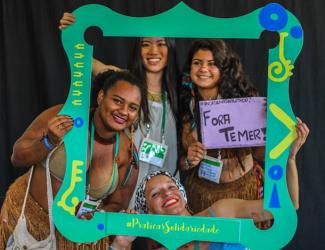
Mujeres Al Borde (MaB, ‘Women on the Edge’) is an explosive feminist cocktail of different identities and artistic disciplines created in 2001 in Colombia. A six-member team coordinates its programs Al Borde Productions, Al Borde Theatre, and Multitudes Al Borde. Over the course of 15 years of artivism more than 5,000 people have participated in their community programming in Colombia, Chile, and other countries in South and Central America. Pansexual artivist, transfeminist, and MaB co-founder Ana Lucia Ramirez shares her reflections on the group’s work.
A revolutionary desire
“Our desire is our revolution!” This has been our slogan since we created Mujeres al Borde. We are convinced that desire (exclusively in the sexual sense) is political.
When we embody a desire that is not heteronormative we begin to live differently in the world and can become more conscious of the oppressions we need to change and the injustices which have been normalized,” explains Ana.
“With this slogan we give a revolutionary and transformative place to our desire, our desire for other possible bodies, other ways to love, to experience pleasure, to have relationships with people, with other beings, with the earth. It is a desire that also goes beyond the sexual, that refers to the desire for another world and the commitment to making way for more just, free, and happy worlds,” she adds.
There are many ways to transform the world. One of Mujeres al borde’s ways has been to ensure that all voices are heard, especially the voices which have been marginalized or, out of concerns for their own personal security, have remained behind a wall of silence.
“The tagline of our community film project AL BORDE Productions is ‘We tell stories to change the world’. ” While we were making autobiographical documentaries with LGBT activists, we learned that one of the first fears that people who are sexual or gender dissidents need to confront is breaking the silence about who we are,” she says. For Ana and her fellow activists, for people to tell their stories in their own voice, and to recognize that their stories are worth telling and being heard “is a huge act of courage; it means confronting a society that threatens to symbolically and materially exclude us if we decide to be visible.”
Finding pleasure in the margins
Ana remembers that in their beginning the idea was to create a space to come together and “create other ways of being ‘the women’ who are living sexual and gender dissidences.” They identify as women who are ‘on the edge’ for not conforming to expectations about “gender, beauty, decency, or ‘political correctness,’ and who are not interested in giving up who we are to enter a place of privilege. On the edge, on the borders and margins, we find pleasure, fluidity, creativity, we find a place to create together with others who no longer fear being the weird ones, and on the contrary, enjoy it.”
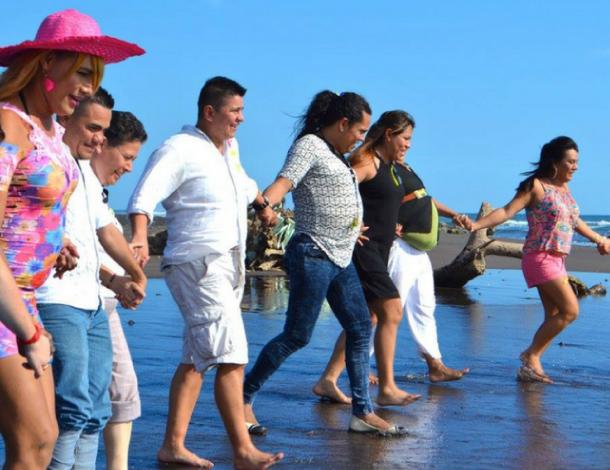
The group has had bisexual women participants, 70-year-old lesbian women, trans women who find themselves and begin their transition in their 40s, 12-year-old trans children, women with intersex experiences, lesbian and bisexual women, pansexual women, girls with lesbian/bisexual moms, non-binary people, men who reject and question their gender identity and privilege, people with different abilities, transvestites of different ages, transformists, cross dressers, queer people, marimacha butch women, and heterosexual cisgender women who are critical of sexual norms and advocate for their rights.
“We have been a very happy group with so much beauty and difference that has come together around transfeminism, art, and activism.”
And if we are talking about artivism…
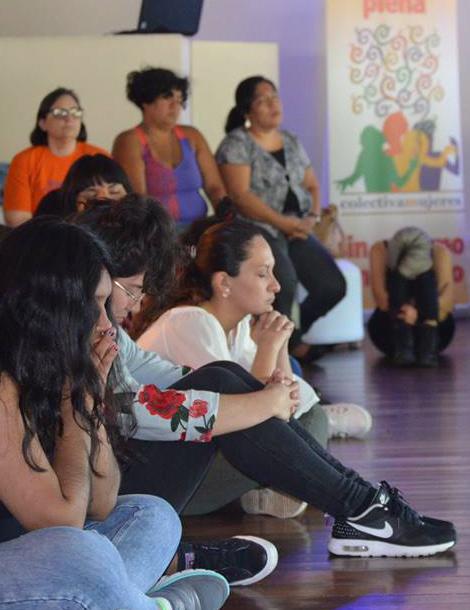
We understand art as an experience that changes us and through which we can also change the world. The activism that moves us recognizes that the power to create the world we dream of is in our own hands, in the strength of our own community doing activism through art.
In a film we are creating images
of what will be our collective memory.
In the creation of a character
people are valiantly discovering themselves.
When we create other narratives through storytelling,
documentaries, femzines or performances, we produce
references that will help others to know they are not alone,
they are not the only ones. Artivism gives our voice back,
heals us, emphasizes community and the collective,
brings us together to dream as a group
and to create new potential dreams.
Our artivism is contrasexual and transfeminist. It is that way because from here on the edge, we have understood that there are certain truths that need to be challenged so that our lives are possible, truths that sustain oppressions that are ending the lives of women, girls, children, gender and sexual dissident people all over the world. We challenge the patriarchy, cissexism, gender binaries, norms on corporality, desire, love, pleasure, the obligation to be heterosexual, to be mothers, to be women and to be men.
No more masks
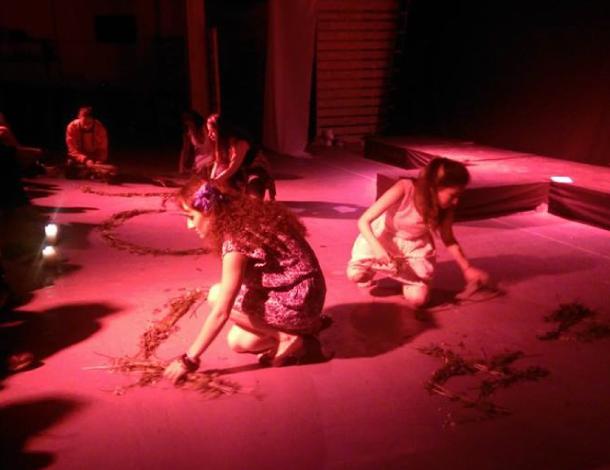
The theatre troupe of Mujeres al Borde, “Las Aficionadas” (The Fans), debuted in June 2001 with its first play, “Olga sin pelos en la lengua” (Straight-talking Olga; or literally, “Olga with no hair on her tongue”). Ana recalls that it was harder to come out of the closet in Colombia in those years. More than half of the lesbian and bisexual women participating in the group hid their sexual orientation and would often march in the Pride parade wearing masks or eye masks.
Clau Corredor, a co founder of the group, imagined a scene in which several of them would take centre stage and say over and over, “I am bisexual. I am a lesbian.” They would say it for three months of rehearsals, “even though they hadn’t found the strength to say it in their own lives,” Ana explains. On opening night there was a full house, with more than 200 people in the audience and “our compañeras were really nervous. The play was a hit, and they said their lines with such strength and determination. ‘I am bisexual. I am a lesbian.’ The audience gave them a standing ovation.”
The “LGBT Pride” parade in Bogota was two days after the show opening, and the protagonist and other compañeras from the show went to the place where they were handing out masks to wear for the march. “We saw them just then and went up to say hello,” Ana recalls, “but before they could put them on, some people on the street started yelling, ‘Olga! Olga! Olga sin pelos en la lengua!’ They came up and excitedly asked whether we were the ones from the play. We were all surprised and happy about being recognized, especially the lead actress.
Just then the person handing out the masks asked them how many they would need. They looked at one another and said, ‘No, this time we are not going to wear a mask.’ That was one of the most meaningful moments for us when we were starting out—one we still remember today with tears and laughter.”